


Loading...
A production failure becomes harder to contain when the team operating the system cannot decide what to stop, preserve, or escalate.
Section
Table of Contents
- Introduction
- The First Decision Is Whether to Contain, Not Why It Failed
- One Queue Cannot Handle Four Different Failure Paths
- Evidence Has to Survive the People Who Need It
- Escalation Should Follow Authority, Not Geography
- Recovery Is a Business Decision After a Technical Fix
- The After-Action Review Has to Change the System
- At 2:17 a.m., the Question Should Already Have an Answer
- FAQs (Frequently Asked Question)
Key Takeaways
- How to distinguish an unreliable AI output from a data exposure, a security event, or a business-control failure before the wrong team owns the response.
- Which containment decisions a GCC team needs authority to make immediately, and which decisions should move to business, risk, legal, or executive owners.
- What evidence must be preserved when prompts, retrieved content, model settings, tool calls, and human approvals can all shape the outcome.
- How to decide whether a production AI service is ready to resume after a fix, rather than reopening it because a technical dashboard has turned green.
Introduction
At 2:17 a.m., Maya, the GCC operations lead for a customer-support agent, sees three signals at once: a supervisor has stopped trusting the agent’s recommendations, a customer record appears in a trace, and the business team wants to know which cases were affected. The application team asks whether the agent should be taken offline. The model provider asks for diagnostic detail. Nobody on the call can yet say who has authority to pause the workflow, preserve the evidence, or tell the business what has changed.
That moment is common because production AI distributes the failure path before it distributes the response rights. A GCC may operate the application while headquarters owns risk policy, the business owns the affected decision, and a vendor operates a component of the service. NIST’s recent work on monitoring deployed AI systems identifies fragmented logging and the difficulty of scaling human monitoring among the barriers that make post-deployment oversight hard. An incident plan has to turn those distributed facts into a sequence of decisions.
The First Decision Is Whether to Contain, Not Why It Failed
Containment has to begin before the investigation has a complete explanation. Waiting for certainty can allow the same failure to repeat through another user, another connector, or an automated action. The initial decision is narrower: should the system, one tool, one data connection, or one workflow path be paused while the organization establishes the impact?
Pausing every system after a poor answer would create its own operating problem. A single low-quality response may call for sampling and review rather than a shutdown. A repeated incorrect recommendation in a lending, pricing, claims, or approval workflow may require an immediate stop. The distinction belongs in pre-agreed severity thresholds, along with named authority for the person who can invoke them.
A GCC operating model needs a delegated containment boundary. The GCC incident lead can suspend a defined automation or revoke a tool connection when a threshold is met; the business owner decides whether a manual fallback is acceptable; security takes over when credentials, unauthorized access, or hostile activity are suspected. The incident is still shared, yet the first action does not wait for a committee across time zones.
AI-assisted cyber exploitation belongs on the security path, even when the affected service uses an AI model. CERT-In’s current blueprint for AI-assisted vulnerability exploitation calls for rapid containment, continuous monitoring, identity governance, and operational readiness in that context. Those measures should inform the security response. They do not turn every incorrect or biased output into a cyber incident or a reportable event.
One Queue Cannot Handle Four Different Failure Paths
An organization that routes every AI issue into a generic support queue will lose time deciding what the event is. A model-quality failure, a potential data exposure, a security event, and a business-control failure can look similar in a user complaint, yet they require different evidence and different authority.
The overlap is real. An inaccurate answer may reveal that retrieval content is stale, and a failed tool call may be caused by an access-policy change. That does not justify a single response path. The response lead needs a first classification that is good enough to determine containment and escalation, then can revise it as evidence emerges.
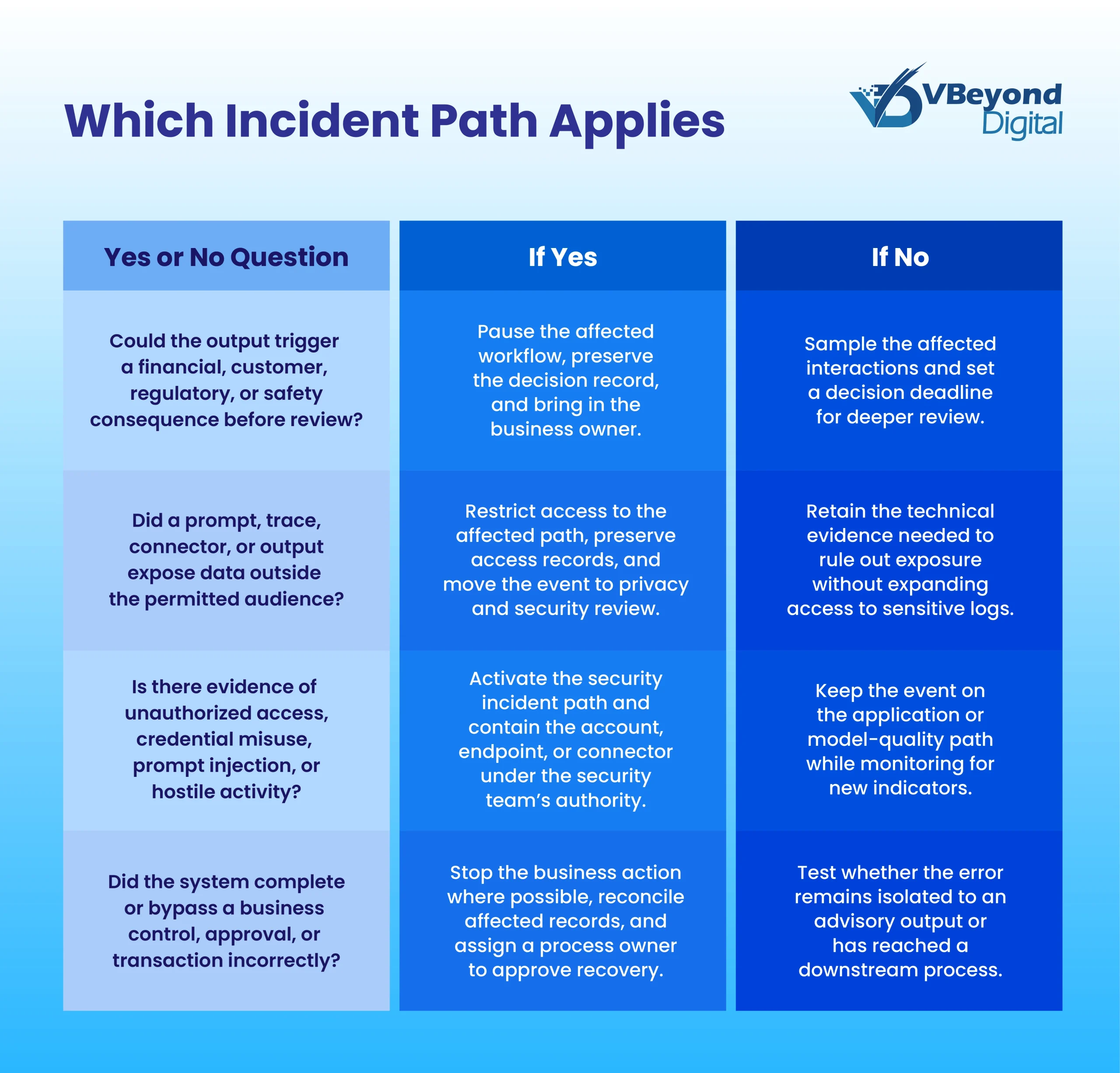
This classification is also why the enterprise cannot outsource accountability to a vendor. A vendor may own a contracted service commitment or a defect in its component. The enterprise still owns the decision to use the system in a business process, the data it permits the system to handle, and the human controls around an output that affects customers or financial operations.
Evidence Has to Survive the People Who Need It
An investigation that begins after logs have rotated, prompts have been overwritten, or a configuration has changed will rely on recollection when it should rely on records. The evidence model has to exist before the failure: a timestamped request and response, the model and version where available, retrieval context, tool calls, configuration changes, identities involved, approval history, and the action that followed.
Keeping everything forever is neither necessary nor responsible. Trace content can itself contain customer or employee data, so evidence preservation has to be paired with access control, retention rules, and a clear need-to-know path. The goal is to give authorized investigators access to the evidence they need to reconstruct the event and preserve the chain of custody, without giving every responder access to every prompt.
Microsoft Foundry observability supports evaluation, production monitoring, and distributed tracing across model calls, tool invocations, and agent decisions. For teams operating AI on Azure, that makes it possible to connect a business complaint to technical evidence, provided the telemetry design, permissions, and review procedure were defined before the incident. This is part of the wider production AI control model that prevents teams from treating evidence as an afterthought.
The evidence path should also state who can preserve it. A GCC team may capture an incident snapshot and freeze a relevant configuration record, while security controls access to sensitive material and the business owner identifies affected decisions. That split reduces the chance that investigation work either destroys evidence or creates a second exposure
Make AI incident response operational with VBeyond Digital
Escalation Should Follow Authority, Not Geography
An escalation chart organized around headquarters and offshore delivery will stall when a live incident needs a decision from someone who is neither. The useful question is which authority the next decision requires: authority to pause a customer workflow, to notify a regulator, to reset credentials, to accept a manual workaround, or to resume service.
Central review still matters for higher-risk events. It is the right place for legal interpretation, material-risk decisions, and policy changes that affect multiple businesses. It should not be the default destination for a defined containment action that the operating team can take safely under an agreed threshold.
The most reliable model gives the GCC incident lead responsibility for coordination and evidence capture, while the business owner remains accountable for process impact and the platform team owns the technical recovery path. Security and privacy owners join when the classification requires them. Vendor management owns the service case and contractual escalation, yet cannot decide whether the enterprise should keep an affected workflow live.
This structure needs rehearsal. A Microsoft Copilot operating model or an Azure AI workflow can involve application owners, data owners, platform engineers, and business supervisors in the same incident. If those teams meet for the first time after a harmful output, the organization has an organizational failure before it has a technical one.
Recovery Is a Business Decision After a Technical Fix
A successful deployment or a cleared infrastructure alert is not enough to reopen an AI-enabled workflow. The system may be available while its outputs remain unreliable, a retrieval source is still stale, a permission change has not been reconciled, or an affected business record needs correction.
Technical restoration is still necessary, and vendors may be best placed to repair their own component. The enterprise must make the separate decision that the business process can resume. That decision should require evidence appropriate to the original failure: a targeted evaluation for output quality, a security check for access misuse, a reconciliation for an incorrect transaction, or a privacy review for a data exposure.
NIST’s monitoring report describes functionality, operational, human-factor, security, compliance, and large-scale impact as distinct monitoring concerns. Recovery criteria should reflect the concerns that were actually affected, rather than applying one technical pass condition to every event. This is where Azure AI architecture and operations meet business control: platform telemetry can show that a service is running, while the process owner decides whether it is safe to use.
The After-Action Review Has to Change the System
An incident review that ends with a ticket closure preserves the paperwork and leaves the same conditions in place. The review has to decide what changes: an evaluation dataset, a prompt guardrail, a retrieval source, an access rule, a monitoring threshold, a runbook, or the authority delegated to the GCC team.
The obvious objection is that every event cannot justify a formal review. That is true for isolated, low-impact issues resolved within a known path. Repeated behavior, material business impact, suspected data exposure, or a response that required improvised authority deserves a review because the organization has learned something about its operating model.
Microsoft Foundry can monitor quality, safety, and operational signals, then support re-evaluation after a change. The operating discipline sits outside the tool: the teams need a named review owner, a time limit for corrective work, and a test that demonstrates the failure condition has been addressed. A healthy response model gets shorter over time because it converts unfamiliar failure patterns into known procedures.
At 2:17 a.m., the Question Should Already Have an Answer
Maya faced an urgent operational decision: should the agent continue influencing customer cases while the team investigated what had happened? The operating team needed predefined containment thresholds to make that call, along with clear procedures for preserving evidence, escalating the incident, and authorizing recovery.
VBeyond Digital can help enterprises test an AI incident-response model across GCC delivery, Microsoft Foundry observability, Azure controls, business ownership, and vendor escalation procedures. The work starts by tracing one real workflow from its first user input to the person authorized to stop it.
At 2:17 a.m., Maya should not be deciding those rules for the first time.
FAQs (Frequently Asked Question)
An AI incident response plan defines how the enterprise detects, classifies, contains, investigates, escalates, documents, recovers from, and learns from a production AI failure. It should identify the business owner, the operating lead, the evidence path, the technical responders, the vendor escalation route, and the conditions for resuming the affected workflow. A plan limited to cyber events will miss model-quality and business-control failures; a plan limited to model behavior will miss security and privacy events.
The authority should be delegated to the role closest to the event when a predefined threshold is met. A GCC operations lead may pause a tool connection or suspend an automation when unauthorized activity, repeated harmful output, or a defined control breach is detected. The business owner should decide whether a manual fallback is acceptable, while security retains authority over security containment. The delegation needs named thresholds so responders do not wait for executive approval during a live event.
No. An inaccurate output may be a model-quality, retrieval, prompt, or workflow-design problem. It becomes a security incident when there is evidence of unauthorized access, credential misuse, malicious manipulation, or another security condition. The response model should classify the event early, then change the path when new evidence warrants it. Treating all output failures as security events wastes specialist capacity; treating a security event as a quality issue delays containment.
The record should allow authorized investigators to reconstruct the relevant decision without retaining unrestricted copies of sensitive content. Depending on the incident, that can include timestamps, prompt and output references, model or deployment configuration, retrieval context, tool-call records, identity and access events, workflow approvals, configuration changes, and the downstream action. Retention, redaction, and access rules should be defined before the incident because trace data may contain customer or employee information.
GCC teams should open the vendor case with the evidence needed to diagnose the provider’s component, then maintain a separate internal decision path for containment, business impact, and communications. The vendor can own contracted service commitments, technical analysis, and remediation within its scope. The enterprise still decides whether to pause the workload, who receives a notification, how affected records are corrected, and when the service may resume.
