


Loading...
A role can be justified on its own and still create an unacceptable finance control gap when paired with another.
Section
Table of Contents
- A Role Can Be Appropriate and Still Be Unsafe in Combination
- Prevention Has to Start Before the Role Is Granted
- Certification Produces a Decision Record, Not Proof That Risk Has Gone Away
- Temporary Access Turns a Quarterly Review Into a Late Discovery
- Remediation Fails When the Rejected Role Has No Destination
- Audit Evidence Should Follow the Conflict, Not the Calendar
- The Review Is Only Useful If It Changes the Access Estate
- FAQs (Frequently Asked Question)
Key Takeaways
- How to distinguish a role that is appropriate on its own from a combination of roles that creates an unacceptable finance control risk.
- Which access-control questions must be answered before a certification campaign can serve as useful audit evidence.
- How preventive role-pair rules, detective access analysis, certification, and remediation fit into one finance-control sequence.
- What evidence to expect when temporary access, role hierarchy changes, or certification decisions require follow-through.
Every finance role can look justified when it is reviewed alone.
A payables lead may need to maintain supplier records. A treasury approver may need to authorize a payment. A user with both capabilities, or with inherited privileges that produce a similar path, presents a different question. The evidence from a role-by-role review does not automatically answer it.
The counterargument writes itself: a manager who understands the employee’s job can approve the necessary access. That is often true. The gap appears when the review asks whether each assignment is needed and never asks what the assignments allow together across a finance process. Oracle segregation of duties is therefore a control-design problem, not simply a certification-calendar problem.
A Role Can Be Appropriate and Still Be Unsafe in Combination
Finance controls are built around incompatible actions because a process can fail even when every individual permission has a business explanation. The risk sits in the sequence: creating or changing master data, entering a transaction, releasing it, approving it, or concealing the resulting exception. The exact conflict differs by process and configuration, yet the analytical question stays the same: can one person, directly or through role inheritance, complete steps that should be independently checked?
A fair objection is that a broad analysis produces too many theoretical conflicts for a finance team to investigate. It can, particularly where inherited duty roles and custom hierarchies have grown without disciplined retirement. That is why conflict analysis needs the business context of ledgers, business units, transaction limits, and the actual process the user supports. An alert without context creates work. A conflict linked to a plausible finance path creates a decision.
Oracle’s access-model guidance distinguishes sensitive access, where one access point is inherently broad, from segregation-of-duties analysis, where the combination of access points creates the risk. That distinction matters because an individual-role certification may be a reasonable review mechanism for sensitive access while remaining incomplete for a role pair that enables an incompatible sequence.
The same weakness often surfaces later in reporting and close support. Oracle Fusion reporting control gaps rarely begin with a single broken report; they build when configuration, ownership, and evidence no longer describe the same operating reality.
Prevention Has to Start Before the Role Is Granted
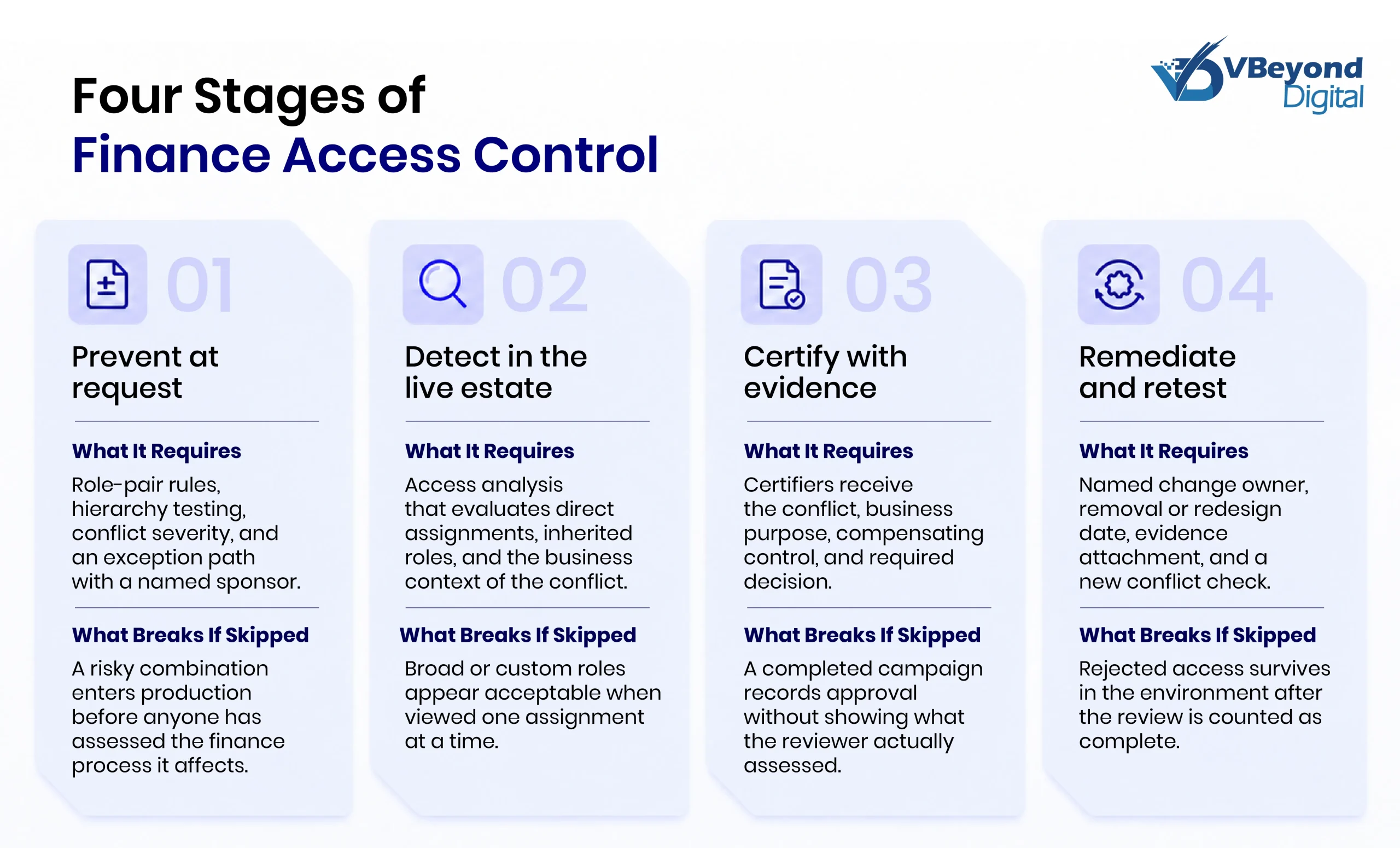
Reviewing access after it has been granted is necessary, but it is a costly way to discover a conflict that should have been stopped in the request path. The better question is whether the proposed assignment can be evaluated before it reaches production, while the request still has an owner, a stated business purpose, and a chance to be redesigned without interrupting month-end work.
Some enterprises will argue that strict preventive rules slow urgent staffing, project testing, or remediation. They can if the rule set is detached from the finance process and treats every role pair as equally serious. A working control model grades conflicts, identifies the finance activity exposed, and gives the process owner a defined route for a time-bound exception. Speed is preserved by deciding the path in advance, not by overlooking the conflict when the request arrives.
Oracle’s provisioning-rules guidance describes rules that prevent assignment of role combinations causing separation-of-duties conflicts. Its treatment of role hierarchy is especially important: role-creation analysis can identify conflicts located anywhere in a hierarchy, while an API-based provisioning workflow evaluates directly assigned or requested roles. Finance and security teams should test the control against their actual request and inheritance patterns rather than assume one check covers every route to access.
Trace Oracle SoD conflicts from review to remediation
Certification Produces a Decision Record, Not Proof That Risk Has Gone Away
An access-certification campaign can show that a certifier reviewed a user-role assignment. It cannot, on its own, prove that the reviewer understood the transaction path created by the user’s combined access, the temporary privilege that was added during a project, or the mitigation proposed for a surviving conflict.
The obvious pushback is that certification already assigns owners, role managers, and certifiers. It does, and that separation can improve accountability. The real test is whether those people receive evidence that lets them make a finance decision. A role code, job title, and deadline are rarely enough. A useful certification item identifies the relevant conflict, the affected business unit or ledger where needed, the role’s business purpose, the compensating control if the assignment remains, and the action required after a rejection.
Oracle’s current certification guidance requires certification owners to appoint participants, scope the roles under review, and assign role managers and certifiers. Its access-certifications guide also distinguishes standard and continuous campaigns. The control design still belongs to the enterprise: Oracle states that the criteria for deciding whether a role is appropriate sit outside the certification feature.
That boundary is useful. It means finance can define the decision standard instead of treating the system’s completion status as the standard itself.
Temporary Access Turns a Quarterly Review Into a Late Discovery
Temporary access is often the most defensible part of an access estate. Close support, a failed integration, an acquisition, or a critical absence can require a narrowly scoped privilege for a short period. The problem is not that temporary access exists. The problem is that a temporary assignment can outlive the event that justified it, then disappear into a later review population that was never designed to explain why it was granted.
A reasonable objection is that a quarterly certification cycle will catch the assignment eventually. Perhaps. That depends on the timing of the grant, the scope of the campaign, whether the assignment is direct or inherited, and whether the reviewer can recognize the conflict. A user can hold a risky combination during a reporting period without the next certification creating timely evidence of who accepted that exposure.
Temporary access needs its own control path: an expiry tied to the operational event, an accountable sponsor, a record of the exact privilege, and an automated or reviewed removal step. Where the access cannot be removed by the expected date, the extension should return to the finance process owner with the conflict and the compensating control stated plainly. Finance-close continuity depends on the same discipline: an operational deadline does not remove the need to know who accepts the residual risk.
Remediation Fails When the Rejected Role Has No Destination
The most revealing evidence in an access review is not the number of items certified. It is the fate of the assignments that were rejected, narrowed, redesigned, or accepted temporarily. A review that records “remove access” without a system owner, completion date, and retest can leave the original conflict in place while the campaign appears complete.
It is tempting to make the security team responsible for every remediation task because it owns the access-control policy. Security can set standards and challenge high-risk exceptions, yet it cannot determine whether a finance role can be removed without understanding the work it supports. The application owner can make the technical change. The finance process owner must decide whether the altered access still permits the process to run. Internal audit needs evidence that the decision was made and tested.
This produces a practical division of work. The risk or security team defines the conflicting access patterns and the evidence threshold. The Oracle application team identifies the direct, inherited, or custom role route that creates the conflict. The finance process owner accepts, redesigns, or rejects the operating impact. The person who completes the change attaches proof and triggers a retest. None of these responsibilities can be inferred from a campaign status alone.
Audit Evidence Should Follow the Conflict, Not the Calendar
Auditors do need evidence that certifications ran on schedule, but a completed calendar does not show whether the control reduced the finance risk it was meant to address. The stronger evidence chain starts with a defined conflict, follows the assignment or exception, records the business decision, captures the remediation or compensating control, and ends with a retest.
Some leaders will argue that this level of evidence is disproportionate for routine access. It would be if every permission received the same treatment. The point is to focus the deeper record on high-risk combinations and sensitive access associated with finance processes, while using tiered criteria for lower-risk items. The evidence should be as specific as the potential impact.
This is where access governance meets post-go-live operating maturity. What goes wrong after Oracle Fusion go-live is often visible first as an unclear handoff between configuration, business ownership, and recurring evidence. A defined control sequence gives each group a record it can understand and defend.
The Review Is Only Useful If It Changes the Access Estate
Oracle segregation of duties deserves more than a recurring request for managers to approve a list of roles. Finance risk emerges in combinations, inheritance paths, temporary assignments, and incomplete remediation. Those conditions require preventive rules, access analysis, informed certification, and evidence that a rejected or modified assignment was actually retested.
VBeyond Digital can help enterprises examine Oracle Fusion access patterns, finance-process ownership, certification evidence, remediation workflows, and post-go-live control maturity. The work usually begins by tracing a small set of high-risk finance conflicts from the role request through to the final proof of removal or mitigation.
If the current review cannot show that path for a material conflict, that is where the work starts.
FAQs (Frequently Asked Question)
Segregation of duties separates incompatible finance activities so one person cannot complete a sequence that should involve independent review or approval. In Oracle Fusion ERP, the risk can arise from a pair of roles, an inherited privilege, a custom role hierarchy, or a temporary assignment that together permit incompatible work. The control objective is to prevent, detect, or formally mitigate that combined access before it affects a finance process.
An access review may ask whether each role is appropriate for the user without assessing what the roles permit in combination. A user can have two individually justified assignments that together create a conflict. Reviews can also miss inherited privileges, recently added temporary access, incomplete role hierarchy analysis, or business context that changes the risk of an otherwise common role pairing.
Preventive controls stop or challenge a risky role combination before it is granted. Detective controls analyze the access already held in the environment and identify conflicts or sensitive access that require investigation. Both are needed because no request process catches every inherited, historical, or manually provisioned assignment. Certification then records a business decision, while transaction controls address risks in the activity itself rather than merely in the entitlement.
Temporary access should have a specific operational purpose, a defined sponsor, an expiry linked to the event that required it, and a removal or extension decision that is reviewed before the date passes. Where the temporary role creates a finance conflict, the record should identify the compensating control and the person who will verify removal. A later quarterly review is a poor substitute for a time-bound access-control path.
Internal audit should be able to trace a high-risk user-role combination from the conflict definition to the certification decision and the final outcome. Useful evidence includes the role and hierarchy path, business purpose, affected process or scope, certifier decision, exception or compensating-control approval where applicable, remediation owner, completion record, and a retest showing the conflict was removed or remains under a documented control.
