


Loading...
Data residency becomes an operating constraint when AI workloads move beyond the model endpoint.
Section
Table of Contents
- Introduction
- A Region Choice Can Leave the Workload Exposed Elsewhere
- The Prompt Is Only One Stop on the AI Data Path
- Architecture Has to State Which Boundary Each Artifact May Cross
- Support Access Is Part of the Data Boundary
- Exceptions Need an Owner Before the First Deadline Arrives
- Audit Evidence Has to Describe the System That Actually Runs
- Residency Is Maintained, Not Completed
- FAQs (Frequently Asked Question)
Key Takeaways
- Why selecting an approved cloud region does not settle the residency position for prompts, retrieval data, logs, backups, or support access.
- How to classify AI data artifacts and turn a legal or policy requirement into a placement decision that engineering teams can implement.
- Which ownership and exception decisions need to be made before an AI workload crosses Azure, Oracle, SaaS, on-premises, and global delivery boundaries.
- What an audit-ready evidence pack should show when a privacy, risk, or internal-audit team asks where the workload processes data.
Introduction
A workload can remain in the approved region while the data that makes it useful crosses the boundary. The inference endpoint may sit in one geography while retrieval content, vector indexes, evaluation data, diagnostic logs, backup copies, and a support session follow different routes. The architecture diagram can therefore look settled before the residency decision has actually been made.
Public cloud is not automatically unsuitable for a sensitive workload. The more useful question is whether the enterprise can show where each data-bearing component is stored, processed, accessed, replicated, and retained. That question changes the way a hybrid cloud architecture should be reviewed before an AI workload reaches production.
A Region Choice Can Leave the Workload Exposed Elsewhere
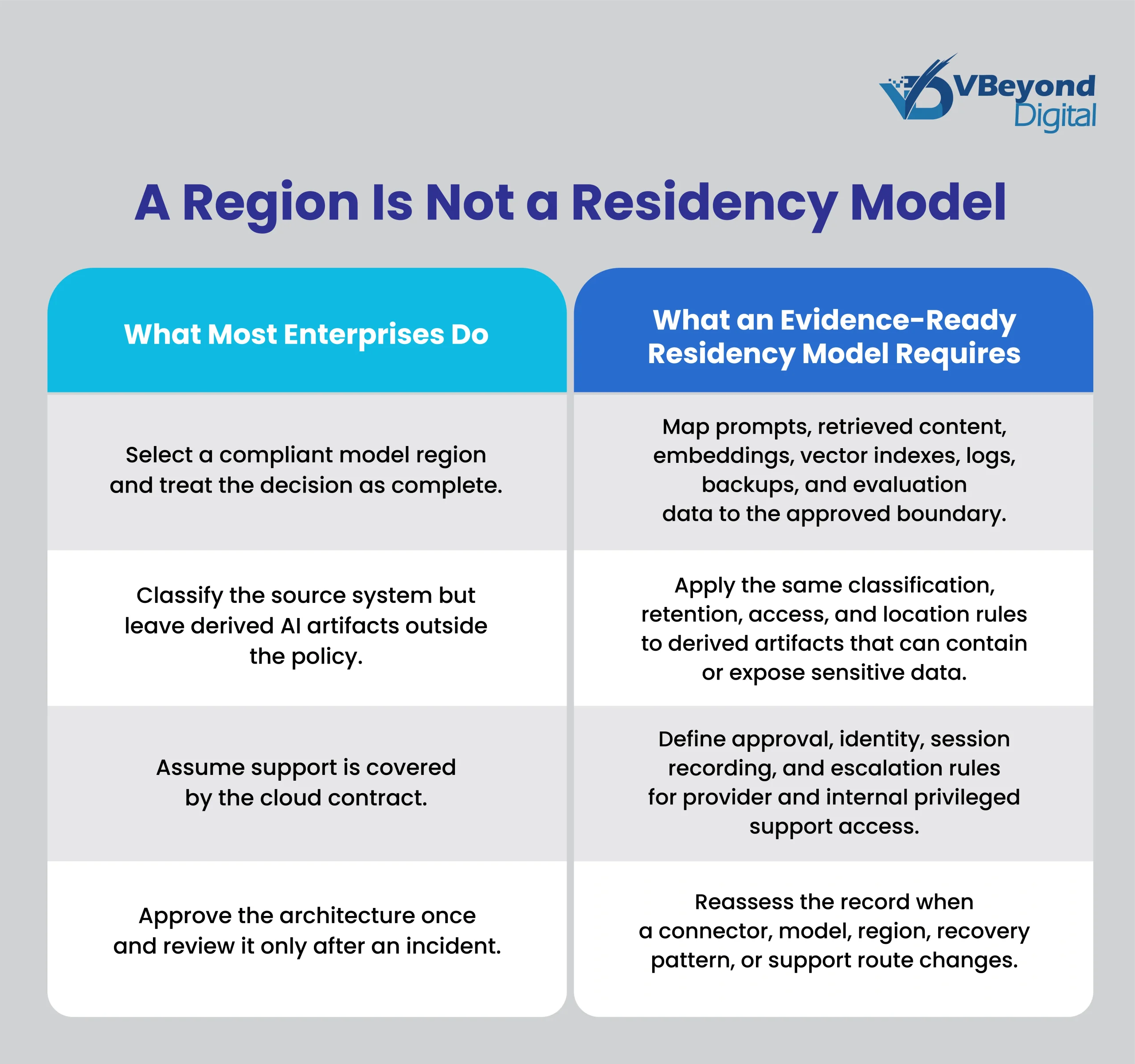
A regional deployment answers one part of the problem. It does not explain the data path around it. When a team says that an AI workload is resident in a chosen geography, the statement is incomplete until it accounts for the input, output, supporting stores, operational telemetry, recovery copies, and people with privileged access.
A fair objection is that cloud-region controls already address most of this. They provide an important starting point. Yet a workload can be correctly deployed in a permitted region and still have a logging workspace, replication choice, SaaS connector, or support route that the original review never assessed. That is the gap that later turns into a privacy escalation or an audit question with no clean answer.
Microsoft’s recent guidance on reliability and sovereignty makes the same distinction between geographic control and authorized access, and it treats backup, replication, support access, and auditability as architecture decisions. The result is a more precise standard for Azure AI architecture decisions: the chosen region needs to be supported by the paths that carry the data before and after inference.
The pattern in enterprise reviews is familiar. The model team can name the endpoint region. The data platform team can name the source system. The security team can name the policy. Fewer teams can produce one current record that joins those answers to the retrieval store, observability pipeline, and recovery design. That missing record is where a residency posture starts to drift.
The Prompt Is Only One Stop on the AI Data Path
Prompts draw attention because they are visible, but they are rarely the only sensitive object in an AI workflow. A retrieval-augmented application can also create embeddings, vector indexes, retrieved passages, system instructions, response traces, evaluation sets, and incident records. Some of those artifacts may contain the same regulated or confidential material as the original source, even when they look less obvious than the document that supplied it.
The counterargument writes itself: an enterprise can simply classify the source data and keep it in the approved system. That classification matters, but it must continue through the derived artifacts. An embedding made from a restricted document, a trace that contains a customer prompt, and a vector store used by a finance assistant each need their own storage, retention, access, and geography decision.
Microsoft’s guidance for sovereign AI workloads identifies the same lifecycle: data ingestion, embeddings, training or fine-tuning, inference, monitoring, and retirement each carry different sovereignty considerations. The practical implication is that classification belongs before model selection and before a retrieval design is approved. A model can be acceptable for one data class and unsuitable for another because the surrounding services have different residency, logging, or support characteristics.
This is especially important when Oracle records, Azure services, SaaS systems, and local applications supply context to the same assistant. The operating questions covered in Oracle-Azure workload placement apply here as well: the boundary is defined by identity, networking, data movement, monitoring, and incident response, not by the name of the platform in the center of the diagram.
Architecture Has to State Which Boundary Each Artifact May Cross
Data residency does not demand the same deployment pattern for every workload. A low-risk internal knowledge assistant may be able to use public-cloud services with clear regional controls and limited retention. A regulated workflow that joins customer records with decision support may require stronger key custody, a narrower support model, fewer permitted services, or a local component. The evidence points toward a tiered approach rather than a universal rule.
Some architects will argue that this produces too many decisions before a pilot can move. It can, if every workload is treated as exceptional. A repeatable classification scheme lowers that burden. It should name the data category, jurisdictions involved, business consequence, permitted processing locations, permitted recipients, encryption and key requirements, logging rule, retention period, and owner who can approve an exception. The result is a decision record that engineering, privacy, and audit can read without translating one another’s terminology.
Microsoft’s sovereign design guidance recommends assessing sovereignty and resilience requirements by workload, based on data sensitivity, regulatory exposure, and business criticality. Its data-control guidance extends the same idea to AI boundaries, including regional deployment choices and supporting stores for logs, prompt history, and vectors. Those requirements are useful only when they become enforceable architecture constraints: allowed regions and services, private paths, identity scopes, retention settings, and checked infrastructure definitions.
The recurring problem is that the policy is written at one level of abstraction and the deployment is built at another. A privacy statement may say that restricted data remains in a jurisdiction. The implementation needs to make that statement testable for a model endpoint, document store, vector database, monitoring workspace, backup vault, and connector. The question for a design review is simple: could a reviewer prove the answer from the deployed configuration, rather than from an intention recorded months earlier?
Support Access Is Part of the Data Boundary
The support model is often relegated to service management after the architecture is approved. For sensitive AI workloads, that is too late. A provider engineer, managed-service analyst, database administrator, or GCC support team may need a route to diagnostics, logs, secrets, or live data when a production incident is hard to reproduce. Each route carries a jurisdiction, approval, and evidence question.
A reasonable objection is that strict support controls lengthen recovery during an incident. They can. The trade-off should be made openly, with a defined break-glass path, local approver, session record, and post-incident review. Without that preparation, speed simply transfers the residency decision to the person on call, who is least able to assess it under pressure.
Microsoft’s sovereignty implementation guidance calls for controlled privileged support access, local approvals, session recording, and documented support models for workloads with stronger requirements. The same discipline should apply to global delivery access controls when teams in different locations operate a shared estate. The relevant boundary includes the primary data store and anyone who can inspect or move information during an incident.
This is where architecture and operating model meet. The workload owner needs to know who can approve an emergency session. The privacy or security owner needs to know what data becomes visible. The support lead needs a tested route that does not depend on a last-minute exception. The evidence should show the request, the approval, the session, the outcome, and any follow-up action. A ticket number alone rarely does the job.
Exceptions Need an Owner Before the First Deadline Arrives
Every hybrid environment accumulates exceptions. A business unit needs a SaaS feature that stores a trace differently. A recovery plan calls for a secondary location. An Oracle application exports a record to an Azure analytics service. A new model provider changes the available deployment types. The problem is not that exceptions exist. The problem begins when nobody owns the decision to accept, constrain, renew, or retire one.
The obvious pushback is that architecture governance already has a review board. A board can approve a design. It cannot sustain every time-bound exception unless the workload owner, expiry date, compensating control, and evidence requirement are attached to the decision. An exception without an expiry date becomes an unreviewed operating condition. An exception without an owner becomes a future dispute.
An exception record should name the exact data artifact and route involved, the applicable jurisdiction or policy, the reason the standard path cannot be used, the business impact of delay, the control that reduces exposure, the person who accepts residual risk, and the date on which the decision must be revisited. That record needs to survive a vendor change, an audit request, and a personnel change. Otherwise, a hybrid cloud architecture ends up governing by institutional memory.
The more mature teams also tie this to release and change control. A model update, a new retrieval source, an altered retention rule, or a change in regional failover is not merely a technical variation. It may alter the data path that justified the original placement decision. The review trigger should be explicit before that change reaches production.
Audit Evidence Has to Describe the System That Actually Runs
An audit pack is often assembled after someone asks for it. By then, the project team may have changed, the configuration has moved, and the reason for an earlier exception has been lost. Evidence gathered under that pressure usually proves that documents exist. It does not always prove that the live workload follows the approved design.
Some leaders will argue that policy assignments and architecture diagrams are sufficient. They are useful evidence, but they are static. A defensible record joins the approved data-flow diagram to the deployed service configurations, policy results, identity assignments, key settings, log locations, access approvals, exception decisions, and records of review. It also shows when those artifacts were last checked against the running workload.
Microsoft’s current sovereignty guidance calls for auditable records of data location, access approvals, policy compliance, and operational practice. That is a reasonable baseline. For AI, the evidence also needs to tie a model version and retrieval path to the same control record. A reviewer should be able to trace a high-impact output back to the data sources, deployment setting, supporting services, and people who had privileged access at the time.
The delivery lesson is less dramatic than the technology discussions suggest. The evidence pack becomes useful when it is produced by ordinary engineering and operations work: infrastructure changes, access requests, policy scans, release approvals, and incident reviews. When those records are maintained as part of the operating rhythm, an audit is a retrieval exercise. When they are not, it becomes a reconstruction project.
Residency Is Maintained, Not Completed
A region selection can be the right starting decision. It is still only a starting decision. The workload will change as new data sources, models, agents, integration paths, recovery choices, and support arrangements arrive. Each change may preserve the original residency rationale, or it may weaken it. The enterprise needs a way to tell the difference before the change becomes routine.
The most effective next step is a placement review for the AI workloads that already handle regulated, confidential, or business-critical data. Start with the actual path from prompt to retrieval, response, telemetry, backup, and support. Name the owners and decision triggers. Then test whether the retained evidence can answer the question a privacy lead or auditor would ask.
VBeyond Digital can conduct a hybrid-cloud residency assessment across data classification, AI data paths, Azure and Oracle controls, support access, and the evidence required for a production decision. The next connector can reopen the residency decision.
Improve Oracle ERP Integration Reliability with VBeyond
FAQs (Frequently Asked Question)
No. The deployment model should follow the workload’s data sensitivity, legal and contractual obligations, business criticality, and required operational control. Public-cloud services can be appropriate when the enterprise can enforce and demonstrate the required regional, access, encryption, logging, and support controls. A stricter deployment pattern may be warranted when those controls cannot meet the applicable requirement.
Include prompts, responses, source documents, retrieved passages, embeddings, vector indexes, training and evaluation data, model artifacts, logs, monitoring traces, backups, incident records, and support-session records. The review should also cover the identities and services that can access those artifacts, since access and processing are part of the residency posture.
Retrieval-augmented generation adds data stores and processing steps beyond the model endpoint. The enterprise needs to confirm the location, classification, access model, retention, encryption, and replication behavior for source content, embeddings, vector indexes, retrieved context, and traces. A regionally deployed model does not answer those questions by itself.
The approval path should include the accountable business owner, the architecture or platform owner, and the privacy, security, or risk function required by the organization’s policy. The record should identify the exact data route, the reason for the exception, the compensating control, the residual risk owner, and a review date. The right titles differ by enterprise, but the responsibility cannot be left implicit.
Retain the approved data-flow design, workload classification, regional and service configuration, policy-compliance results, key-management configuration, access and support approvals, log and backup locations, exception records, deployment changes, and review evidence. The evidence should allow a reviewer to compare the approved architecture with the workload that was running at a specific point in time.
