


Loading...
An exception preserves delivery speed only when someone owns the risk, the evidence, and the path back to compliance.
Section
Table of Contents
- A Legitimate Exception Needs More Detail Than the Delivery Pressure That Created It
- A Compliance Score Cannot Carry the Whole Story
- Waiver and Mitigated Are Different Risk Decisions
- Expiry Is a Decision Event, Not a Date Field
- Centralized Management Still Needs Ownership at the Workload
- Removal Is the Only Proof That the Lifecycle Works
- The Exception Should Still Be Understandable After the Urgency Has Passed
- FAQs (Frequently Asked Question)
Key Takeaways
- How to tell the difference between a justified Azure Policy exemption and an unmanaged exception that has simply become familiar.
- Which fields, owners, and compensating controls must exist before a team receives permission to bypass a policy assignment.
- Why expiry requires a review decision, even though Azure keeps the historical exemption object for record-keeping.
- How to use compliance substate, central exemption views, and workload ownership to make Azure governance reporting more honest.
An Azure Policy exemption can document an approved deviation. It can also make a compliance score look healthier while the resource remains outside the control the score is meant to describe.
Neither fact makes exemptions a mistake. A migration can require a temporary waiver while a legacy dependency is retired, and a control can be met by an alternative safeguard that Azure Policy does not directly test. The problem begins when the delivery urgency is recorded and the return path is not. The exemption remains, the workload changes, and the original approver may have moved on.
A Legitimate Exception Needs More Detail Than the Delivery Pressure That Created It
The request to bypass a policy often arrives in the least convenient form: a release is blocked, a production dependency is older than the guardrail, or a business deadline cannot move. Those are real constraints. They are not enough to define the risk that the exemption creates.
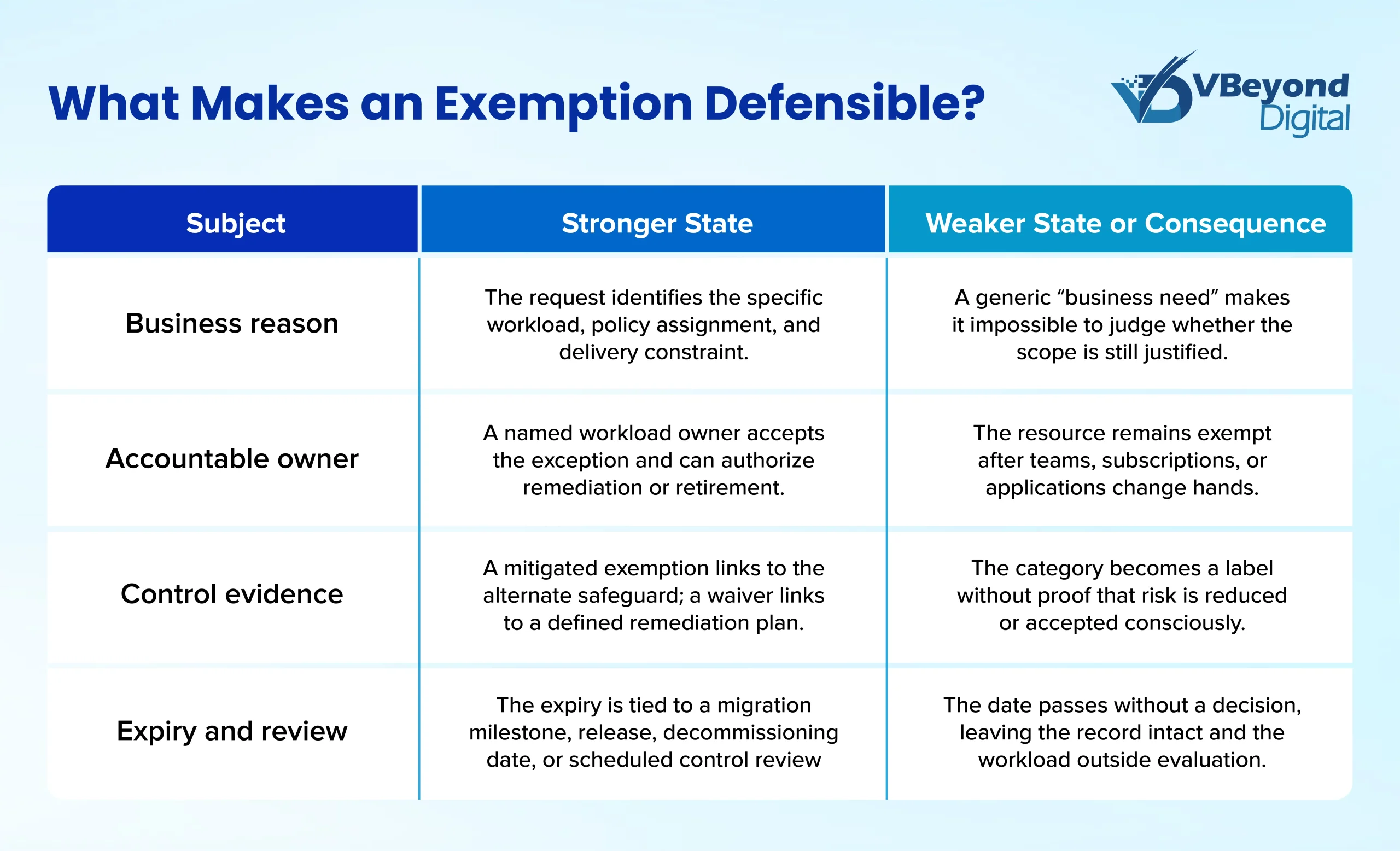
The reasonable objection is that exhaustive paperwork will turn the exception process into another delivery bottleneck. It should not. A controlled request can be short if it answers the questions that determine whether the exception is safe to grant: which resource and assignment are affected, why the normal control cannot apply now, who accepts the risk, what reduces the exposure in the meantime, and what event ends the exemption.
Azure Policy’s exemption structure supports a description, metadata, assignment reference, exemption category, scope, and expiration. The platform does not require every governance field an enterprise needs. The operating model has to supply the accountable workload owner, approval record, ticket reference, compensating-control evidence, and a review date that a control forum can actually act on.
The most useful test is whether a new platform engineer could understand the exception six months later without calling its creator. If the record only says “urgent production requirement,” it documents the urgency and nothing else. The risk has not become clearer because the object exists in Azure.
A Compliance Score Cannot Carry the Whole Story
A percentage can be useful for finding control trends across subscriptions. It becomes misleading when leaders read it as proof that the exempt portion of the estate is safe. Azure Policy treats an exempt resource differently from one that is evaluated as compliant, and that distinction needs to remain visible in management reporting.
Exemptions are sometimes described as administrative noise because the resource has a written reason. The written reason can be useful, yet it says nothing by itself about the control that would have applied, the duration of the exposure, or the business value of keeping the resource in that state. A dashboard that rolls those questions into one favorable number leaves security, finance, and application owners looking at different versions of the same environment.
Azure Policy records a compliance substate for exempt resources so teams can see what the state would be if the exemption were removed. The post-go-live Azure governance problem begins when that information is treated as a portal detail rather than a review input. A monthly view should separate evaluated compliance, waived noncompliance, mitigated exceptions, expired exemptions, and exceptions approaching their review date. These are different conditions with different decisions behind them.
Waiver and Mitigated Are Different Risk Decisions
The category selected for an exemption determines what the enterprise is saying about the control. A waiver accepts a noncompliant state for a period. A mitigated exemption says the policy intent has been met through another method. Combining those labels in one “exception” bucket erases the difference between accepted exposure and documented alternative control.
Neither category is automatically safer. A mitigated label without evidence is only a favorable description. A waiver can be appropriate when a remediation plan is real, funded, and limited in scope. The important question is whether the selected category tells a reviewer what has actually happened to the policy intent.
Microsoft’s current exemption guidance describes Waiver as temporary acceptance of noncompliance and Mitigated as a case where another method meets the policy intent. That framing should shape the review evidence. A mitigated exemption needs proof of the alternative safeguard and its owner. A waiver needs a remediation milestone, an expiry date, and a decision owner prepared to revisit the risk when the date arrives.
Expiry Is a Decision Event, Not a Date Field
An expiry value is often treated as evidence that an exception is temporary. It is only an instruction to revisit the decision. If no team receives the event, evaluates the workload, and either removes, renews, or changes the exemption, the organization has outsourced its judgment to a timestamp.
Automatic deletion would create a different kind of risk. A workload might return to enforcement in the middle of a release or a migration without anyone understanding the effect. The better approach is an escalation window before expiry, followed by a documented decision. The owner can remove the exemption after remediating the resource, renew it with new evidence and approval, or replace a waiver with a mitigated exemption where the policy intent is demonstrably met another way.
Microsoft’s Azure Policy guidance is precise on the final state: when an expiresOn date is reached, Azure preserves the exemption object for record-keeping but no longer honors it. That distinction matters in audit conversations. The historical record remains available; the resource is again subject to the assignment’s evaluation.
Keep temporary Azure waivers from becoming permanent risk
Centralized Management Still Needs Ownership at the Workload
Centralized exemption views make it easier to find the objects. They do not identify whether the business case for each object remains valid. A cloud platform team can keep the inventory clean and still lack the authority to decide whether a revenue application, regulated data store, or shared integration can return to the normal policy state.
It is tempting to assign all exemption review to security because the exceptions affect control posture. Security should define the guardrails and review higher-risk cases, yet it cannot own every remediation decision. The workload owner understands the dependency and business timing. The platform team understands the assignment and technical route back to compliance. Finance may need to assess the cost effect where an exemption enables a larger SKU, public endpoint, or duplicated environment.
Recently, Microsoft Defender for Cloud’s centralized exemption management has made exemptions visible from one location and provides guidance for identifying duplicate or conflicting exemptions. The visibility is useful, especially where several subscriptions and management groups are involved. The enterprise still needs one authoritative record for each policy-and-resource combination, with the workload owner and control owner able to explain why it exists.
This discipline also keeps cloud cost conversations honest. A policy bypass that permits an expensive resource type or a nonstandard network path may be a security decision with a FinOps consequence. Azure cost governance becomes harder when exception decisions and workload accountability live in separate records.
Removal Is the Only Proof That the Lifecycle Works
The strongest exemption register shows clear progress toward resolution. It records exemptions leaving the register because resources have been remediated, migrated, retired, or brought under an alternate control that can be tested.
Some exceptions will remain longer than first planned. A complex legacy system may need another approval cycle, and a shared service can take time to redesign. That is different from an exemption that never comes back to a decision owner. The record should show the changed plan, the reason for the delay, the control posture during the extension, and the next review event.
This is where Azure architecture and operating control meet policy administration. The work is complete when the affected workload can be evaluated against the control again, or when a verified alternate safeguard is in place with a named owner and ongoing evidence. A policy assignment or an approved waiver alone does not establish that the underlying risk has been addressed.
The Exception Should Still Be Understandable After the Urgency Has Passed
A temporary waiver can preserve a delivery date without weakening governance, provided the exception stays specific, owned, visible, and reviewable. An exemption lifecycle gives platform teams permission to solve the immediate problem while keeping the later decision in view.
VBeyond Digital can help enterprises review Azure Policy exemptions across landing zones, workload ownership, compensating controls, reporting, and removal procedures. The starting point is often a small sample of older exemptions that nobody has revisited.
The record remains after expiry; the exemption is no longer honored.
FAQs (Frequently Asked Question)
An Azure Policy exemption removes a resource, resource hierarchy, or defined subset of resources from evaluation against a policy or initiative for a stated reason. It is different from a permanent exclusion because the exemption is designed for specific, tracked cases that remain visible in compliance review. The exemption should identify its scope, category, owner, business context, and the conditions under which it will be removed or reconsidered.
A waiver means the organization is temporarily accepting a noncompliant state. A mitigated exemption means the control objective is met through another method that the policy does not directly evaluate. The distinction affects the evidence required. A waiver needs a remediation or retirement plan, while a mitigated exemption needs proof that the alternate control exists, is operating, and has an accountable owner.
Azure keeps the policy exemption object for record-keeping when the expiry date passes, but no longer honors the exemption. The resource returns to policy evaluation. Teams should review the workload before that date, because returning to evaluation may expose a still-unresolved configuration or control gap that needs a planned remediation path.
The right cadence depends on the policy’s risk and the change rate of the workload. A high-risk exception affecting public network access, identity, encryption, or regulated data may need a shorter review period than a limited migration waiver. Every exemption should also have an event-based review when a migration closes, the workload changes owner, a policy assignment changes, or the compensating control fails.
Yes. Exempt resources are reported differently from resources that Azure evaluates as compliant. Waiver and mitigated categories can also affect security reporting differently in Defender for Cloud. Reporting should show the exemption category, scope, expiry, compliance substate, accountable owner, and control evidence so leaders can distinguish healthy controls from accepted or separately mitigated risk.
