
Loading...
A retirement notice becomes manageable when model dependencies, evaluation evidence, and release authority are already in place.
Section
Table of Contents
- A published retirement date can still catch production by surprise
- A retirement notice exposes dependencies that ordinary asset records miss
- Benchmarks cannot authorize a replacement for a business workflow
- Deployment type decides who has to move and how much time remains
- Release evidence prevents a fast migration from becoming a silent change
- Model lifecycle work becomes cheaper when it is treated as routine operations
- FAQs (Frequently Asked Question)
Key Takeaways
- How to find the applications, prompts, tool definitions, and schemas that depend on a retiring Azure OpenAI model before a deadline forces a production change.
- Why public model benchmarks cannot approve a replacement for a customer-facing or business-critical workflow without a test set drawn from that workflow.
- How deployment type changes the migration plan, including the manual work required for provisioned capacity and the validation still required after an automatic upgrade.
- What evidence an enterprise should retain to show who accepted changed model behavior, cost, latency, and rollback risk.
A published retirement date can still catch production by surprise
Microsoft Foundry gives generally available models a lifecycle and retirement date, yet many production applications treat the deployed version as a fixed dependency. The result is a familiar late discovery: a Service Health advisory reaches a subscription owner, while the people who own the customer workflow, prompt, schema, and release decision have not seen it. A model can be reachable through the same endpoint after an upgrade and still produce an answer, tool call, or JSON object that the surrounding application cannot use safely.
Current Microsoft guidance lists the Azure OpenAI gpt-4o version dated 2024-05-13 as deprecated, with retirement planned for December 2026 and gpt-5.6-sol identified as the suggested replacement. The schedule is useful only when an enterprise can connect that version to its own deployments and business workflows. Microsoft Foundry’s current retirement schedule is a change signal, not an approval record.
That distinction is easy to underestimate. Some teams assume the vendor-selected replacement settles the issue. It does not settle whether the replacement is available in the required region, fits the deployment type, stays within a workload’s quota and spend boundary, preserves structured output, or behaves acceptably on cases that matter to a customer or finance process. The pattern in production is usually an inventory gap: the platform team knows the deployment name, while the application owner knows the business consequence, and neither record identifies the other.
Microsoft Foundry is the right place to make lifecycle state visible to the platform, but an enterprise needs an owner for the application-level decision. The central question is not whether the old model will retire. It is whether the enterprise has enough time and evidence to make the next model safe for the work it already performs.
A retirement notice exposes dependencies that ordinary asset records miss
An Azure resource inventory rarely shows the full surface affected by a model change. A model deployment can sit behind several applications, each with different prompts, retrieval settings, output schemas, tool calls, human-review rules, cost limits, and recovery paths. A shared deployment is especially easy to misread: one platform record can conceal a customer assistant, an internal knowledge workflow, and a service automation with very different tolerance for changed output.
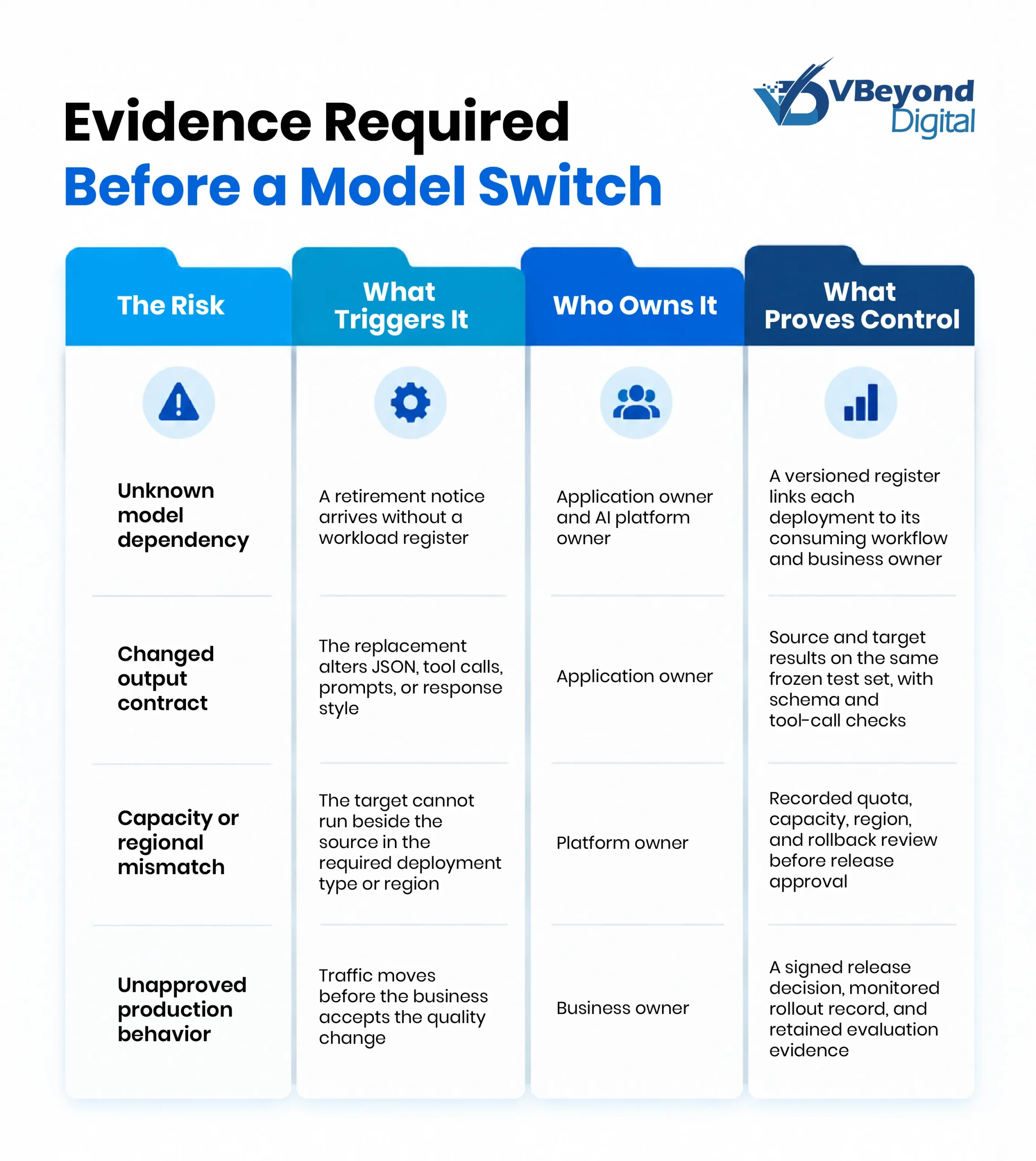
The first control is a workload register that joins technical and business facts. It should name the source model version, deployment type, region, quota, consuming application, service owner, business owner, prompt or agent version, retrieval dependency, output contract, data classification, success criteria, and retirement date. The register needs a clear answer for every row: can the workload pause, can it fall back to another process, or must it keep serving while the migration occurs?
This is more demanding than a tag cleanup. A team may have accurate resource tags and still fail to locate the downstream parser that rejects a changed field, the Power Automate flow that assumes a tool-call argument, or the customer-service team that needs to approve a different answer style. Azure cloud architecture services are relevant here because the dependency record has to span the model deployment, identity path, data path, application layer, and production support model.
The reasonable objection is that a complete register is too much work for every low-risk experiment. That is probably true. The threshold should follow business impact. A model that drafts internal meeting notes needs less evidence than one that routes a customer case, generates a compliance response, or supplies a value used in a finance workflow. The register becomes mandatory when model behavior can change a business decision, a customer interaction, a transaction, or an operational control.
Benchmarks cannot authorize a replacement for a business workflow
A replacement model may look better on a public leaderboard and still fail the workload that matters. Public tests cannot reproduce an enterprise’s retrieval corpus, prompt discipline, tool chain, JSON constraints, latency profile, or edge cases. They can narrow a shortlist. They cannot decide whether the model belongs in production.
Microsoft’s model migration guidance calls for evaluating a candidate against the enterprise’s own application, prompts, and representative data. That work starts before a target is chosen. The team needs a frozen test set with representative inputs, expected outputs where those exist, and explicit success criteria. It should run the current model against that set first, then compare the candidate on the same cases. Without that baseline, a migration team can describe a new model as improved without being able to show what improved, where behavior moved, or whether the cost of that movement is acceptable.
What this looks like in practice is less tidy than a model scorecard. Prompt changes, tool definitions, parameter support, response schemas, calling code, and downstream parsing can all change in the same release. The migration should replay the existing configuration on the target before any tuning. That first pass separates behavior introduced by the replacement from behavior introduced by the migration team. Subsequent prompt or schema changes then become traceable decisions. They do not arrive as an untested bundle of edits.
The same discipline explains why production AI initiatives often stall. A pilot can work with informal human judgment. A production migration needs a quality threshold that the workload owner can accept, a latency boundary that the platform can support, and a cost view based on actual traffic. The number of measures should fit the workflow. An agent that calls tools needs tool-call validity and sequence checks; a retrieval workflow needs groundedness and answer quality; a regulated customer process may require a human review sample as part of release approval.
Deployment type decides who has to move and how much time remains
The same retirement date does not create the same operational path for every deployment. Microsoft Foundry states that Standard, Global Standard, and Data Zone Standard deployments can be upgraded on a rolling schedule, while provisioned deployments require the customer to migrate manually. Automatic service continuity helps with endpoint availability. It does not establish that the new behavior is acceptable for the application behind that endpoint.
Provisioned capacity requires an explicit migration design. A team can move in place or stand up a parallel deployment, but it must first confirm target quota, regional availability, capacity, budget impact, and rollback conditions. The manual path gives the enterprise control over timing, yet it also makes ownership visible: someone has to authorize the move, observe the first production traffic, and decide whether the evidence supports continuing.
Standard deployments need the same accountability in a different form. Microsoft documents controls for upgrade timing, but a workload owner still needs a test environment and a decision point before the scheduled transition. An auto-upgrade should prompt earlier validation, not less validation. The Foundry lifecycle policy also makes the asymmetry clear: an inference endpoint returns 410 Gone after retirement, and preview models can have a shorter, less stable lifecycle. Production design has to account for that difference before a service path becomes business-critical.
Release evidence prevents a fast migration from becoming a silent change
Model retirement belongs inside change management because the migration changes a live decision system. The release record should preserve the model versions, deployment type, prompt and schema revisions, test dataset version, evaluation results, approver, rollout method, monitoring thresholds, and rollback trigger. Each item answers a question that arrives later: what changed, who accepted the trade-off, what did the team test, and what would have caused a reversal?
The recurring gap is a migration that is technically complete but cannot be reconstructed. Logs may prove that requests succeeded while failing to show whether the new model passed the agreed quality gate. A prompt may have been edited without a record of the source version. A model might move while the old deployment remains available, leaving the organization unsure which path handled a customer interaction. Production AI control requires versioned evidence across the deployment, the application, and the business decision, not only application telemetry.
The release authority should follow the risk. The platform owner can approve infrastructure readiness. The workload owner must accept changes to task quality and process impact. Security, privacy, or compliance review may be necessary when the target changes region, data-boundary behavior, or access path. A single committee cannot perform all of those judgments. It can set the threshold and resolve an escalation when the owners disagree.
Test Azure OpenAI changes before production rollout
Model lifecycle work becomes cheaper when it is treated as routine operations
The retirement schedule will keep changing, and every enterprise will carry several versions across applications. The useful operating model has a regular lifecycle review, an automated pull of model lifecycle fields, named workload owners, a current dependency register, and an evaluation set that grows from real incidents and production edge cases. The aim is to start the assessment while a rollback corridor still exists, not while an expiry date has turned the work into an emergency.
Microsoft Foundry provides lifecycle status, migration guidance, evaluation tools, and observability features. Those tools reduce effort, but they do not choose an acceptable quality threshold or decide whether a customer-facing process can tolerate a changed answer. The enterprise retains that responsibility because the enterprise owns the workflow and its consequences.
VBeyond Digital can assess Azure OpenAI and Microsoft Foundry workloads for retirement exposure, map their dependencies, and set up the evaluation and release controls that support repeatable migrations. The immediate deadline can be managed. The next model change will still need evidence.
FAQs (Frequently Asked Question)
No. Microsoft states that Standard, Global Standard, and Data Zone Standard deployments can be upgraded on a rolling schedule, while provisioned deployments require manual migration. Fine-tuned and batch workloads have separate migration paths. The deployment type must be in the workload register before the migration plan is approved.
Start when a model becomes a production dependency, not when a retirement notice arrives. Microsoft says replacement models become available for testing in Global Standard before retirement and later in provisioned regions. That window should contain the assessment, prompt and schema work, validation, staged rollout, and rollback preparation. The real deadline is the retirement date minus the time needed to complete those steps.
Test the source and target against the same frozen set of representative cases. The criteria should reflect the workload: output quality, groundedness for retrieval work, tool-call validity for agents, response-schema adherence, latency, unit cost, safety, and any human-review requirement. A public benchmark can aid shortlisting, but it cannot replace this workload-specific evidence.
The application or workload owner should approve the business-quality and process-impact threshold. The platform owner should approve deployment, capacity, identity, and operational readiness. Other owners join when the change affects regulated data, customer commitments, security controls, or budget limits. Approval should be recorded alongside the evaluation and rollout evidence.
The recommended replacement is a useful starting point, but Microsoft advises comparing candidates using the enterprise’s own application and data. Regional availability, deployment type, quota, API behavior, quality, latency, and cost can alter the decision. The schedule should start evaluation work, not end it.
