


Loading...
Production agents need a bounded identity, task-specific authority, and an approval path that stays outside the reasoning loop.
Section
Table of Contents
- A published retirement date can still catch production by surprise
- Shared accounts make autonomous actions hard to explain
- Tool permissions have to follow the task that created them
- Policy services must decide whether a tool action can proceed
- Audit evidence needs protection from the agent it records
- GCC teams need authority to contain an agent without waiting for a committee
- Production access needs a record before the first disputed action
- FAQs (Frequently Asked Questions)
Key Takeaways
- How to decide whether an AI agent needs its own identity and why a shared human or service account makes later investigation harder.
- How to limit an agent’s permissions to the task in progress, including short-lived credentials and downstream authority that cannot exceed the original mandate.
- How to set human approval thresholds for actions that can alter production records, expose controlled data, or create a business commitment.
- What evidence to retain so a GCC, a headquarters team, and a vendor can reconstruct who authorized an autonomous action and how it was executed.
A published retirement date can still catch production by surprise
“Can the agent use the finance-operations service account until its own identity is ready?” The question often reaches an architecture review after a workflow has already succeeded in a test tenant and shortly before it is allowed to create cases, update supplier records, or submit a request into a business system.
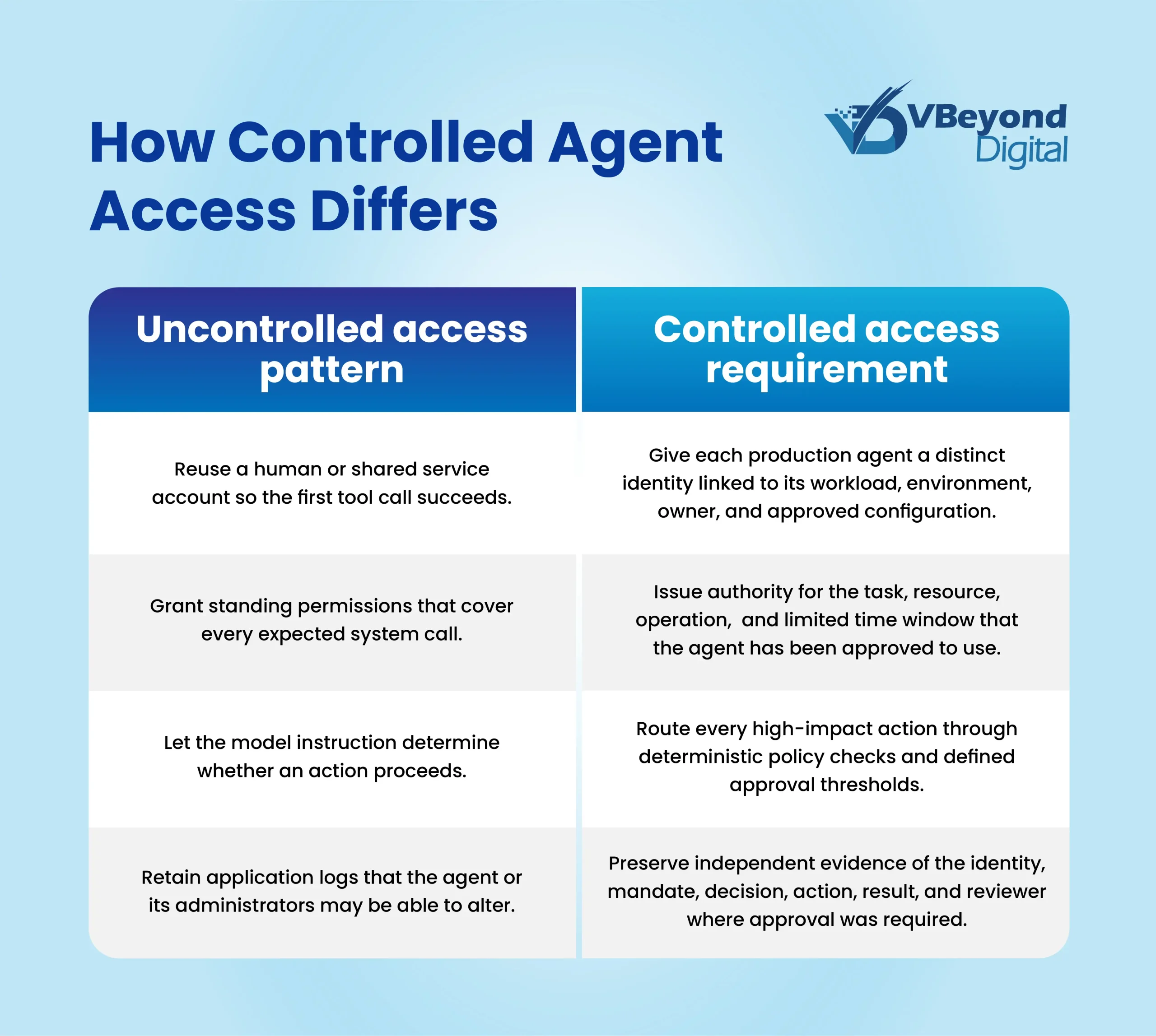
The account may already have roles, scopes, and integrations that were approved for a different process. Once an agent calls it, a disputed supplier change or case update becomes harder to attribute. The audit record has to separate the agent’s action from every other process using the same principal.
The agent therefore needs its own principal, linked to a specific workload and approved configuration. NIST’s design tenets for agent identity management call for distinct, cryptographically verifiable agent identities that remain separate from human users and conventional service accounts. That distinction gives a GCC operations team, a business owner at headquarters, and the teams responsible for connected systems a common starting point when an action needs explanation.
Shared accounts make autonomous actions hard to explain
Shared accounts blur the difference between a scheduled integration, an administrator’s recovery procedure, and the agent’s immediate task. A reviewer sees accumulated access, yet the record does not show which privilege belongs to which process. That ambiguity carries into incident response, access certification, and the approval of a future change.
Hosted agents in Microsoft Foundry Agent Service receive a dedicated Microsoft Entra identity. The enterprise still decides the role, scope, and purpose attached to that principal. Those decisions should sit with the agent definition and change record, where the application owner and security team can review them as the workflow changes.
The same design is needed when an agent crosses subscriptions, data services, and business applications. Azure cloud architecture work should show where the principal is allowed to operate and which team maintains the access path. A role grant without that surrounding record becomes difficult to review once the original implementation team has moved on.
Tool permissions have to follow the task that created them
An agent may start by retrieving an order status and later invoke a workflow that amends the order or changes a supplier record. The receiving service needs enough context to determine whether that later request is within the work that was approved. A broad API key or standing write role carries no such context.
The task request should carry the approved outcome, resource scope, action type, and time window into each tool call. NIST’s guidance calls for short-lived, audience-specific authorization and delegated authority that cannot exceed the originating authority. A gateway can use those attributes to issue a credential for one operation and reject a later request that exceeds the mandate.
This is familiar in enterprise automation. Identity and credential architecture has to reflect the workload’s purpose and operating life. Agent tools need the same discipline, including a clear route for revoking authority when the task, data, or risk state changes.
Microsoft Foundry, Power Platform, Copilot, ERP, and custom applications will implement that path differently. The receiving system still needs a basis for accepting or rejecting the call.
Policy services must decide whether a tool action can proceed
Prompt content and retrieved data can influence what an agent proposes. They should have no authority to change the rule that governs a payment-related task, a supplier update, a restricted record, or a customer commitment. That rule belongs in a policy service or workflow control outside the model’s reasoning path.
The agent can prepare a case and assemble context for a reviewer. A deterministic control then evaluates the requested operation against the caller, task mandate, data class, action value, and current risk state. It can permit the call, send it for named approval, or stop it. The decision remains traceable because the rule and inputs sit outside the model.
Guardrails and content filters can reduce harmful model behavior. They do not authorize a change in an ERP, CRM, or cloud-management system. That separation limits the effect of a prompt injection or untrusted document that reaches the model.
Microsoft Foundry can centralize tools, authentication, agent versions, and tracing within a managed platform. The approval threshold and policy check need to be tested with the task paths the business intends to use before the agent receives production access.
Audit evidence needs protection from the agent it records
Logs that the agent can alter have limited value during an investigation. The record needs to sit outside the agent’s authority and show the task origin, policy decision, tool invocation, target resource, result, and any human approval. A security or audit team can then establish who allowed the action and the conditions that applied when it ran.
An active agent can generate a large number of traces, which raises cost and privacy questions. Retention should follow business impact and data classification. A low-risk read-only request may need technical trace data for a short operational period. A write action affecting a finance, employee, customer, or regulated record needs a longer-lived record that includes the authorization decision and has separate access protection.
NIST calls for a tamper-evident, append-only body of evidence kept independently of the agent. Production AI control depends on the same connection between system behavior, decision authority, and retained proof. Microsoft Foundry agent tracing can inspect model calls, tool invocations, and agent decisions. The enterprise still decides retention period, reader access, and the link from each trace to the affected business process.
When a failure occurs, the GCC operations team needs access to the trace and a route to contain the agent. The workload owner assesses process impact. Security and privacy teams assess data exposure when it is relevant. The escalation plan should assign those roles before an incident begins.
GCC teams need authority to contain an agent without waiting for a committee
Distributed delivery can spread one agent across several accountability boundaries. A GCC may configure and operate it. A headquarters function may own the customer process or finance control. A platform team may maintain identity and network controls. The model provider and connected application vendors may operate parts of the supporting service. A central policy document does not tell the on-call engineer whether to disable a tool, revoke a grant, or pause the workflow.
The operating model should set common policy centrally and assign local containment authority within clear thresholds. A GCC team needs a documented kill path for a suspected access issue. Actions with customer, regulatory, financial, or wider data consequences should move to the business owner or control function named for that workflow.
Each agent should have a register entry that identifies its purpose, target systems, approved action classes, business owner, technical owner, and containment route. Vendor responsibilities belong in contracts and support procedures. The enterprise remains accountable for the way the agent is used in its own process.
The same operating questions apply to agents created through Microsoft Copilot, Power Platform, and custom Microsoft Foundry applications. The register should identify the action path and the person who can suspend it.
Production access needs a record before the first disputed action
Once an agent can affect a supplier, customer, employee, or production environment, the production record needs to show which identity was assigned, which actions were approved, and who can intervene when the agent’s behavior or context changes.
VBeyond Digital can assess agent identities, tool paths, authorization controls, and containment procedures across Microsoft Foundry and connected business systems. Start with the agents that can change a production record or expose controlled data.
Test Azure OpenAI changes before production rollout
FAQs (Frequently Asked Questions)
Every agent that accesses enterprise data or invokes a business-system tool needs a distinct, reviewable security principal. The identity should identify the workload, environment, approved configuration, and technical owner. A low-risk agent may receive a narrow read-only role. An agent that changes records or initiates transactions needs tighter authorization, explicit thresholds, and more complete evidence.
Azure RBAC is necessary for defining permissions, yet it does not establish the full control path. An agent also needs a task-bound mandate, short-lived authorization, protected tool interfaces, policy checks outside the reasoning loop, approval rules for sensitive actions, and independent evidence. RBAC provides part of the boundary; the operating design determines how the agent receives and uses that access.
Approval should follow the action’s impact, reversibility, data sensitivity, and financial or regulatory consequence. Reading a public knowledge source can sit below the threshold. Changing supplier master data, releasing a payment-related task, or exposing a restricted record should trigger a named human decision. The threshold needs enough context for the reviewer to understand the request and enough selectivity to avoid routine approval without judgment.
The team needs a documented containment path before production use begins. That path should let an authorized operator disable the relevant tool, revoke the agent’s current access, preserve the trace record, identify affected transactions, and escalate to the business, security, privacy, or vendor contacts named for that workflow.
Retain the agent identity, approved configuration or version, task origin, mandate, requested tool action, target resource, policy decision, authorization used, result, timestamp, and human approval when required. The record belongs outside the agent’s write authority. Retention period and access restrictions should reflect the data class and business effect of the action.
