


Loading...
Access control becomes defensible when every privileged assignment has an owner, a purpose, a scope, and a review date.
Section
Table of Contents
- Introduction
- The Last Useful Permission Is Usually the One Nobody Wants to Remove
- Group-Based Access Helps Until the Group Becomes the Explanation
- Production Safety Is Why Cleanup Keeps Stalling
- Automation Identities Turn Exceptions Into Future Access Paths
- PIM Reduces Exposure. It Does Not Decide Whether a Role Still Belongs
- Audit Evidence Has to Explain the Access, Not Just List It
- The Audit Finding Usually Starts as an Unanswered Ownership Question
- FAQs (Frequently Asked Question)
Key Takeaways
- How to distinguish a useful production permission from an assignment that only survives because nobody has had time to question it.
- How to narrow Azure role assignments without discovering a broken deployment or integration during the next release window.
- What business owners, platform teams, and security teams each need to own when groups, service principals, and emergency access are reviewed.
- What evidence an auditor needs beyond an export of Azure role assignments to accept that privileged access remains justified.
Introduction
The team that understands a production subscription best often needs enough access to keep it running. The same permission, left in place after an incident, a migration, or a release, can leave the platform owner unable to say why a former project group or deployment identity can still change it.
Permission sprawl rarely begins as a careless decision. It begins with a reasonable workaround that survives its original purpose. In a large Azure estate, the assignment can sit at a management group, subscription, resource group, or resource; it can reach a person through a group; and it can belong to a managed identity or service principal rather than a human. Microsoft’s role-assignment documentation describes those components, including the optional description that can record why a principal received a role. That description is often the missing piece when a cleanup begins.
The question for a Head of Cloud Platform is therefore narrower than whether Azure RBAC is configured. Can the platform explain every powerful assignment in terms of a current workload, an accountable owner, a defined scope, and a date when the decision will be reviewed? When the answer is no, the issue is an operating model problem before it becomes an audit problem.
The Last Useful Permission Is Usually the One Nobody Wants to Remove
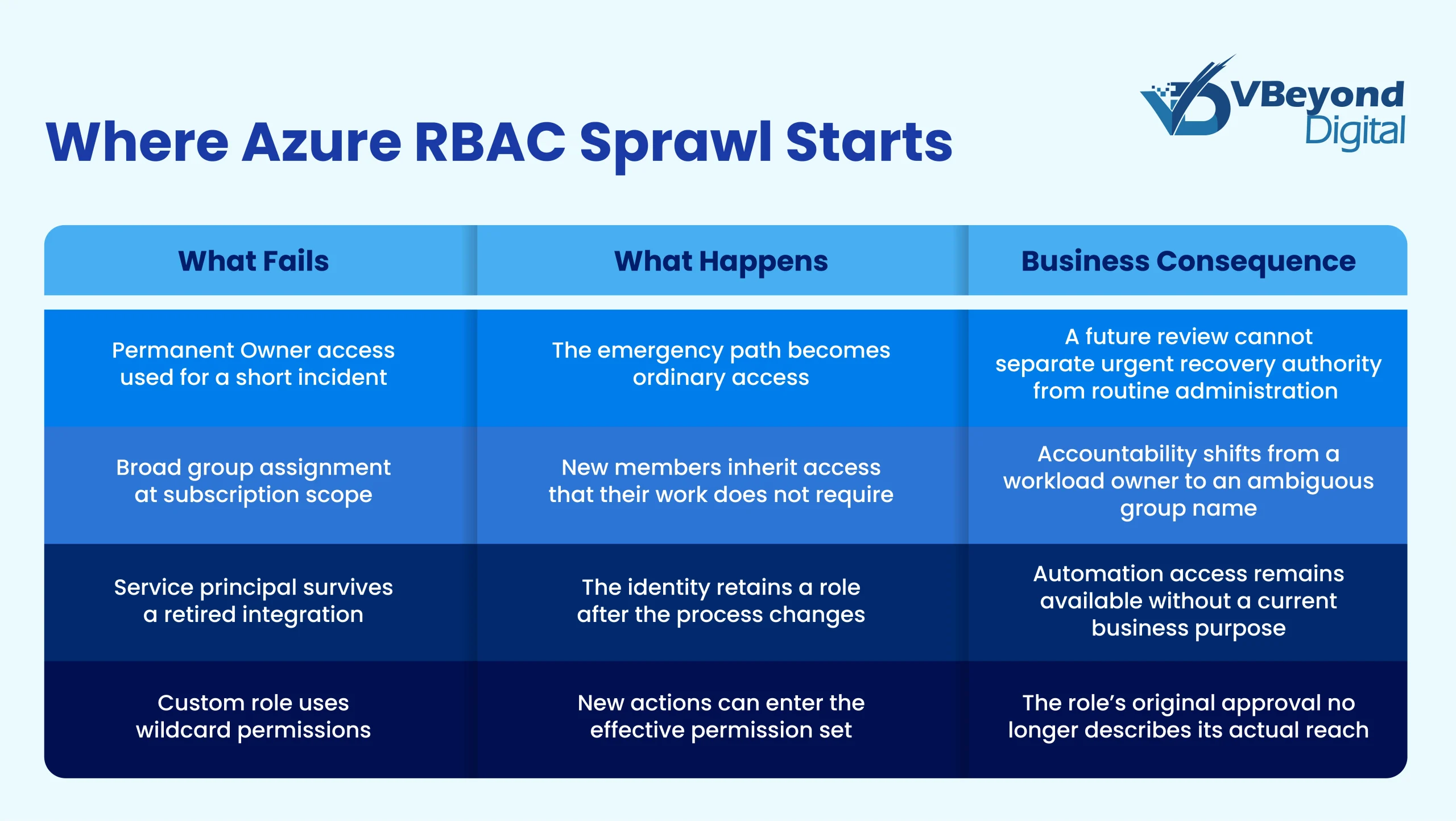
The most difficult assignment to remove is rarely an obviously abandoned account. It is the Contributor role granted during a production defect, the Owner role kept by a project lead after a migration, or the group whose membership now spans several teams because it was convenient at the time. Each may still support work that matters, which is why a cleanup that begins by deleting access tends to stall.
A fair objection is that the platform team cannot test every role change before an audit deadline. It cannot. The answer is to rank assignments before changing them. Start with permanent Owner, User Access Administrator, role-assignment-capable roles, broad Contributor assignments, wildcard custom roles, and identities tied to production automation. Then add age, scope, last use where reliable telemetry exists, business owner, exception reference, and workload criticality. This converts a spreadsheet of permissions into a queue of decisions with different production risks.
The consistent pattern in mature cloud estates is that a role export does not reveal the control issue by itself. The evidence has to connect the principal, role, scope, workload, business owner, approval, and next review. Microsoft recommends least privilege, narrow scopes, group assignments rather than direct user assignments, and a maximum of three subscription Owners in its Azure RBAC best-practices guidance. Those are useful guardrails; the operating work begins when each exception has to be explained.
Group-Based Access Helps Until the Group Becomes the Explanation
Groups reduce direct user assignments and make joiner-mover-leaver processes more manageable. They can also hide the reason access persists when the group name has outlived the project that created it. A group called Cloud-Operations says little about whether every member needs Contributor across six production subscriptions.
The obvious pushback is that individual assignments are easier to inspect than group membership. They are. Yet making every assignment individual shifts the administrative burden into hundreds of separate approvals and makes revocation harder to perform consistently. The better design gives each access group a named owner, a concise purpose, an approved scope, membership criteria, and a review frequency. A person who cannot meet those conditions may still need access, but through a different, time-bound path.
That distinction matters when a platform is trying to connect identity decisions to its broader Azure cloud architecture. Management-group access belongs to enterprise functions with an enterprise mandate. Resource-group access belongs to a defined product or service responsibility. Resource-level access belongs to a narrow operational task. Microsoft’s current identity guidance makes the same case for avoiding user-specific permissions and using groups, management groups, and resource groups at the appropriate scope in its identity and access-control guidance.
Production Safety Is Why Cleanup Keeps Stalling
Removing excess access can interrupt a deployment pipeline, a recovery procedure, a finance integration, or an on-call response. That risk is real, and it is why blanket removal exercises create distrust. The platform has to prove a replacement path before it removes a powerful assignment.
The counterargument writes itself: leaving questionable access in place is safer than breaking production. Only in the short term. A cleanup plan should move through observation, proposed change, controlled implementation, and post-change verification. During observation, the owner validates the workload and the current access path. During the proposed change period, the platform identifies a narrower built-in role, a different scope, a group-based assignment, or a time-bound activation. During implementation, it changes one path at a time inside a defined release window. Post-change verification checks the workload, the deployment route, the runbook, and the incident path rather than merely confirming that the assignment disappeared.
What this looks like in practice is a decision record for every material removal: the application or operational task affected, the accountable business owner, the technical approver, the fallback method, the validation result, and the rollback condition. An access review that cannot answer those questions should not auto-apply removal across a production estate. It should create a controlled remediation decision instead.
Automation Identities Turn Exceptions Into Future Access Paths
Human access receives attention because people change jobs and leave. Automation identities can persist through several application releases, vendor changes, and support handoffs, often with a role granted when a deployment script first failed. That makes them a separate control population, not a footnote to user access.
A reasonable objection is that automation cannot wait for an approver when a workflow needs to run at 2:00 a.m. That is correct. The control question is whether the identity has only the permissions required for that workflow, at the smallest viable scope, with an owner who can explain its purpose. Managed identities, service principals, and workload identities need a system owner, an environment, a credential or federation method, a role, a scope, a change process, and a retirement signal. A deleted principal can also leave a role assignment behind, so deletion in Microsoft Entra is not the end of the review.
The pattern is clearest in enterprise automation: credentials and permissions are often treated as deployment details, then become a continuing access route. The earlier article on automation identity failures examines the same problem where Azure and Power Platform workflows meet. The same review discipline belongs inside enterprise automation controls when low-code workflows and cloud identities share a production path. A platform team should review these identities alongside human administrators, with separate evidence for their purpose and operation.
Bring greater control to Azure cloud operations
PIM Reduces Exposure. It Does Not Decide Whether a Role Still Belongs
Privileged Identity Management can reduce the period in which an elevated role is active, add approvals, and produce a record of activation. It cannot decide whether a permanent role, an eligible role, or a custom role remains appropriate for a changed workload. That decision still belongs to the accountable owner and the platform controls around the assignment.
Some leaders will argue that a quarterly attestation is enough once PIM has been enabled. It helps, provided the review asks a meaningful question and reaches the identities that matter. Microsoft Entra PIM can create recurring reviews for privileged Azure resource and Entra roles, including direct service-principal access; it can also collect a reason for approval and apply review outcomes. Microsoft’s access-review guidance describes those options and the limits around group-based Azure resource assignments.
The more useful review has two owners. The business or workload owner confirms the access still serves a current process. The platform or security owner confirms the role, scope, identity type, and activation method remain technically appropriate. Neither can do the other’s job. That is why a review completed by an administrator alone can look tidy while leaving the underlying access decision untested.
Audit Evidence Has to Explain the Access, Not Just List It
An auditor will accept that a production platform has privileged access. The harder question is whether the enterprise can show how that access was granted, why it still exists, who reviewed it, and what happens when the owner does not respond. A role-assignment export answers only the first question.
The evidence suggests that the most durable control is a quarterly operating cadence with a monthly exception review for high-risk roles. The quarterly review should preserve the assignment inventory, identity type, role and scope, purpose, owner, approval reference, review decision, and applied outcome. The monthly exception review should focus on permanent privileged access, break-glass use, custom roles, service principals, and assignments made outside the standard route. A control owner needs to report overdue reviews and unresolved removals to the platform governance forum, where a business decision can be made rather than another technical ticket created.
That cadence belongs with recurring cloud operations, not a one-off audit project. The access model becomes credible when it can survive the next migration, incident, and reorganization without relying on someone’s memory of why a role was added.
The Audit Finding Usually Starts as an Unanswered Ownership Question
The platform owner facing a role cleanup does not need to remove every powerful assignment immediately. The work starts by making each assignment legible, ranking the ones that create the greatest exposure, and replacing production-critical access only after its alternative path has been tested. That is slower than deleting roles from a report, but it is faster than recovering from a broken deployment or defending an unexplained privilege during an audit.
VBeyond Digital can conduct an Azure RBAC and identity-governance assessment that maps privileged assignments, automation identities, exception paths, ownership, and review evidence across the Azure estate. Which Owner assignment, inherited group, or automation identity could the platform still defend if an auditor asked why it exists?
Contact Us to align Azure governance with the way your cloud environment is managed.
Work with VBeyond Digital across Azure consulting, configuration, security and compliance, monitoring, integration, and ongoing management.
FAQs (Frequently Asked Question)
High-risk privileges require more attention than ordinary project access. A quarterly access-review cycle is a reasonable baseline for privileged Azure roles, while permanent Owner assignments, emergency access, sensitive service principals, and exceptions benefit from monthly scrutiny. The calendar matters less than named reviewers, evidence of the decision, and a defined treatment for a reviewer who does not respond.
No. Group-based assignment reduces direct-user complexity, yet it can obscure access when a group has no purpose, owner, scope, or membership rule. Each privileged group needs the same evidence as a direct assignment, plus a review of who can add or remove its members.
No. PIM can make elevated access eligible, time-bound, approved, and reviewable. It does not determine whether the underlying role is correct for the workload, whether its scope is too broad, or whether a service identity still needs it. Those remain operating decisions.
Treat removal as a controlled change. Identify the task the principal performs, test the smallest viable role and scope in a nonproduction environment where possible, establish a rollback path, and verify deployment, runbook, and incident procedures after the change. Access should be removed only after the replacement path is known to work.
Retain the current assignment inventory, role and scope, principal type, business purpose, accountable owner, approval or exception reference, review decision, and implementation outcome. For time-bound access, retain the activation and expiry evidence. For service principals and managed identities, preserve the workload, environment, and retirement owner alongside the assignment.

