


Loading...
An agent becomes a production system when it can act on enterprise data, not when a central team decides to notice it.
Section
Table of Contents
- An Agent Becomes Operational Before The Organization Treats It That Way
- One Governance Rule Creates Two Different Kinds Of Failure
- GCC Scale Exposes Ownership Gaps That Local Pilots Can Hide
- An Agent Cannot Graduate From A Demo On A Successful Test Alone
- Evidence Has To Change When The Agent Changes
- The Incident Queue Still Needs An Owner
- FAQs (Frequently Asked Question)
Key Takeaways
- How to distinguish a useful maker-built agent from a production service that needs a named business owner, technical owner, and escalation route.
- Why applying the same approval path to every agent either drives untracked work elsewhere or leaves higher-risk agents insufficiently governed.
- What a GCC delivery team needs before an agent can move from a working demo into a supported production workflow.
- How to test whether an agent has enough evidence, ownership, and lifecycle discipline to withstand an audit or a live incident.
The overnight support call has become an argument about a name in a ticket. The GCC team says it built the agent for a business request. The business function says it only asked for a faster way to find answers. The Power Platform administrator says the agent sits in an approved environment. Nobody can say who owns the connector that sent the response into a customer workflow.
That exchange is becoming more plausible as Copilot Studio agents move from demonstrations into day-to-day work. Microsoft now exposes controls for authentication, knowledge sources, tools, channels, triggers, audit logs, and environment routing in its current security and governance guidance. The harder issue is organizational: an enterprise can have the controls available and still lack a production model that assigns responsibility when an agent uses them.
An Agent Becomes Operational Before The Organization Treats It That Way
A fair objection is that many agents only answer questions and carry little operational risk. That is true for a read-only assistant with limited knowledge sources and a small, known audience. The boundary changes when an agent retrieves sensitive data, invokes a connector, starts a flow, publishes into a business channel, or reacts to an event without a person initiating the exchange. At that point, its risk follows access and action, not the label on the maker’s project.
The pattern in production reviews is familiar. An agent begins as a narrow request from a finance, service, or HR team. It works. Someone asks for access to one more knowledge source. A maker adds a connector to avoid manual rekeying. The agent then gains a channel that reaches more users than the original request implied. Each change sounds reasonable on its own. Together they create a service boundary that was never formally named.
Microsoft’s own project-governance guidance points to the lifecycle work behind that boundary: requirements capture, zoned environments, gated deployment, testing, monitoring, and application lifecycle management. Those are not administration chores. They are the minimum evidence that the enterprise knows what the agent is allowed to do, who approves changes, and who can stop it.
For teams extending Microsoft Copilot into business workflows, the first practical question is simple: if this agent returns an incorrect answer, sends an action to the wrong system, or loses access after a policy change, which named role owns the next hour? A project sponsor is not enough. The operating owner must have the authority to investigate, pause the agent, and call the teams that control its data and integrations.
One Governance Rule Creates Two Different Kinds Of Failure
Some leaders will argue that a single governance path is easier to administer. It is. It also treats a read-only agent that summarizes a controlled knowledge base as equivalent to an agent that can trigger a workflow or reach external endpoints. Those are different trust boundaries, and a uniform rule fails in opposite directions: it either delays harmless work until makers look for a path around it, or it gives more autonomous agents a level of freedom their owners cannot support.
The contrarian point is not that every agent needs a risk council. It is that control must be proportional to what the agent can access, decide, and initiate. Gartner’s May 2026 research reaches the same conclusion and forecasts that 40% of enterprises will demote or decommission autonomous agents by 2027 after governance gaps surface in production. The figure is a forecast, not a certainty about any single program. Its value lies in the distinction Gartner makes between an agent’s autonomy and its access scope.
That distinction has to appear in the approval record. A low-risk agent might need a business owner, an approved knowledge source, a defined user group, and a review date. An agent that creates cases, alters records, calls a procurement service, or runs through a trigger needs more: a technical owner, connection identity, test evidence, a rollback path, monitoring thresholds, and an incident lead. The recurring problem is that teams record the use case and omit the control boundary.
This is where a generic inventory starts to fail. An inventory can tell an enterprise how many agents exist. It cannot establish whether an agent’s actual access, current version, and support route still match the approval that allowed it into production.
Keep Copilot Studio Agents Governed Beyond the Demo Stage
GCC Scale Exposes Ownership Gaps That Local Pilots Can Hide
A fair concern is that asking for named ownership will slow a GCC delivery model built around speed. It may slow the first production release, particularly where the enterprise has never agreed who owns a shared connector, a service account, or a business exception. The delay exposes work that was already necessary. A later incident simply makes it more expensive and more public.
What appears in distributed delivery is a split between the team that can change an agent and the team that absorbs its consequences. A GCC maker may own the build backlog. A platform administrator may own the environment. A business owner may accept the output. Security may approve the data policy. Individually, none of those roles owns an inaccurate response that enters a regulated process or a failed action that blocks an operational workflow. That gap is where shadow IT becomes a production problem.
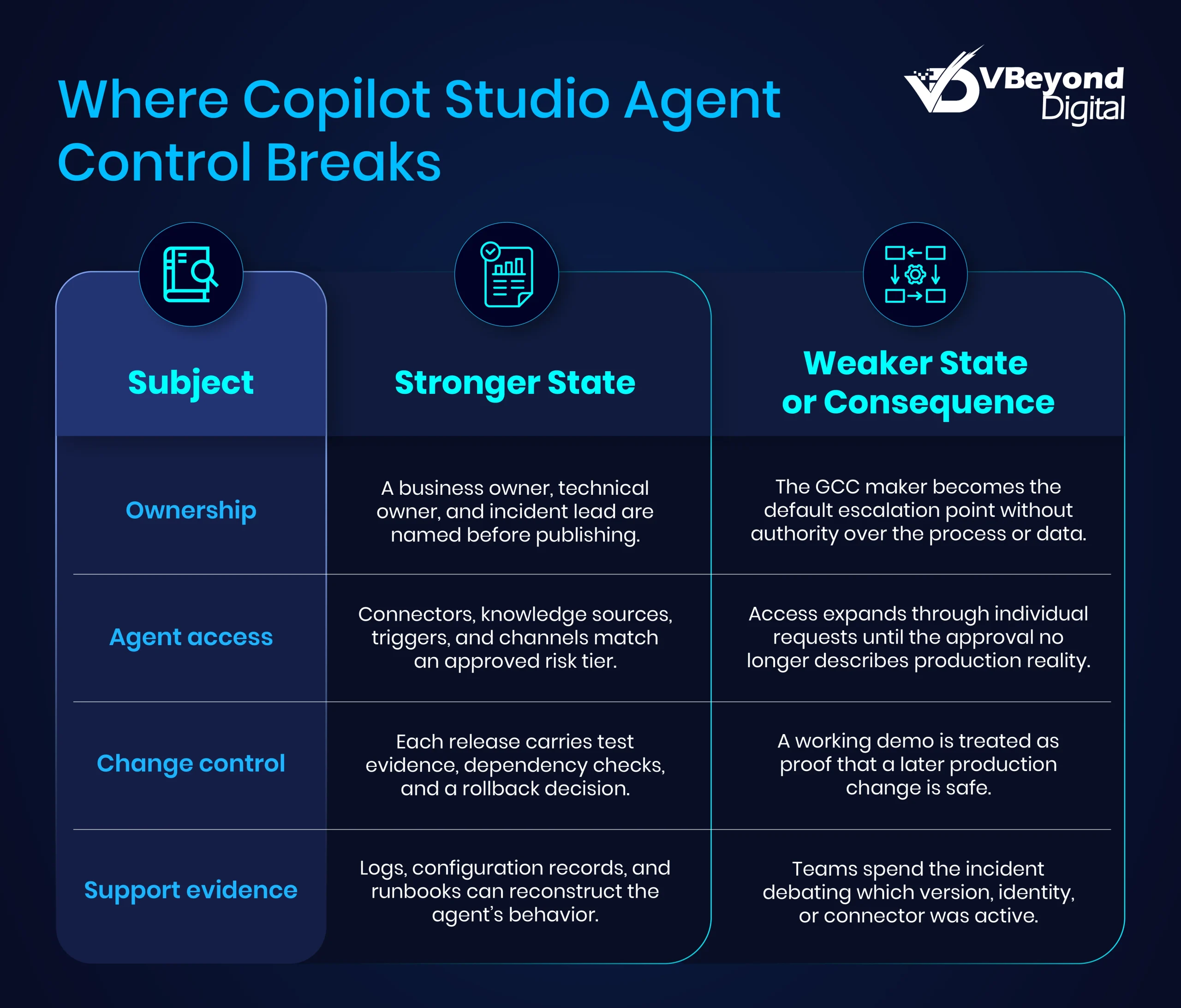
The practical model needs an accountable business owner for the use case and outcome, a technical owner for the agent’s architecture and release path, and named control owners for identity, data, and compliance. The GCC team can own build, testing execution, runbook maintenance, and first-line investigation when that is part of its remit. It should not inherit business-risk accountability merely because it has the most immediate technical context.
That division is especially important in GCC advisory and execution work, where delivery responsibilities tend to broaden before decision rights are redrawn. The operating model should set escalation targets, handoff criteria, and incident communications before an agent reaches a business channel. It should also make clear who may override or retire the agent when its behavior no longer matches the approved use case.
An Agent Cannot Graduate From A Demo On A Successful Test Alone
The obvious pushback is that a detailed production gate will turn agent delivery into a long project. It should not. The gate can be light for an agent with narrow access and no ability to act. It has to become more demanding as the agent gains connectors, triggers, external endpoints, or authority to affect a workflow. The point is to make the escalation path visible before a production incident discovers it for the team.
Microsoft’s data-policy documentation shows why technical controls alone do not finish the job. Policies can govern authentication, knowledge sources, connectors, HTTP requests, publishing channels, skills, and event triggers. The enterprise still has to decide which combinations are permissible for a given use case, who approves exceptions, and how the policy’s effect is tested in the specific environment where the agent will run.
A dependable production gate has to connect environment strategy, connection identity, behavior testing, change promotion, and support readiness. The practical gap is often less dramatic than a security failure: a production agent works in development because it used a maker’s connection, then fails when that identity does not exist in the target environment. That failure consumes the same support capacity as a more serious incident, while leaving the business owner unsure whether the agent or its surrounding automation changed.
For Power Platform governance at enterprise scale, the useful measure is not how many agents passed an approval step. It is whether the enterprise can reproduce the agent’s production configuration, identify its dependencies, and show who accepted the residual risk. That is a much higher bar than a successful demonstration.
Evidence Has To Change When The Agent Changes
Logging is often treated as the answer to auditability. It is only part of the answer. A transcript can show what an agent said, yet it may not show which knowledge source version, connector identity, policy, prompt instruction, or release package shaped the result. An audit trail that cannot connect behavior to configuration leaves the enterprise with a record of the symptom and little evidence of the cause.
The current Copilot Control System groups security and governance, management controls, and measurement and reporting. That framing is useful because it refuses to reduce governance to a set of blocks. Production control needs all three: constraints on access, lifecycle decisions that keep the live agent identifiable, and evidence that the agent is meeting the business condition it was approved to serve.
In operating reviews, the missing artifact is frequently the change record that links a new version to test cases and expected behavior. A support team can see a rise in handoffs or failed actions. It cannot tell whether a connector change, a policy change, a knowledge-source update, or a revised instruction caused it. The identity and credential architecture behind the agent needs the same scrutiny. Production agents need a small but durable evidence pack: the approved purpose, risk tier, owners, dependencies, change history, test results, and the conditions that require the agent to be paused.
The Copilot Studio implementation guide includes security, monitoring, governance, lifecycle management, analytics, testing, and capacity in the same delivery model. The implication is practical. Monitoring does not belong after publishing; it belongs in the definition of what publishing means.
The Incident Queue Still Needs An Owner
No governance structure will remove every bad output or failed connector. It can make the first response intelligible. The enterprise should know whether a business owner must decide on customer impact, whether the platform team must contain access, whether the GCC team must investigate the release, and when security or compliance takes over.
The opening support call becomes less ambiguous when those decisions exist before an agent reaches production. The GCC team may still be the first group to see the failure. It should not be the group left to determine, in real time, who has the authority to stop the agent or accept the business consequence.
VBeyond Digital can conduct a Copilot Studio production-control assessment across agent ownership, environments, connector access, testing gates, audit evidence, and support escalation. It gives the enterprise a working ownership map and a prioritized set of control gaps to resolve before more agents enter production.
The map still has to hold during an incident.
FAQs (Frequently Asked Question)
The risk begins when the agent’s actual access, action scope, or audience exceeds the ownership and control evidence attached to it. An agent does not need to be secretly built to create that problem. A legitimate project can become unmanaged when connector changes, new channels, or event triggers broaden its operational role without a corresponding approval and support decision.
No. A read-only agent that serves a limited user group and an agent that can trigger workflows or reach sensitive systems do not deserve the same path. Governance should reflect the agent’s autonomy, access, data sensitivity, and business consequence. A shared baseline is useful; the production gate should become more demanding as those factors increase.
The business owner remains accountable for the use case and its consequences. The GCC team may own development, test execution, or operational investigation when those responsibilities are explicitly assigned. The platform, identity, data, and security owners retain responsibility for their respective controls. A single named incident lead should coordinate the response when those boundaries overlap.
The record should identify the approved purpose, risk tier, business owner, technical owner, connectors and knowledge sources, authentication and environment configuration, test evidence, release version, monitoring plan, escalation route, and conditions that justify a pause. The exact artifacts will vary by risk tier; the ability to reconstruct the live configuration should not.
Choose a representative production agent and run an ownership drill. Ask the named roles to identify the agent’s current version, active connectors, data-policy scope, user audience, support route, and most recent test evidence. Then simulate a failed action or access violation. Any uncertainty in the first hour is a governance gap worth fixing before the agent population grows.

