


Loading...
Shared Azure costs become credible when funding decisions, workload ownership, and allocation evidence exist before the report arrives.
Section
Table of Contents
- The Invoice Arrives After The Ownership Decision
- Tags Can Locate A Resource Without Settling Who Funds It
- Shared Platforms Need A Funding Decision Before A Chargeback Formula
- An Allocation Rule Needs Evidence The Business Can Challenge
- A Monthly Review Keeps Chargeback From Becoming A Quarter-End Argument
- A Chargeback Model Is A Record Of Operating Decisions
- FAQs (Frequently Asked Question)
Key Takeaways
- Why a chargeback dispute usually starts with an unrecorded funding or architecture decision rather than an inaccurate Azure cost report.
- How to distinguish a centrally funded platform baseline from consumption that a product or business unit can reasonably own.
- What evidence an allocation rule needs before finance can use it in showback, chargeback, and forecast discussions.
- How to run a monthly cost-accountability review that resolves exceptions while the relevant engineering and finance context is still available.
Every business unit receives a number for its share of the Azure platform. The platform team is still asked why no one can agree who owes it.
The report can identify a subscription, resource group, tag, or service category with impressive precision. It cannot decide whether a shared firewall, private endpoint, data platform, monitoring workspace, integration runtime, or AI foundation layer should be funded centrally, recovered from consuming products, or treated as a temporary investment. That decision belongs to the enterprise, and it has usually been made implicitly by the time finance asks for chargeback.
The problem is becoming harder to ignore as shared services carry more of the enterprise workload. The FinOps Foundation’s shared-cloud-cost guidance was updated recently and makes the same practical distinction: common infrastructure and the workloads that consume it need a connection to business value, rather than a residual bucket with no accountable owner. Azure Cost Management provides the data. A credible chargeback model has to supply the ownership logic.
The Invoice Arrives After The Ownership Decision
A cost report is often treated as the beginning of the conversation. By then, the decision that created the dispute is already old. A central connectivity hub may have been designed for enterprise use, an observability platform may have been sized for several products, or a data service may have been approved as a common capability without a recorded rule for who funds its baseline and who pays for incremental consumption.
Some shared costs should remain central. A security control that the enterprise requires across every workload should not be pushed into a product chargeback simply because a formula can divide it. The pattern that appears most often is a platform team carrying costs that are genuinely shared while being asked to defend them as if each one were discretionary product consumption. That makes a central engineering decision look like a failure of cost control.
The first repair is to make the cost category explicit before assigning a number. Each shared service needs a short statement of purpose, its funding basis, the group with authority to change that basis, and the evidence used to calculate any recovery. The Microsoft guidance on cloud cost optimization describes cost management as visibility and cost optimization as the decisions that follow from it. Those decisions sit inside the enterprise’s broader Microsoft Azure cloud architecture and have to be owned there.
An objection often follows: a full ownership model creates too much administration for a cloud program that needs to move quickly. It creates less work than explaining a disputed bill every month. The model does not need a committee for every resource. It needs a small number of funding categories that engineers and finance can apply consistently.
Tags Can Locate A Resource Without Settling Who Funds It
Tags are necessary, yet they are frequently asked to answer a question they were never designed to settle. A costCenter tag can identify the team that deployed a resource. It cannot establish whether that team should pay for a centrally required security control, a shared integration service, or capacity consumed by several workloads through one platform endpoint.
This distinction matters because tagging disputes are often symptoms of a different omission. The tag may be missing, stale, inherited badly, or applied at a scope too coarse to reflect actual consumption. More often, the tag is technically correct and the allocation remains contested because the enterprise has not decided whether the resource represents a product cost, a platform baseline, or a shared service with a defensible proxy measure.
The consistent gap across Azure estates is a gap between resource metadata and business accountability. A product team can own the compute it provisions for a named workload. It cannot be made responsible for all network egress, central logging, identity, or shared data-services spend merely because its tag is present on one related resource. The Microsoft billing and tenant relationship documentation sets out how billing contracts, tenants, and subscriptions relate. The enterprise still has to define the operating relationship between those billing scopes and its own products, cost centers, and funding decisions.
That is why a tagging standard needs companion fields and review rules. The minimum record for a recoverable shared cost should identify the consuming workload or service, the business owner, the allocation basis, the effective period, and the person who can approve an exception. The requirement becomes more demanding for data and AI platforms, where one shared service can support use cases with very different value and consumption patterns.
Turn Azure Chargeback Disputes Into Clear Cost Decisions
Shared Platforms Need A Funding Decision Before A Chargeback Formula
The most tempting answer is to allocate every shared dollar. That can create a false appearance of fairness. A formula that divides a common platform evenly across five business units may be simple, yet it punishes a small user and subsidizes a heavy consumer. A formula based on usage can be equally misleading when the telemetry tracks requests while the real driver is reserved capacity, retained data, or a fixed security service.
The enterprise needs to choose the funding model before choosing the formula. Some services should be classed as enterprise baseline, funded centrally because every workload needs them. Some should be recoverable consumption, allocated to products through a direct meter or a stated proxy such as traffic, storage, seats, or transaction volume. Some will be strategic investment, central for a defined period while a platform is being built or a new capability is being adopted. The category matters more than mathematical perfection because it tells finance and engineering what decision the number is meant to support.
The FinOps Foundation’s Cost Allocation Story Collection includes examples of traffic-based shared-cost allocation and multidimensional showback. They are useful illustrations rather than universal formulas. The reasonable allocation basis depends on the service’s cost driver and the behavior the enterprise wants to make visible. When a cloud team allocates an API gateway by traffic, for example, the purpose is to show which products are consuming the service. It should not pretend that the result is the legal or contractual invoice for that product.
This is where workload unit economics becomes useful. A product owner needs to see which cost changes with its decisions, which cost is a shared prerequisite for operating in the environment, and which cost sits temporarily outside both categories. Without that distinction, a chargeback report creates a finance debate without improving any workload decision.
An Allocation Rule Needs Evidence The Business Can Challenge
A chargeback number should be challengeable. That may sound like an invitation to reopen every monthly bill, but it is the opposite. A rule that a product owner can inspect, test against source data, and understand will settle more disputes than a black-box calculation maintained by a small FinOps team.
The evidence does not have to be elaborate. It has to be complete enough to reconstruct the result. Every material allocation should have a named cost category, a source scope, a defined denominator, an owner, an effective date, and an exception path. If the basis is traffic, the report needs the agreed traffic measure and the reason it represents consumption. If the basis is headcount or revenue because technical telemetry is unavailable, the report should say so plainly and record who accepted that proxy.
What this looks like in practice is a versioned allocation register alongside the cost report. Finance should be able to ask why a product’s share changed, and the answer should point to a documented change in the underlying cost, consumption evidence, allocation basis, or approved exception. The Azure cost reports built in Power BI should show the rule and owner beside the number, rather than presenting a polished total with its assumptions hidden in a workbook.
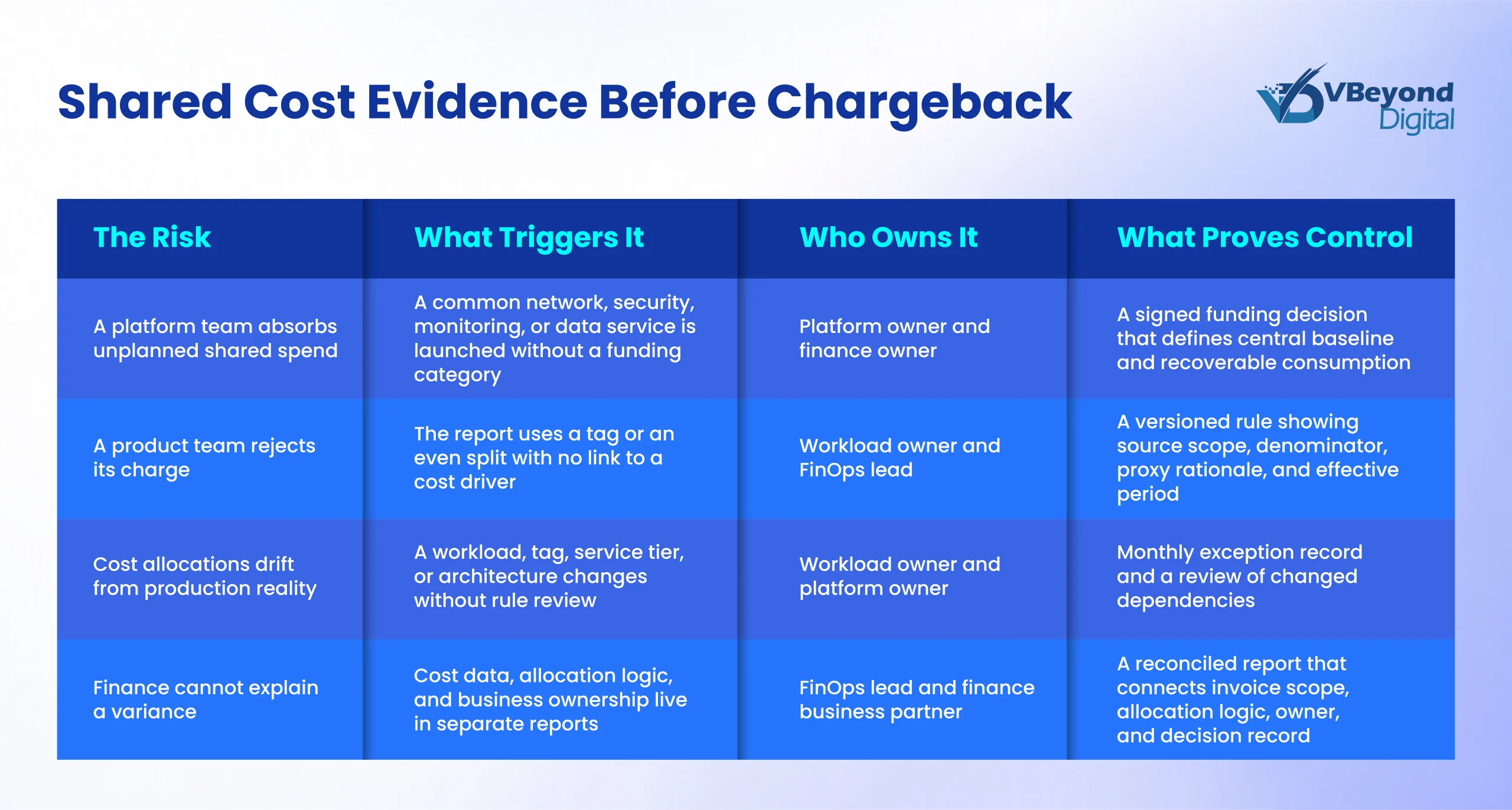
The practical test is whether the allocation report can withstand a review by the business owner who receives it. A team that understands the data and still disagrees with the funding model has a decision to escalate. A team that cannot understand the calculation has been handed a reporting problem, not an accountable cost.
A Monthly Review Keeps Chargeback From Becoming A Quarter-End Argument
No allocation model remains accurate by staying still. Workloads expand, subscriptions move, shared platforms add features, and projects stop using services that their original formula still charges. A year-end redesign is too late for most of those changes because the people who made the architecture and funding decisions may no longer remember why the rule was adopted.
A monthly FinOps review should focus on changes, not merely variance. The agenda should identify new shared services, material consumption shifts, unallocated costs, expired exceptions, missing ownership records, and allocation rules that no longer reflect production behavior. The purpose is to decide what changes before the next bill, rather than to explain why the last bill cannot be changed.
Enterprise teams typically discover that the disputed number is only one visible symptom. The underlying issue is often an unowned platform decision, an unapproved exception, or a product that has grown beyond the capacity assumptions used when the service was funded. The FinOps Foundation’s current shared-cost guidance calls for allocation that connects common infrastructure to the workloads that consume it. A monthly review provides the operating rhythm that keeps that connection current.
For a cloud platform with many cost centers, the review should also distinguish showback from chargeback. Showback can expose a cost and its drivers while the enterprise is still testing whether the allocation basis is fair. Chargeback should follow when the funding decision, source data, and exception route are mature enough to support a financial consequence. Treating the two as the same stage makes a developing allocation model look more certain than it is.
The same review should look beyond a current variance. Azure governance after go-live weakens in exactly this way when policy exceptions, ownership changes, and platform growth remain visible in dashboards but are not brought back into a decision forum. Cost governance needs the same discipline.
A Chargeback Model Is A Record Of Operating Decisions
The report does not need to settle every question in the first month. It needs to make the unsettled questions visible, give them named owners, and keep them from becoming permanent unexplained spend. A shared platform can be a sound economic choice even when its costs cannot be allocated perfectly. The enterprise should be explicit about where it accepts a proxy, where it funds a baseline centrally, and where it expects a workload to own what it consumes.
VBeyond Digital can review Azure cost management across shared-service categories, tagging and metadata, allocation rules, Power BI reporting, exception governance, and the monthly FinOps cadence. The result is a practical control model for turning contested cost reports into decisions that finance, platform, and product teams can use.
The next report will still reflect the choices made before it closed.
FAQs (Frequently Asked Question)
Tags identify resources and can support allocation. They do not decide whether a cost is a centrally funded platform baseline, recoverable workload consumption, or a temporary strategic investment. The dispute persists when the enterprise has not recorded that funding decision and the allocation basis that follows from it.
Costs required for every workload, such as a mandated security control or core connectivity pattern, often belong in a central baseline. The right answer depends on whether a product can meaningfully alter the cost through its own decisions. If a product cannot affect the spend, charging it back may create a number without accountability.
No. Usage is useful only when the selected measure represents the service’s real cost driver. A shared data platform may incur fixed capacity and retention costs that request volume does not explain. A reasonable proxy should be documented with its limitations and reviewed when the service changes.
Showback makes cost and consumption visible to the business without transferring a financial consequence. Chargeback uses an agreed model to assign cost to a budget or cost center. Enterprises often need showback first while they test whether ownership, source data, and allocation rules are credible enough for chargeback.
The approval should bring together the platform owner who understands the service, the finance owner who accepts the funding treatment, the FinOps lead who maintains the allocation logic, and the business owner who will receive the report. One person should own the rule after approval, with a defined route for exceptions and changes.

