


Loading...
Agentic AI forecasts become usable when spend follows a workflow, an owner, and a measurable business outcome.
Section
Table of Contents
- A Price Per Token Cannot Describe An Agentic Workflow
- Model Routing Is An Operating Decision, Not A Technical Convenience
- Finance Needs A Unit Cost That A Product Team Can Affect
- Cost Guardrails Need To Stop The Expensive Path Before It Repeats
- The Cost Record Has To Cross Every Platform Boundary
- The Forecast Starts Where The Workflow Can Still Change
- FAQs (Frequently Asked Question)
Key Takeaways
- Why a per-token rate does not predict the cost of an agentic workflow that retrieves context, invokes tools, retries failures, and changes models.
- How to define an AI unit cost that a product owner can influence through workflow design, model routing, and operational controls.
- Which consumption controls should exist before a production agent can exceed its forecast without a named exception owner.
- How to separate experimentation spend from production spend without hiding the cost of either from finance or engineering.
An agentic AI forecast is already wrong when it begins with a model price.
A model price can describe the cost of an input and an output. It cannot describe the actual work an agent performs to resolve a case, route an exception, prepare a quote, or investigate an operations alert. That work can involve model calls, retrieval, tool execution, retries, evaluation, guardrails, storage, integration traffic, and human review. The unit that finance needs to understand is the workflow, not the individual API request.
This does not make AI cost unknowable. It makes the accounting question more demanding. The FinOps Foundation’s current AI guidance identifies the same difficulty: AI services can introduce different meters, changing service variants, shared environments, and weak allocation paths across multi-agent workloads. A forecast becomes useful when it exposes those drivers rather than hiding them inside a monthly total.
A Price Per Token Cannot Describe An Agentic Workflow
Teams often start with the most available data: model price, tokens consumed, and a monthly budget. Those figures are needed. They fail as a forecast when one customer request can call a router, retrieve documents, invoke two tools, retry an API timeout, request a second model response, and hand an ambiguous result to a human reviewer. The cost sits in the chain of work, and the chain changes as the workflow evolves.
The first question should be: what is the business unit of work? It may be a resolved customer case, a completed document review, a replenishment exception, a developer task, or a risk decision. That unit needs a cost record that joins model use with retrieval, tool calls, retries, human intervention, and supporting cloud services. A cost per 1,000 tokens is still available, but it becomes a component of the unit cost rather than the unit itself.
What appears consistently in production is a gap between an AI platform’s consumption data and the product owner’s operating data. Engineering can see model activity. Finance can see spend. Neither view can explain whether one workflow became more expensive because demand rose, prompts expanded, retrieval was poorly bounded, a model route changed, or a downstream system kept failing and triggering retries. An accountable forecast has to preserve that distinction.
Model Routing Is An Operating Decision, Not A Technical Convenience
The easy answer is to use the cheapest model that still produces an acceptable result. That may reduce an individual request cost while increasing retries, human correction, latency, or risk in the wider workflow. The reverse can also be true: a stronger model may be justified for a narrow decision where a weak result creates expensive downstream work. Model choice therefore belongs in the workload’s operating design, with a stated reason for the cost and performance trade-off.
Microsoft’s June 2026 guidance on models, cost, and quality frames model selection around capability, safety, latency, and cost, and advises teams to validate against their own evaluation data rather than a public benchmark. That is a more useful starting point than a model leaderboard because it turns the selection into a testable workload decision.
The model route should be versioned with the workflow. A simple classifier may use a smaller model. A complex policy review may need a stronger reasoning model with grounded context. A high-volume route may need a cap, a fallback, and an explicit decision about whether it can move to a less expensive path when capacity is constrained. The enterprise has to know who may change that route and who accepts the resulting effect on service, accuracy, and cost.
This is especially important in Azure AI production architecture, where model choice is tied to deployment model, identity, network boundary, capacity, monitoring, and support. A routing rule that lowers the model bill while increasing the operational bill has not reduced the workload cost.
Finance Needs A Unit Cost That A Product Team Can Affect
Finance does not need a perfect AI cost number before it can govern spending. It needs a measure that reveals which decision a product team can change. Cost per completed workflow, cost per eligible case, cost per document reviewed, or cost per approved transaction can serve that purpose when the definition is stable and the inputs are visible.
A common objection is that such measures are too difficult to establish before the technology settles down. A temporary proxy is acceptable when it is labeled as a proxy, given an owner, and reviewed at a stated interval. Misleading precision is worse. Calling total monthly token consumption a product’s unit cost when the same platform is serving several products produces a report that no one can use to make a decision.
Vasilio Markanastasakis of the FinOps Foundation describes the 2026 framework as expanding FinOps scopes from infrastructure views into business decision contexts. In the Framework 2026 update, the foundation also connects workload placement and technology-category decisions to value, performance, and business outcomes before commitments are made. That is the necessary direction for AI cost management: identify the product or workflow decision that drives the spend, then measure its cost alongside the outcome it was approved to improve.
The control record should name the workflow owner, the cost metric, the expected operating range, the model route, the data and tool dependencies, and the action taken when the range is exceeded. Production AI control models already need evaluation and monitoring for output quality. Cost is another production signal, and it needs the same link to a named workload and an accountable response.
Cost Guardrails Need To Stop The Expensive Path Before It Repeats
An alert that arrives after a monthly threshold is crossed tells a team that the cost already happened. It does not control the workflow behavior that produced it. Agentic systems need guardrails closer to execution: a per-workflow spend ceiling, a limit on tool calls or retries, a maximum context size, a model-routing condition, an approval for higher-cost paths, or a safe fallback when an external dependency fails.
The controls should not prevent legitimate work by default. A regulated exception review, a complex engineering task, or a planning process under pressure may require a higher-cost route. The point is to make the exception explicit and to give it an owner. What this looks like in practice is a workflow that can exceed a normal consumption band only when a business or platform owner can see why, decide whether the increased cost is justified, and review whether the condition persists.
Microsoft’s Foundry Models documentation distinguishes between managed-compute and serverless deployment options, including different billing and operational arrangements. Those choices are part of a cost-control decision, alongside regional availability, capacity, data handling, and the model provider’s support path. A guardrail that ignores the deployment design will find the cost later than the architecture created it.
The Cost Record Has To Cross Every Platform Boundary
Agentic AI rarely lives in one bill. A workflow can use Azure inference, a SaaS agent, an Oracle application, a retrieval service, a data platform, and a tool endpoint with its own pricing. A dashboard that shows each supplier total may be accurate and still leave the enterprise unable to forecast the cost of the business process that crosses them.
The cost record needs a common workload identifier and owner across those boundaries. It should allow finance to see the total operating cost of the workflow while preserving the individual drivers that engineering can change. The number will sometimes remain estimated, particularly where a shared service or a SaaS product does not expose enough telemetry. The estimate should be visible and should not be passed off as direct attribution.
This is where Azure cost accountability and AI cost management meet. Budgets and dashboards can reveal an aggregate variance. A forecast needs to explain which agent, model route, tool dependency, or workload change produced it, and which owner can alter the next run.
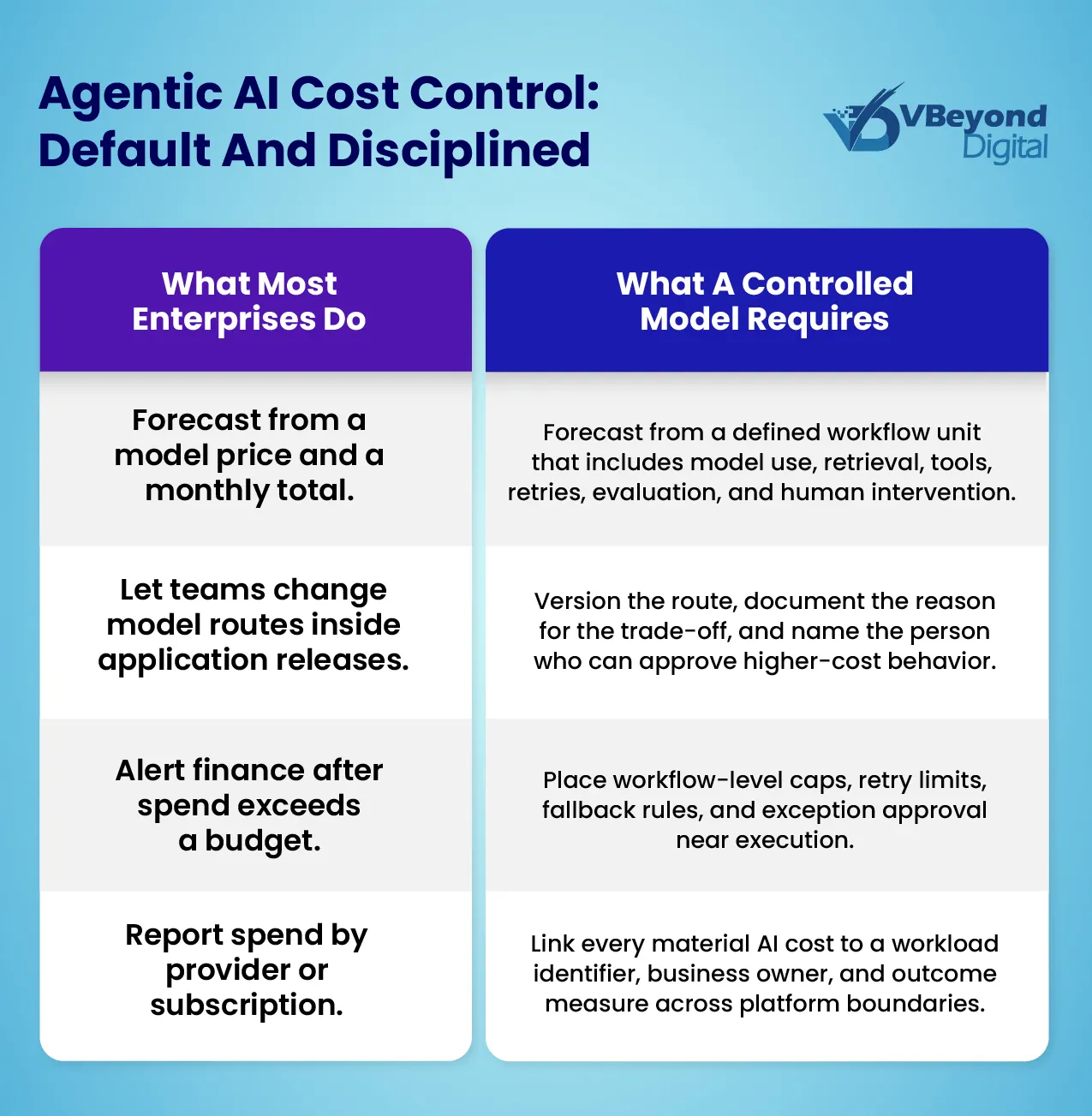
The difference is not a better dashboard. It is whether the enterprise can act on the cost signal before the workflow repeats the same expensive behavior.
The Forecast Starts Where The Workflow Can Still Change
Cloud cost management for agentic AI will remain approximate in places. Model providers change, work patterns shift, and a new tool or retrieval path can alter the economics of a workflow quickly. That is a reason to keep forecasts close to operations, not a reason to wait for a perfect number.
VBeyond Digital can assess AI cost controls across model routing, unit-cost measures, workload ownership, consumption guardrails, cross-platform attribution, and FinOps reporting. The review identifies where an agentic workflow has spend without a controllable owner or an outcome measure.
If the enterprise cannot tie its next AI cost forecast to a named workflow and a decision that can still change, the work starts there.
Turn Azure Chargeback Disputes Into Clear Cost Decisions
FAQs (Frequently Asked Question)
Tokens are a component of cost, not the full workload. An agent can retrieve documents, call tools, retry failures, use multiple models, invoke guardrails, and require human review. Forecasting only from token price leaves those drivers outside the operating model.
The measure should match the business work the agent is approved to perform, such as a resolved case, a processed document, a planning exception, or a completed review. It should include the components that materially drive the workflow cost and identify any estimate or proxy clearly.
The product or business owner should own the workflow outcome and the decision to operate it. The AI platform owner should own the route, deployment conditions, and operational telemetry. FinOps and finance should define the cost treatment and review the forecast with those owners. No single group can answer every part of the question alone.
Set normal consumption ranges by workflow, apply limits on retries, tool calls, context size, and higher-cost model routes, then define an exception path for work that genuinely needs more capacity. The exception should be visible to a named owner rather than silently absorbed into a monthly budget variance.
Yes, when the enterprise uses a common workload identifier, ownership record, and unit-cost measure across its providers and applications. The data may have different quality across services, so reports should distinguish direct attribution from allocated or estimated cost.

