


Loading...
Section
Table of Contents
- Introduction: Reporting Failure Is a Business Control Issue, Not Just an IT Ticket
- Why Oracle Fusion Reporting Breaks When Demand Scales
- What Breaks After Go-Live: Visibility, Consistency, and Risk
- The Missing Layer: Governed Data Architecture Beyond ERP
- Conclusion: The Fix Is Architectural Discipline, Not More Reports
- FAQs (Frequently Asked Question)
Key Takeaways
- Oracle Fusion Reporting fails when operational reporting tools are stretched into enterprise analytics and high-volume extraction use cases.
- This blog covers how Oracle Fusion ERP reporting and Oracle Fusion BI reporting support operational needs but struggle with enterprise analytics.
- It defines the role of Oracle data architecture, semantic models, governed pipelines, and Oracle Fusion Data Intelligence in scalable reporting.
- It also discusses how Microsoft Fabric Oracle mirroring can support analytics by replicating supported Oracle database sources into OneLake.
Introduction: Reporting Failure Is a Business Control Issue, Not Just an IT Ticket
Oracle Fusion Reporting issues after go-live rarely stay inside IT. A slow OTBI analysis can delay a finance review. A BI Publisher extract can become the source for downstream reconciliations. A duplicated metric definition can put procurement, operations, and finance in separate conversations about the same number. For CIOs, CTOs, IT Directors, Product Heads, and digital program leaders, the impact is measurable: longer reporting cycles, weaker data visibility, more manual correction, and greater control risk.
The root cause is usually not one weak report. It is a design mismatch. Oracle Fusion ERP reporting and Oracle Fusion BI reporting are valuable for operational, formatted, and statutory reporting, but they are not a replacement for Oracle data architecture built for enterprise analytics. Oracle’s own reporting guidance separates embedded Fusion reporting from Oracle Fusion Data Intelligence, positioning embedded reporting for operational needs and Oracle Fusion Data Intelligence for curated, replicated, cross-application analytics.
That distinction matters after go-live. Business teams begin asking for margin by product, supplier risk by region, cash exposure by entity, headcount cost by project, and order status across functions. These questions need governed data pipelines, consistent KPI definitions, controlled access rules, and a semantic layer that can support Oracle fusion reports and analytics at scale.
Why Oracle Fusion Reporting Breaks When Demand Scales
Oracle Fusion Reporting starts to break when organizations ask operational reporting tools to perform the role of an enterprise analytics layer. This usually happens after go-live, when reporting demand moves beyond transaction checks and statutory outputs. Finance wants margin analysis across entities. Procurement wants supplier risk by region and contract type. Operations wants order, inventory, and fulfillment signals in one view. Leadership wants one version of revenue, cost, cash, and working capital.
These needs are valid, but they require Oracle data architecture that separates operational workloads from analytical workloads. Oracle Fusion ERP reporting and Oracle Fusion BI reporting are designed for specific reporting needs inside the application. They are not meant to become the main extraction method, integration layer, data warehouse, and KPI governance model at the same time.
A practical distinction is important:
- OTBI supports real-time operational analysis, often tied to subject areas and transactional questions.
- BI Publisher supports formatted, pixel-perfect, scheduled, and statutory reporting.
- Oracle Fusion Data Intelligence supports curated analytics by extracting and loading Fusion Cloud Applications data into an analytical store for dashboards and business analysis. Oracle documentation states that Oracle Fusion Data Intelligence extracts and loads data from Fusion Cloud Applications into an analytical platform, with dashboards created in Oracle Analytics Cloud.
- Oracle fusion analytics warehouse patterns support decision reporting when data needs to be modeled, refreshed, governed, and combined with non-ERP sources.
The breakdown begins when these roles are mixed. For example, teams may use Oracle Fusion BI reporting to generate recurring data extracts, then load those extracts into spreadsheets, Power BI models, or departmental databases. Over time, report logic becomes duplicated across functions. One team calculates booked revenue from one subject area. Another calculates revenue from a BI Publisher extract. A third adjusts the number manually during month-end review. The business then spends time reconciling reports instead of acting on decisions.
Oracle’s 2026 A-Team guidance is direct on this point. It lists OTBI as low-volume and user-interaction oriented, and states that OTBI is not recommended for data extraction. The same guidance positions BICC for high-volume bulk extraction and incremental extracts, while REST and SOAP services are intended for real-time integrations and not recommended for data extract.
There are also technical limits that make scaling difficult. Oracle documentation lists OTBI analysis and export limits, including a 65,000-row limit for certain exports and 25,000 rows for Excel exports. These controls exist to prevent long-running queries and protect application performance. BI Publisher also has memory, data-size, row-output, and SQL timeout settings. Oracle notes that raising BI Publisher settings beyond recommended values can degrade services and create reporting issues.
What Breaks After Go-Live: Visibility, Consistency, and Risk
After go-live, Oracle Fusion Reporting pressure usually increases faster than the reporting architecture can support. During implementation, teams often focus on process readiness, data migration, security roles, cutover, and user acceptance testing. Reporting receives attention, but many reporting needs are still limited to must-have outputs. After production use begins, the business starts asking harder questions that cut across finance, procurement, supply chain, HR, and operations.
This is where Oracle Fusion reporting issues become visible. The issue is not only report speed. The deeper problem is fragmented visibility.
Common failure patterns include:
- Conflicting KPI definitions: Finance, procurement, and operations may define “open liability,” “committed spend,” “available inventory,” or “recognized revenue” differently.
- Manual reconciliation: Business teams export Oracle Fusion ERP reporting outputs into spreadsheets to adjust, join, or compare numbers.
- Duplicated report logic: The same metric is rebuilt across OTBI, BI Publisher, Power BI, and departmental files.
- Delayed decisions: Leaders wait for IT to rebuild datasets or confirm which number is correct.
- Control exposure: When reporting logic sits inside many files and custom reports, lineage and access rules become difficult to prove.
A practical example is supplier performance reporting. Oracle Fusion may contain purchase orders, receipts, invoices, and payment status. But a business-ready supplier view may also need contract terms, logistics data, quality events, supplier risk scores, and payment behavior. If Oracle Fusion BI reporting is treated as the only analytics source, teams may not get a complete view of supplier delay, working capital impact, or invoice exception cost.
This is why Oracle data architecture becomes important after go-live. Oracle Fusion Data Intelligence is built for analytical reporting by extracting and loading Fusion Cloud Applications data into an analytical platform where users can create dashboards in Oracle Analytics Cloud. Oracle documentation also states that Oracle Fusion Data Intelligence spans data pipelining, data warehousing, semantic models, and curated content such as prebuilt metrics, dashboards, and analyses.
For CIOs and IT Directors, the business risk is clear: without a governed Oracle data architecture, Oracle fusion reports and analytics become dependent on scattered extracts and local interpretation. A monthly performance pack may contain correct numbers from individual teams, but still fail as an enterprise view because definitions, refresh timing, and security context do not match.
A scalable reporting model must answer four control questions:
- Where did the data come from?
- When was it refreshed?
- Who owns the metric definition?
- Which users are allowed to see which level of detail?
Oracle fusion analytics warehouse patterns address these questions by creating a controlled analytical layer between Fusion transactions and business-facing reporting. This does not remove the value of Oracle Fusion Reporting. It gives each layer a specific role. Fusion remains the transaction core. Oracle Fusion ERP reporting supports operational and statutory needs. Oracle Fusion Data Intelligence or another approved analytical platform supports governed cross-functional decision reporting.
The Missing Layer: Governed Data Architecture Beyond ERP
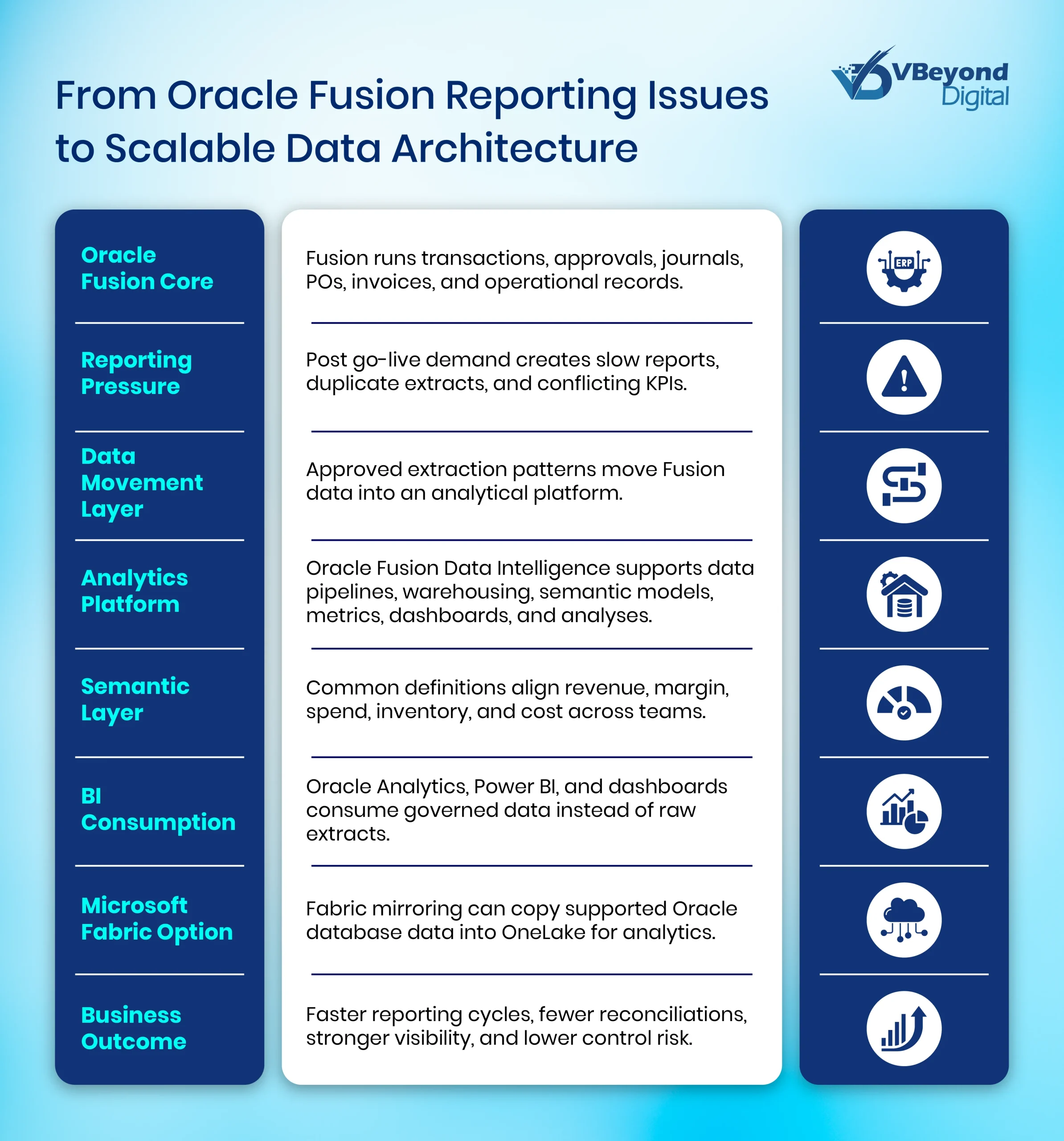
A scalable model for Oracle Fusion Reporting starts with a clear separation of duties. Oracle Fusion should remain the transaction core. It should process journals, purchase orders, invoices, receipts, projects, workforce records, and operational approvals with accuracy and control. Enterprise analytics should sit outside that transaction workload, supported by Oracle data architecture that is built for data movement, modeling, refresh control, security, and business-facing reporting.
The target model should assign a specific role to each layer:
- Oracle Fusion as the system of record: Keep business transactions, approvals, and source data integrity inside Fusion.
- Approved extraction and replication layer: Use Oracle-supported extraction methods such as BICC, APIs, or Oracle Fusion Data Intelligence pipelines based on volume, latency, and use case.
- Analytical platform: Place curated data in Oracle Fusion Data Intelligence, Oracle Fusion Analytics Warehouse, Azure, Microsoft Fabric, or another approved enterprise analytics platform.
- Data quality and conformance layer: Align entities, hierarchies, time periods, currencies, cost centers, suppliers, products, and customer records.
- Semantic layer: Define metrics once, including revenue, margin, committed spend, inventory value, project cost, and working capital.
- BI consumption layer: Serve Oracle Fusion BI reporting, Oracle Analytics, Power BI, executive dashboards, and operational scorecards from governed data models.
Oracle Fusion Data Intelligence supports this pattern because it extracts and loads data from Oracle Fusion Cloud Applications into Oracle Autonomous AI Lakehouse, with dashboards created and customized in Oracle Analytics Cloud. Oracle describes it as a packaged analytics service with prebuilt metrics, dashboards, data pipelines, and an extensible model for Fusion application data.
The semantic layer is the control point most teams miss. Without it, every report becomes a separate interpretation of the business. With it, Oracle fusion reports and analytics can use common definitions across functions. Oracle documentation also states that Oracle Fusion Data Intelligence semantic models can be customized to support business requirements, with security configurations for subject areas and data access. Direct production changes are restricted, and changes are managed through development or test environments before movement to production.
For organizations standardizing analytics on Microsoft platforms, Microsoft Fabric Oracle mirroring can also be part of the broader Oracle data architecture discussion. Microsoft states that Fabric mirroring for Oracle creates a read-only copy of Oracle data in OneLake that updates in near real time, with prerequisites such as LogMiner, archive log mode, supplemental logging, and an On-Premises Data Gateway. Microsoft also lists current scale and schema limits, including support for up to 1000 mirrored tables and partial support for column changes, which means architecture teams must validate fit before using it for production reporting patterns.
Build Oracle Reporting That Scales.
Conclusion: The Fix Is Architectural Discipline, Not More Reports
Oracle Fusion Reporting should not be assessed only by how many reports are delivered after go-live. The better measure is whether leaders can trust the numbers, trace the source, understand refresh timing, and act without manual reconciliation. When Oracle Fusion reporting issues appear as slow dashboards, inconsistent KPIs, or repeated extract failures, the correct response is not to keep adding reports. The correct response is to review the Oracle data architecture behind them.
VBeyond Digital helps enterprises move from reactive report fixing to governed reporting architecture. We bring clarity and velocity to digital initiatives by aligning Oracle Fusion Reporting, Oracle data architecture, BI consumption, and business control requirements.
FAQs (Frequently Asked Question)
Oracle Fusion Reporting fails at scale when transactional reporting tools are used for enterprise analytics, high-volume extracts, historical analysis, and cross-functional KPIs. The issue is usually missing Oracle data architecture, not only report design.
Oracle Fusion BI reporting and Oracle Fusion ERP reporting are valuable for operational and formatted reports, but they are not suited for all extraction, semantic governance, multi-source analytics, or enterprise data modeling needs. Oracle guidance positions Fusion Data Intelligence for curated analytics.
The best model separates Fusion transactions from analytics. Oracle Fusion Reporting should connect to approved extraction methods, curated data storage, governed semantic models, and BI tools. Oracle Fusion Data Intelligence or an Oracle fusion analytics warehouse pattern can support this model.
A semantic layer defines KPIs, hierarchies, dimensions, access rules, and business logic once. This reduces conflicting numbers across Oracle fusion reports and analytics, improves auditability, and gives leaders consistent definitions for revenue, margin, spend, inventory, and cost.
Microsoft Fabric Oracle mirroring can help when supported Oracle database sources need replication into OneLake for analytical consumption. It is not a direct replacement for Fusion SaaS extraction, so teams should validate source type, latency, permissions, and scale limits first.

