


Loading...
AI-assisted supply-chain work needs decision evidence and named owners before recommendations become operational action.
Section
Table of Contents
- An AI Recommendation Becomes A Control Event Before It Becomes A Transaction
- Approval Thresholds Have To Follow Decision Consequence
- An Agent Cannot Be Audited From Its Output Alone
- Integration Boundaries Turn Local Agents Into Shared Operational Risk
- Control Ownership Has To Survive The Hand-off To Operations
- The Supply-Chain Decision Needs Its Evidence Where It Was Made
- FAQs (Frequently Asked Question)
Key Takeaways
- How to decide which Oracle Fusion SCM AI recommendations require approval, which can proceed within a tolerance, and who should own that decision.
- Why a saved recommendation is not enough as audit evidence when inputs, rules, integrations, and approval paths can change separately.
- What to include in an evidence pack that lets a supply-chain team reconstruct a decision after a stockout, supplier issue, or production delay.
- How to move agentic supply-chain work into production without handing control ownership to the team that happens to configure the feature.
A supply-chain recommendation can leave a purchase order, inventory balance, and production schedule untouched. It can still change the evidence required to approve the next decision.
That is easy to miss when AI enters an established workflow as an assistant, an exception finder, or a suggested action. The visible transaction may remain with a planner, buyer, or production lead. Yet the recommendation may have shaped the options considered, the priority assigned to a shortage, or the supplier path that reached approval. The control question begins before the system writes back to Oracle Fusion.
Oracle’s recent supply-chain agentic-applications announcement places inventory planning, supplier qualification, production readiness, and Kanban workspaces closer to everyday operational decisions. The sensible response is not to put every recommendation through a council. It is to decide, in advance, which recommendations can stay within a defined operating tolerance and which require human judgment, recorded evidence, or an escalation.
An AI Recommendation Becomes A Control Event Before It Becomes A Transaction
The common objection is that a recommendation has no control consequence until someone acts on it. That view is too narrow for decisions that influence inventory placement, supplier eligibility, production readiness, or replenishment. A planner who accepts a recommendation is still making a business decision, but the enterprise needs to know what the system presented, which data and rule set shaped it, and whether the planner was permitted to accept it without a higher review.
Control design should start with the decision type rather than the feature name. A recommendation to sort an existing work queue may need only an owner and monitoring. A recommendation that changes a supplier qualification status, adjusts a safety-stock position, or advances a production exception carries a different consequence. The record should capture the proposed action, the decision context, the approval threshold, the named decision owner, and the route for an override.
What this looks like in practice is a gap between an agent’s visible suggestion and the business process that absorbs it. Teams often know which page displayed the recommendation. They cannot show whether the recommendation was advisory, whether it crossed a financial or service-level threshold, or who had authority to accept an exception. Those missing answers become costly when a later review asks whether the system assisted a decision or quietly changed its control path.
The post-go-live Oracle Fusion control work is relevant here because approvals, integrations, reporting, and operating ownership already have to survive a live application. AI assistance adds another record that needs to join that chain.
Approval Thresholds Have To Follow Decision Consequence
One approval path for every AI recommendation would slow supply-chain work until users looked for ways around it. The opposite approach, where every recommendation is treated as routine because it stops short of a transaction, creates an unrecorded change in decision rights. The better control is proportional: it follows the consequence of accepting, declining, or ignoring the recommendation.
For inventory decisions, the threshold may be a deviation from a planning tolerance, a service-level exposure, or a value limit. For supplier qualification, it may involve data quality, compliance status, or a risk condition that procurement cannot waive alone. For production readiness, it may be the difference between an internal scheduling adjustment and a decision that risks a customer commitment. These are business thresholds, not model settings, and each one needs a business owner who can explain why it was set.
Daniel Bachar, Senior Director of SCM Product Strategy and Marketing at Oracle, describes current Fusion SCM work as bringing information, recommendations, and actions together in the same experience in his July 2026 SCM release overview. That combination makes approval design more important, not less. When the recommendation and the action sit near each other, the process has to make the moment of human judgment visible.
The recurring problem is an approval rule that exists in a procedure document but is absent from the live workflow. The practical answer is to map each risk tier to a concrete system behavior: no review required within a stated tolerance; named approver required above it; and automatic escalation when the recommendation touches a controlled supplier, a safety boundary, a customer commitment, or a regulatory condition.
An Agent Cannot Be Audited From Its Output Alone
Saving the final recommendation is better than saving nothing. It still leaves an incomplete record. A later reviewer may need to know which inventory or supplier inputs were available, which integration response arrived, whether a prompt or configuration had changed, what policy or approval rule applied, and whether a planner overrode the proposed action.
An audit trail therefore needs to connect a result to its operating context. The evidence pack should carry the recommendation, relevant input snapshot or reference, agent and integration version, any tool calls that affected the result, the approval or override, and the subsequent transaction where one occurred. The exact artifacts will vary with the workflow, but the enterprise should be able to reconstruct the decision path without asking individual users to remember it weeks later.
Niall Commiskey, Senior Director of Product Management for Oracle Integration, describes Human in the Loop controls in the 26.07 update as deliberate oversight at decision points where the cost of an error exceeds the cost of human intervention. The release also covers approval branching, notifications, activity-stream audit views, and long-term log persistence. Those functions are useful only when the process owner has already stated what must be reviewed and what the retained record must prove.
The same discipline should reach analytics. A stockout analysis or supplier-performance report can fail at scale when it cannot align the operational decision, its source data, and the downstream metric. The underlying Oracle Fusion reporting architecture matters because a decision record that cannot be reconciled with Power BI reporting governance leaves supply-chain, finance, and audit teams working from different versions of the event.
Integration Boundaries Turn Local Agents Into Shared Operational Risk
An agent can appear to be a local Fusion feature while depending on a much wider chain of systems. It may draw from a data platform, call an integration, reach a supplier service, trigger a notification, or rely on an identity and policy outside the SCM application. A recommendation can be correct in the local screen and still be based on delayed, incomplete, or unauthorized context from one of those dependencies.
This is where implementation teams often over-focus on the agent configuration. The question that matters in production is whether the wider path has a named owner and a testable failure response. If an upstream feed is stale, should the agent pause, flag the recommendation, or continue with a visible warning? If an approval callback fails, who owns the recovery? If a new integration version changes the data shape, who retests the recommendation before the next planning cycle?
Oracle’s June 2026 integration update lists agent activity streams, asynchronous callback support, rollback, credential rotation, and deployment controls in the surrounding integration environment. Those are components, not an operating model. Their value depends on a release path that joins change approval, test evidence, dependency review, and a named incident route.
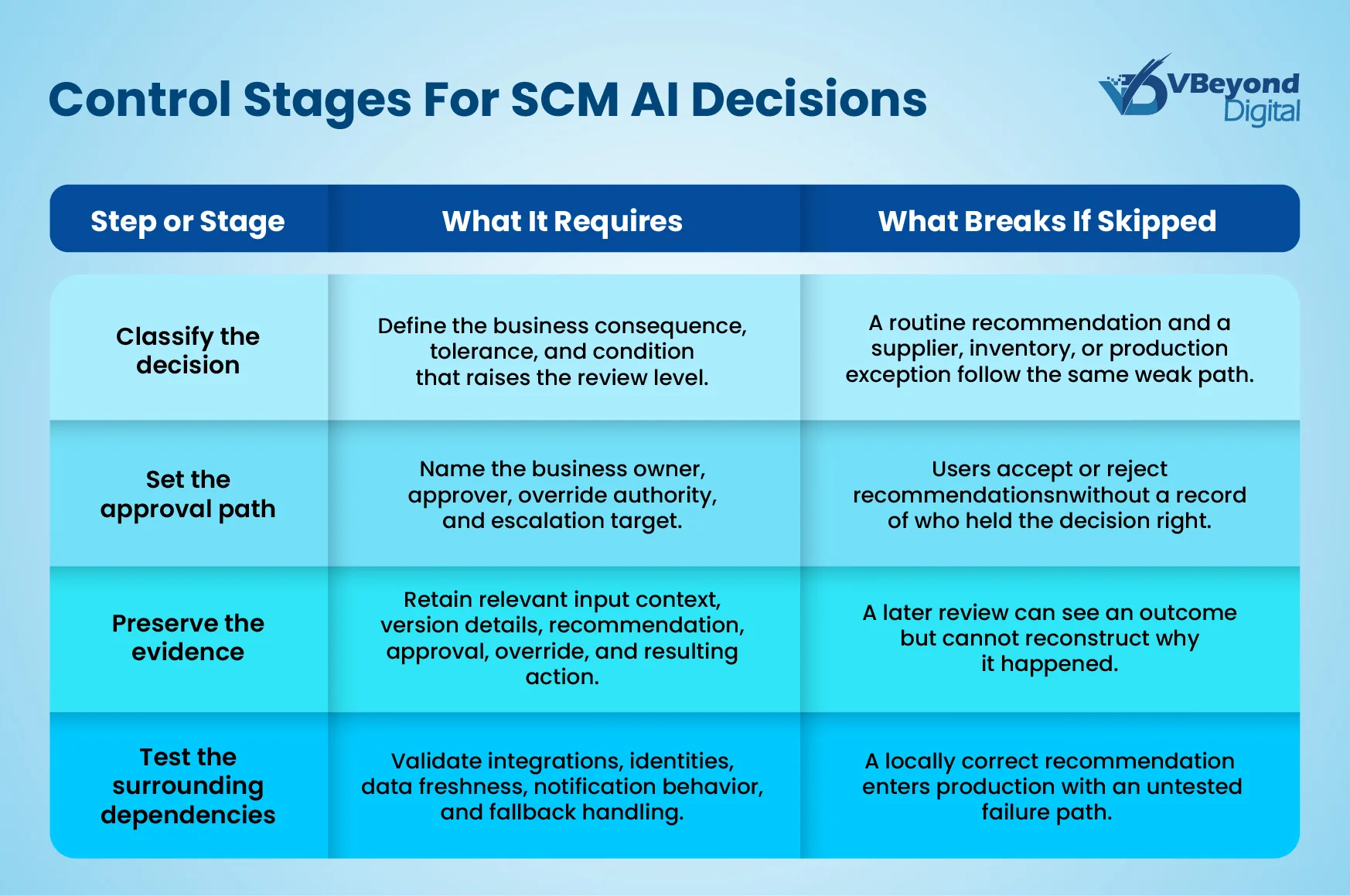
The sequence matters because later controls cannot repair a missing earlier decision. A thorough log cannot establish a threshold that was never approved, and an escalation process cannot restore a dependency check that was skipped before release.
Control Ownership Has To Survive The Hand-off To Operations
Project governance often ends at go-live just as operational ownership becomes more difficult. The supply-chain team owns the business consequence. The application team owns configuration and release coordination. Data, integration, security, and risk owners hold separate responsibilities. None of those roles should have to infer its authority during an exception that crosses planning, procurement, and manufacturing.
The ownership model should name one accountable business owner for each agentic use case; a technical owner for the deployed configuration and dependencies; and specific control owners for data, identity, integration, and compliance conditions. The operational runbook should also name who can pause the agent, who communicates an exception, and who decides whether an override is temporary or changes the rule for future decisions.
Some leaders will argue that this division is excessive for early adoption. It may be excessive for a read-only insight that cannot affect a workflow. It is reasonable for recommendations that direct scarce inventory, influence supplier approval, or alter production priorities. The control burden should grow with the business consequence, and it should be revisited as the agent gains new data, tools, or authority.
The Supply-Chain Decision Needs Its Evidence Where It Was Made
Oracle Fusion SCM can bring recommendations nearer to the work that needs them. That proximity can help a planner surface a shortage earlier or help procurement focus attention where it is needed. The enterprise still has to decide what a recommendation may influence, who can accept it, and which record will explain the result after the operational context has moved on.
VBeyond Digital can assess Oracle Fusion SCM AI controls across approval thresholds, exception ownership, integration readiness, decision evidence, reporting continuity, and production support. The review identifies the use cases where the existing process no longer proves the control that the business expects.
Before the next production release, test the decision record with the workflow.
Turn Azure Chargeback Disputes Into Clear Cost Decisions
FAQs (Frequently Asked Question)
No. Review should be proportional to the consequence of the recommendation. A low-consequence suggestion can remain within a defined tolerance with monitoring. Recommendations that affect supplier status, inventory policy, production readiness, customer commitments, or controlled data need a named decision right and a record of the approval or override.
The evidence should link the recommendation to its relevant input context, agent and integration version, applicable rule or policy, decision owner, approval or override, and the operational action that followed. The record has to make a later reconstruction possible without relying on personal memory.
The business owner remains accountable for the use case and operational consequence. An application or platform owner should own deployed configuration, release coordination, and support routing. Data, integration, security, and compliance owners retain responsibility for their respective conditions. A runbook should state how these roles work together when an exception occurs.
They can provide a place for review and approval, but they do not decide where review is needed or what evidence must be retained. The business process must define thresholds, decision rights, escalation conditions, and the effect of an override before the workflow can enforce them.
Test the recommendation against representative operational scenarios, including stale or missing data, integration failure, an approval timeout, an override, and a downstream reporting check. The team should be able to show who receives each exception, what action is expected, and how the decision remains traceable after the event.

