


Loading...
AI-assisted finance work changes the control environment when approvals, exceptions, access, and audit evidence are not governed as operating decisions.
Section
Table of Contents
- AI Changes the Control Environment Before It Changes the Ledger
- Approval Evidence Weakens When RecommendAations Replace Context
- Exceptions Need Owners When AI Changes the Queue
- Access Governance Must Cover AI-Assisted Workflows
- Auditability Requires the Prompt, Context, Action, And Reviewer
- A Production Control Model Starts Before the Next AI Rollout
- Finance Control Maturity Has to Catch Up with AI Speed
- FAQs (Frequently Asked Question)
Key Takeaways
- Why Oracle Fusion ERP AI should be evaluated as a finance-control environment change, not only an efficiency layer.
- How to identify where AI-assisted finance work can blur approval evidence, exception ownership, access responsibility, reconciliation review, and audit traceability.
- What evidence finance and audit leaders should expect when AI influences approvals, risk monitoring, exception routing, or close-period analysis.
- How to decide whether existing Oracle Fusion ERP governance is mature enough for AI-assisted finance workflows after go-live.
Oracle Fusion ERP AI can make finance work faster. Finance controls often depend on slowing work down long enough to prove what happened.
Both statements can be true. The first is the operating promise behind AI-assisted finance: faster analysis, faster exceptions, faster recommendations, faster monitoring, and fewer manual steps. The second is the reason finance processes are controlled in the first place. Close discipline, segregation of duties, approval evidence, reconciliations, access reviews, and audit trails all require a record that someone can inspect later.
The control question is not whether Oracle Fusion ERP AI is useful. The sharper question is whether the enterprise has decided how AI-assisted actions will be reviewed, evidenced, reconciled, and owned when they touch finance processes that auditors and executives expect to remain explainable.
AI Changes the Control Environment Before It Changes the Ledger
A reasonable objection is that AI assistance does not necessarily post a journal entry, approve a payment, or override a control. That objection matters. It prevents the conversation from turning into a false claim that AI use automatically weakens Oracle Fusion ERP controls.
The control environment changes earlier than that. It changes when AI contributes to how work is prioritized, what exception is surfaced, what explanation is suggested, what control signal is reviewed, what action a finance user takes next, and what evidence is retained about that sequence. Even if the human remains the approver, the process has changed if the human is now responding to AI-assisted guidance.
Oracle’s current ERP positioning places AI agents and AI-assisted finance work close to enterprise finance operations. Oracle’s finance AI agent announcement describes AI agents for finance leaders in areas such as insights and efficiency, while Oracle’s Fusion AI ERP documentation lists AI features for Enterprise Resource Planning. The point for finance leaders is practical: once AI becomes part of the work path, control design needs to catch up.
The pattern in Oracle Fusion post-go-live environments is that process ownership is usually clearer than evidence ownership. Finance knows who owns the close. ERP teams know who owns configuration. Internal audit knows what evidence it expects. The gap appears when an AI-assisted workflow changes how a user arrived at an action, but no one has defined what evidence must exist to explain that action later.
That is where an Oracle Fusion ERP control review should begin. The review should not ask whether AI is good or bad. It should ask which finance decisions now receive AI assistance, which controls those decisions touch, and what evidence the enterprise would need if an auditor questioned the path.
Approval Evidence Weakens When RecommendAations Replace Context
Approval workflows can look intact while the evidence behind the approval becomes thinner.
The formal approval may still come from the right person. The workflow may still route through Oracle Fusion ERP. The segregation-of-duties rule may still exist. The problem appears when the approval record shows the final action, but not the AI-assisted recommendation, exception signal, or contextual prompt that influenced the review.
This is not a product-defect argument. It is an operating-model argument. A finance approver using AI-assisted information still owns the approval, but the enterprise must decide whether the evidence package should capture the recommendation context, the source data used, the exception reason, the human decision, and any override or acceptance. If that evidence is absent, internal audit is left reviewing the approval outcome without seeing the decision context that shaped it.
Oracle’s AI Agent Studio materials show the direction of travel for configurable AI agents inside Fusion Cloud Applications. Oracle’s AI Agent Studio release guidance describes AI Agent Studio as part of Fusion Cloud Applications, and Oracle’s AI agents readiness guidance places AI agents inside application workflows. For finance leaders, this makes evidence design a live governance issue.
The recurring gap is that approval matrices are reviewed more often than approval evidence. Finance teams may confirm that the correct person approved the item, but not whether the evidence retained explains why the item was approved, what AI-assisted context influenced the decision, and whether that context should be available during audit review.
Close Oracle Fusion AI Control Gaps Before Finance Scales
Exceptions Need Owners When AI Changes the Queue
Exception handling is where AI-assisted finance work can create ambiguity without ever making the final decision.
Finance exceptions are rarely neutral. An exception can affect a reconciliation, supplier payment, revenue review, expense approval, close adjustment, or control investigation. If AI helps surface, classify, prioritize, summarize, or route that exception, the enterprise needs to know who owns the review standard and who owns the evidence trail.
Oracle Risk Management and Compliance gives enterprises a formal control and monitoring context. The documentation shows Oracle’s risk and compliance product area, while Oracle’s Advanced Controls documentation supports control monitoring and analysis in the risk-management environment. The operating issue is not whether control tooling exists. It is whether finance, ERP, risk, and audit teams agree how AI-assisted exception signals enter that control environment.
In most finance operations, exception ownership is already distributed. Finance owns business impact. ERP owners understand configuration and workflow behavior. Risk teams understand control design. Internal audit tests evidence. IT and security may own identity and access. AI assistance adds a layer of influence across those teams, and the ownership model must name who can accept, reject, escalate, or remediate the exception pattern.
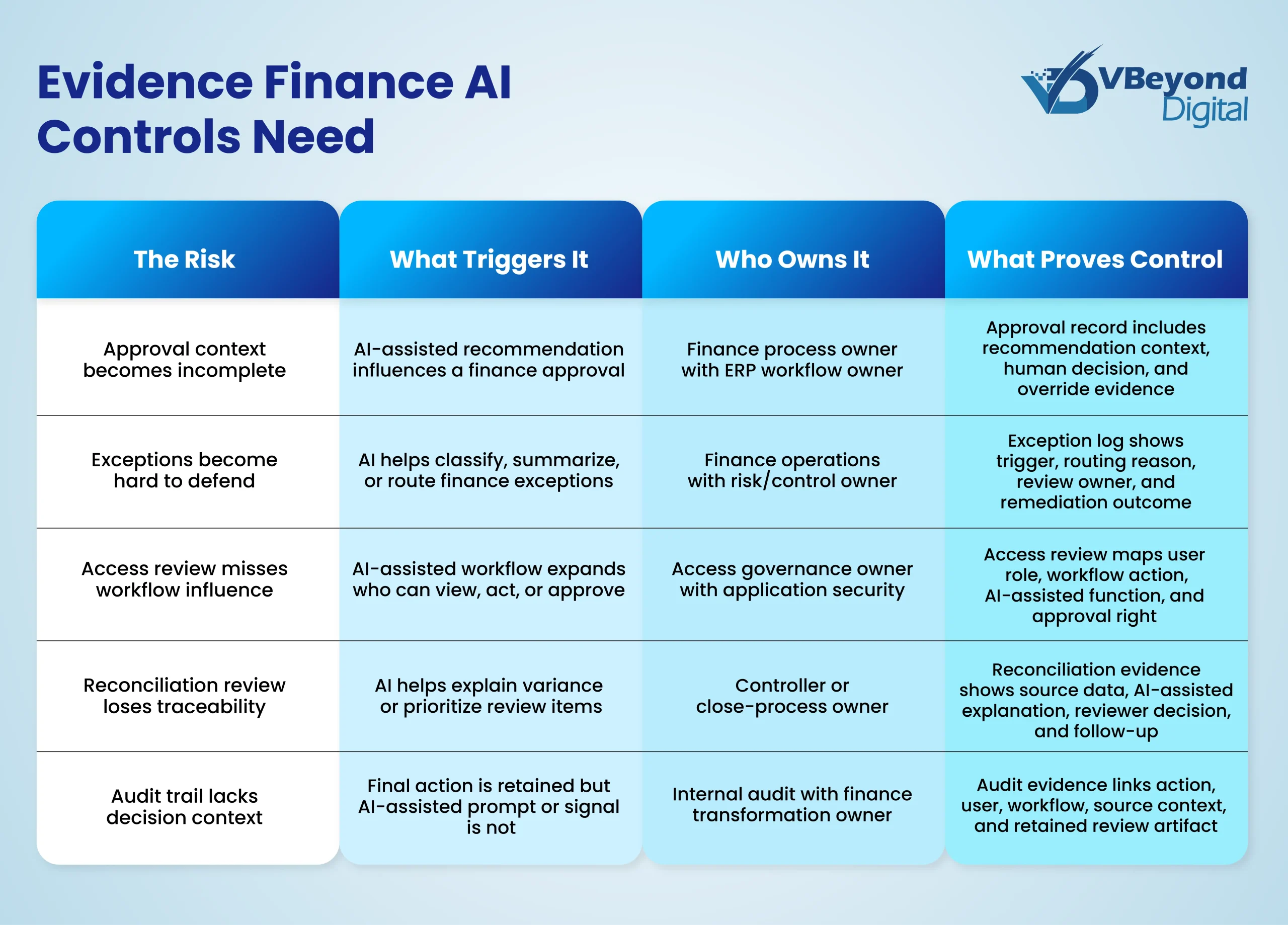
The table forces the right sequence. The risk should be named before the control is redesigned. The trigger should be separated from the final action. The owner should be a person or function with decision authority, not a system name. The evidence should prove the control operated, not simply show that a workflow completed.
Access Governance Must Cover AI-Assisted Workflows
Access governance becomes harder when finance users do more than open records and complete predefined tasks.
AI-assisted workflows can change what access means. A user may not receive a new finance role but may receive a new form of assistance that helps interpret exceptions, summarize account activity, or guide workflow decisions. If access reviews only confirm legacy role assignments, they may miss the new operational influence created by AI-assisted features.
The control question is straightforward. Which users can invoke AI-assisted capabilities? Which workflows can those capabilities affect? Which sensitive data can the user see through the assisted experience? Which approval or exception process might be influenced? Which access review will detect whether that combination is still appropriate?
Oracle’s Fusion Cloud Applications documentation shows the breadth of SaaS application areas enterprises must govern together. Oracle Cloud SaaS documentation spans finance and adjacent operational modules, which matters because finance controls often depend on data and workflows outside the finance team alone. Access governance cannot stay limited to a narrow finance-role review if AI-assisted work crosses procurement, projects, expenses, risk, and reporting paths.
The pattern in access reviews is that role design receives more attention, while workflow influence receives less. A user may have the right formal role and still have too much practical influence if AI-assisted workflows help them act across exception categories, close activities, or reporting views that were never evaluated together.
Auditability Requires the Prompt, Context, Action, And Reviewer
Auditability fails when the enterprise can prove the final transaction but cannot reconstruct the decision environment around it.
This is where AI-assisted finance differs from many earlier automation discussions. Traditional workflow evidence often focuses on who approved, when they approved, what rule routed the task, and what record changed. AI-assisted work may require more context: what prompt, summary, recommendation, model-assisted output, source data, or exception signal influenced the human decision?
The answer will not be the same for every finance workflow. Some AI-assisted actions may remain advisory and low risk. Others may touch close adjustments, supplier exceptions, account reconciliations, user access, or compliance monitoring. The evidence requirement should follow the risk of the workflow, not the novelty of the AI feature.
Oracle’s Fusion AI getting-started documentation frames AI for Fusion Applications as a layer across application experiences. Oracle AI for Fusion Applications documentation gives the enterprise a useful starting point for understanding the scope of AI-assisted application work. For audit leaders, scope is only the beginning. The control model must decide what evidence is retained for each workflow category.
This is where Oracle Fusion reporting governance matters. Finance reporting, reconciliations, and exception review often depend on downstream data paths and retained context. If reporting only shows the final state, it may not support the control question that audit is asking.
A Production Control Model Starts Before the Next AI Rollout
Finance leaders do not need to block AI-assisted ERP work to protect controls. They need to classify the control impact before adoption spreads.
The practical model starts by separating AI-assisted finance workflows into categories. Some workflows are informational, such as summarizing account activity or surfacing a variance. Some are advisory, such as recommending a next action or exception path. Some are operational, because they influence approval, escalation, access review, reconciliation, or monitoring. Each category needs a different evidence requirement.
The second step is ownership. Finance should own process intent and control impact. ERP owners should own workflow configuration and application behavior. Risk and internal audit should define evidence expectations. Security and access teams should govern who can use AI-assisted functions and what data those functions expose. Reporting owners should ensure that dashboards and extracts can support review, not only performance measurement.
The third step is recurring review. AI-assisted workflows should be reviewed after release changes, finance-process changes, access changes, control failures, and audit findings. This is the same post-go-live discipline behind Oracle Fusion post-go-live controls, only now the review must include AI-assisted decision context.
Cross-platform evidence also matters. Finance data, reporting, identity, workflow integration, and analytics often extend beyond Oracle alone. Where Oracle Fusion ERP connects to analytics, integration, or cloud environments, cross-platform audit evidence should be part of the control design rather than a reconstruction exercise after audit questions arrive.
Finance Control Maturity Has to Catch Up with AI Speed
Oracle Fusion ERP AI can reduce manual effort, surface issues earlier, and make finance work more responsive. None of that removes the need to prove who acted, what influenced the action, why the exception was handled that way, and what evidence was retained.
The implication for CFOs, ERP leaders, internal audit leaders, and Oracle application owners is practical. AI-assisted finance work should not be approved only through a feature-readiness lens. It should be reviewed as a change to the finance control environment, with specific attention to approvals, exceptions, reconciliations, access governance, reporting continuity, and auditability.
VBeyond Digital’s Oracle Fusion ERP AI control assessment reviews finance workflows, approval evidence, exception ownership, access governance, reporting continuity, release-readiness controls, and audit traceability. The assessment is built for enterprises already running Oracle Fusion ERP that need to understand where AI-assisted work changes control obligations after go-live.
The control record has to explain the work after the speed is gone.
Prepare Oracle Workloads for Azure Operations and Support.
FAQs (Frequently Asked Question)
Oracle Fusion ERP AI does not create finance control risk by default. The risk appears when AI-assisted finance work affects approvals, exception handling, reconciliations, access review, or audit evidence without a matching control model. Finance leaders should review where AI changes the workflow path, evidence package, or ownership of decisions.
Ownership should follow the process impact. Finance owns the business process and control outcome. ERP owners own configuration and workflow behavior. Risk and internal audit define evidence expectations. Security and access teams govern permissions. The gap appears when the enterprise assumes the system owns the action because AI assisted the workflow.
The evidence should show the approval record, approver, source context, AI-assisted recommendation or signal where relevant, human decision, override or acceptance, and follow-up action. The evidence requirement should scale with risk. A low-risk summary does not need the same evidence package as a close-period adjustment or high-value payment exception.
Internal audit should start with workflow impact, not the AI feature list. The review should identify which AI-assisted workflows affect finance controls, which evidence is retained, who owns review, how exceptions are resolved, and whether access rights remain appropriate for the assisted workflow.
An assessment should review finance workflows, approval evidence, exception routing, reconciliation support, access governance, reporting continuity, release-readiness controls, and audit traceability. The useful output is an ownership and evidence map that shows where AI-assisted finance work changes the control environment.

