


Loading...
Cost alerts show the spike. Governance has to change the decision that creates the next one.
Section
Table of Contents
- Introduction
- Budget Alerts Do Not Own The Workload Decision
- Cost Allocation Loses Credibility When Shared Services Stay Ambiguous
- The Cost Spike Usually Starts In Architecture, Not Finance
- Dashboards Need Decision Rights, Not More Detail
- AI Spend Makes Weak Azure Cost Governance More Visible
- The Operating Model Has To Decide Before The Alert Arrives
- Conclusion: Cost Governance Works When Finance And Technology Share The Same Decision Model
- FAQs (Frequently Asked Question)
Key Takeaways
- Why Azure budgets and alerts do not stop recurring cost escalation when workload decisions, ownership, and architecture review remain outside the cost-governance model. .
- How to decide which team should own an Azure cost increase when the spend is caused by shared services, environment design, AI experimentation, or capacity choices.
- What a credible Azure cost attribution model requires beyond tags: workload context, environment purpose, product ownership, shared-cost rules, and outcome measures.
- How to assess whether existing Azure cost dashboards are helping leaders make decisions or only turning finance and technology disputes into better-looking reports.
Introduction
The Monday finance review starts with a familiar screenshot: one Azure subscription is already past its monthly threshold, and the alert arrived before anyone in technology can say which workload changed.
The CFO can see the spike. The CIO can see the dashboard. The cloud platform team can see the subscription, resource group, meter, and tag. None of that answers the question in the room: who made the workload decision that created the spend, and who is allowed to change it before the same pattern repeats next month?
This is the point where Azure cost governance becomes uncomfortable. The enterprise may already have budgets, alerts, tags, dashboards, anomaly detection, and showback reports. Those controls matter. Microsoft Cost Management supports cost analysis, Power BI reporting, budgets, anomaly alerts, scheduled alerts, tag inheritance, shared-cost allocation, exports, and accountability across scopes. The toolset is not the weak point.
The weak point is usually the operating model around the toolset. Budget alerts arrive after an architecture choice, environment decision, data pipeline change, test workload, reservation gap, or AI experiment has already started consuming. Dashboards expose the number. They do not decide whether the workload should exist, whether the capacity is justified, whether the cost belongs to a product owner, or whether the business outcome still warrants the spend.
In cost-governance reviews, the pattern is consistent: finance sees overspend as a control failure, technology sees it as workload demand, and product teams see it as the cost of delivery. Each view is partly right. The escalation continues because nobody owns the whole decision chain.
Budget Alerts Do Not Own The Workload Decision
An Azure budget alert can warn the enterprise that a threshold has been crossed or is likely to be crossed. It cannot explain whether the workload should have been designed differently.
That distinction sounds obvious until an executive review treats alert coverage as governance maturity. A budget can be set at a subscription, resource group, or other supported scope. A forecasted alert can warn before the period ends. An anomaly alert can flag unexpected daily usage. Those controls are useful because Microsoft’s Cost Management guidance places budgets, anomalies, scheduled alerts, allocation, and exports inside a broader FinOps toolset.
The practical failure appears one step later. The alert names the scope, but the decision may sit elsewhere. A data engineering team may have increased refresh frequency. A product team may have kept a performance tier through the weekend. A platform team may have allowed a shared service to grow without a distribution rule. An AI team may have shifted from tests to repeated inference calls without updating the cost model. A business unit may have demanded lower latency without seeing the cost consequence.
The common objection is that tags should solve this. Tags help, but they only work when they reflect the decision model. A tag that says department, environment, or application can improve reporting. It does not prove that the tagged owner has authority to resize, pause, redesign, or defend the workload. In many estates, tags describe where the cost sits. They do not identify who can change the cost.
The delivery pattern is plain enough: teams often implement budgets and alerts faster than they assign workload accountability. That produces a reporting system with no corresponding decision system. The result is a monthly ritual in which finance asks for action, platform teams investigate, application owners defend demand, and the actual remediation waits for someone with enough authority to change architecture or service levels.
Connect Azure Cost Alerts to Decisions Before Spend Rises
Cost Allocation Loses Credibility When Shared Services Stay Ambiguous
Chargeback and showback break down when shared costs are mathematically allocated but operationally unowned.
The objection from finance is fair: shared services have to be distributed somehow. Network, security, observability, integration, data platform, identity, and management services do not always map cleanly to one workload. Microsoft provides cost allocation rules that can shift shared service costs from subscriptions, resource groups, or tags to consuming departments or business units for internal accountability. The same guidance is explicit that allocation does not change the invoice or billing responsibility; it supports internal chargeback and showback.
That is where the governance issue begins. Once allocated cost appears in a product or department report, the consuming team may challenge whether the split is fair, whether it reflects usage, whether the central platform is oversized, or whether the allocation formula hides a design problem. A dashboard can distribute cost. It cannot settle the operating question of who owns optimization for a shared platform.
The pattern in enterprise Azure cost reviews is that shared services become the place where trust erodes first. Product teams accept direct compute costs more easily because the workload relationship is visible. They resist platform charges when the rule is unclear, the service is not tied to consumption, or the platform owner cannot explain what optimization work has been done. Finance then treats the dispute as resistance to accountability. Engineering treats it as a flawed attribution model.
Azure cost governance needs two rules before allocation becomes credible. First, shared services need named platform owners who are accountable for efficiency, sizing, and service-level tradeoffs. Second, consuming workloads need transparent allocation logic that can be explained to a business owner without a billing export. If either rule is missing, showback becomes a spreadsheet argument.
This is where Azure managed services work becomes more than operational support. Managed operations need to maintain the evidence behind cost movement: what changed, which service grew, who approved the service level, and which optimization decision is pending. Without that operating trail, allocation gives finance a number but not a credible action path.
The Cost Spike Usually Starts In Architecture, Not Finance
The first preventable cost decision often happens before the first alert.
A workload can become expensive because it is over-provisioned, but that is only one version of the problem. It may also become expensive because non-production environments mirror production without a shutdown routine, data pipelines run more often than the business needs, storage retention outlasts legal or analytic value, logs are kept at a noisy level, or an AI workload moves from experiment to repeated use without an agreed unit-cost measure.
Budget owners often ask why the alert did not prevent the spike. The better question is why the architecture review did not expose the cost behavior before the workload changed. Microsoft’s April 2026 cost optimization article makes the current pressure clearer by separating cost management from cost optimization and by pointing to AI workloads as a source of new cost dynamics. That recent Microsoft framing matters because it moves the conversation beyond visibility toward workload design and value.
The practical issue is not that architects ignore cost. It is that cost often enters architecture review as an estimate rather than as an operating constraint. A design may include resilience, security, performance, and deployment decisions, but the ongoing cost trigger is left for cost management to detect later. By then, the workload is live, users depend on it, and the cheaper design option may require rework.
In most Azure estates, the strongest cost-governance decisions happen when cost is reviewed at the same moment as reliability and security. If a team chooses active-active resiliency, the cost owner should know which business process justifies it. If a team chooses a higher performance tier, the product owner should define the user or revenue consequence. If an AI workload consumes variable tokens or compute, the owner should define the unit of value before usage grows.
That is why Microsoft Azure cloud architecture cannot be separated from cost governance. The workload design is already a cost decision. The only question is whether the enterprise names that decision before finance sees it as an overrun.
Dashboards Need Decision Rights, Not More Detail
A better Power BI dashboard can still fail if nobody has authority to act on what it shows.
That is not an argument against reporting. Cost reporting matters because leaders need one source of cost movement, allocation logic, owner mapping, and trend context. Microsoft Cost Management supports Power BI reporting, exports, and external process integration, which makes it possible to build richer views than the finance portal alone can provide.
The problem is that dashboards often become the compromise between finance and technology. Finance wants cost by business unit. Technology wants cost by subscription, service, resource group, or workload. Product leaders want cost by customer, capability, transaction, environment, or outcome. All three views are legitimate. None is sufficient by itself.
The reporting model has to match the decision model. If a dashboard shows cost by subscription but the enterprise funds products, the report will not support product tradeoffs. If it shows cost by tag but tags do not match ownership, the report will create false accountability. If it shows cost by business unit but shared services are allocated through opaque rules, leaders will dispute the number rather than decide what to change.
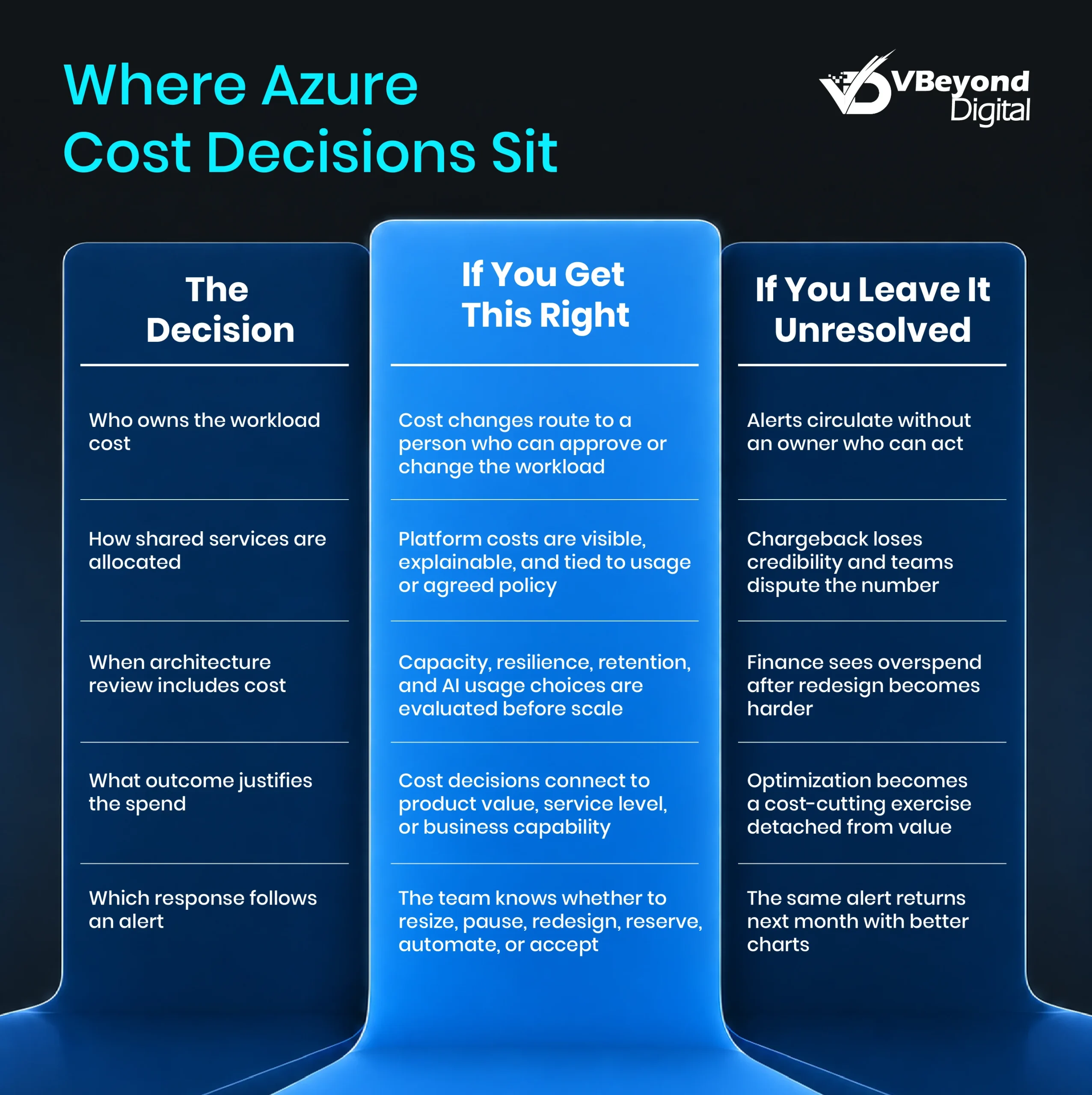
The recurring pattern is that dashboards are built for explanation before they are built for decision. They show what happened, but not who can approve the next move. A cost spike should route to a named workload owner, a named platform owner, and a named finance partner with a defined choice: resize, pause, redesign, reserve, automate shutdown, change service level, accept the cost, or retire the workload. If the dashboard cannot support that choice, it is still a reporting layer, not a governance layer.
This is where Power BI governance becomes part of Azure cost governance. The metric model has to preserve business meaning. A cloud cost dashboard that cannot distinguish production from test, shared platform from product workload, committed capacity from consumption, and cost from value will produce more meetings than decisions.
AI Spend Makes Weak Azure Cost Governance More Visible
AI cost growth exposes attribution gaps that traditional infrastructure reporting could sometimes hide.
A conventional workload usually has a clearer resource boundary. AI usage can move differently. Experiments start quickly, token or inference usage can grow without the same capacity-planning rhythm, and the business value may be harder to measure than uptime or transaction volume. The recent FinOps Framework 2026 update identifies FinOps for AI as part of the expanding scope of technology value management, and its AI guidance points to spend unpredictability, faster development cycles, policy needs, and value alignment.
The most obvious objection is that AI costs are only one slice of Azure spend. That is true. They still matter because they pressure the same weak points that already affect cloud cost governance: attribution, owner mapping, usage context, and value measurement. If an Azure OpenAI workload, Copilot-enabled process, or AI data pipeline grows quickly, the budget alert may tell finance what happened before the operating model can explain whether the usage was justified.
The practical question is no longer only which team consumed the resource. It is whether the consumption produced an outcome the business recognizes. For AI workloads, that might mean cost per evaluated case, cost per resolved service interaction, cost per prediction reviewed, cost per inference request, or cost per business process completed. The exact metric depends on the use case. The governance requirement is the same: spend has to connect to the unit of work or value.
In delivery conversations, AI cost governance usually fails when teams treat AI usage as innovation spend until finance asks for a run-rate forecast. By that point, the data needed for value measurement may not exist. The platform team can show tokens, calls, compute, storage, or service charges. The business may not be able to show which decisions improved, which users adopted the workflow, or which manual effort changed.
That is why the Azure cost model should be extended before AI usage scales. The owner should define the cost unit, the acceptable usage pattern, the business measure, and the trigger for review. Without that, AI spend becomes another cost category that everyone can see and nobody can defend.
The Operating Model Has To Decide Before The Alert Arrives
Azure cost governance becomes useful when it changes decisions before finance has to chase explanations.
Some leaders will resist adding more governance because they have already seen slow approval processes damage cloud delivery. That concern is legitimate. The answer is not a heavier committee for every resource change. The answer is a small set of decision rights that match spend risk and workload importance.
The operating model should name who owns five decisions. The workload owner decides whether the workload still needs the capacity, service level, environment, or feature that created the cost. The platform owner decides whether architecture, shared services, automation, reservations, savings plans, or policy can reduce waste without breaking the service. The finance partner decides how the cost is budgeted, allocated, and escalated. The business owner decides whether the outcome still justifies the spend. The governance forum decides when a repeated pattern becomes a design problem rather than a one-month variance.
These roles only work when the data supports them. Cost Management data guidance notes that current-period charges can be estimated, updated at different intervals, rerated, and finalized after billing close. That makes timing part of governance. A daily dashboard cannot be treated as final invoice truth, and an alert cannot be treated as a complete investigation. The workflow has to distinguish early signal, operational investigation, finance review, and final allocation.
The strongest Azure cost governance models use alerts as triggers, not conclusions. A budget alert should open an ownership workflow. An anomaly alert should start a workload investigation. A shared-cost movement should route to both the platform owner and the consuming owner. A recurring variance should force an architecture review. A dashboard should show the decision state, not only the cost state.
Power Platform automation can help when it routes these signals into approval, ticketing, or review workflows, but automation does not solve the ownership question by itself. The workflow has to know who receives the alert, what authority that person has, which evidence is required, and what decision is expected.
Conclusion: Cost Governance Works When Finance And Technology Share The Same Decision Model
The Monday finance review changes when the screenshot is no longer the starting point of the investigation.
The CFO still needs the number. The CIO still needs the platform facts. The workload owner still needs the service context. The difference is that the alert now points to a decision record: which workload changed, who owns it, which business outcome it supports, which shared-cost rule applies, which optimization options exist, and who can approve the response.
The implication is uncomfortable but useful. If Azure costs keep rising after budgets and alerts are in place, the enterprise should not start by adding more alert thresholds. It should test whether cost data is connected to workload ownership, architecture review, shared-cost logic, and business value. If those links are missing, the next alert will be more timely but not more useful.
VBeyond Digital can support an Azure cost governance review that maps cost signals to workload owners, architecture decisions, Power BI reporting, shared-cost allocation, AI usage patterns, and managed operations. The assessment should leave the enterprise with fewer unresolved questions: who owns the spend, who can change the workload, which cost is shared, which outcome justifies the run rate, and which decision is due next.
That work has to happen earlier.
FAQs (Frequently Asked Question)
Azure costs keep rising when budgets and alerts are treated as the control model rather than as signals inside a workload-governance model. Alerts can show that spend crossed a threshold, but they do not decide whether the workload design, service level, environment pattern, shared-cost rule, or owner assignment is correct. The fix is to connect alerts to named workload owners and defined response decisions.
Azure budget alerts are useful because they create early visibility and can trigger investigation or automated workflows. They are not enough by themselves because they usually arrive after the workload decision has already created spend. A mature model uses alerts to start ownership review, not to replace architecture and product accountability.
An Azure cost attribution model should include workload name, product or service owner, environment, business unit, shared-service treatment, data or AI usage context, and the business outcome the workload supports. Tags help create the reporting path, but the governance model needs authority and decision rights behind those labels.
Shared Azure costs should have both a platform owner and a transparent allocation rule. The platform owner is accountable for efficiency and service design. The allocation rule explains how costs move to consuming teams or business units. Without both, showback and chargeback can become disputed finance exercises rather than governance mechanisms.
An Azure cost governance review should examine budget and alert coverage, cost data quality, tag inheritance, shared-cost allocation, Power BI reporting, workload ownership, architecture review points, AI spend patterns, and response workflows. The goal is to determine whether cost signals lead to decisions or only to explanations after the spend has already occurred.

