

Loading...
Before cutover, confirm application readiness, expected operating costs, and a tested recovery plan.
Section
Table of Contents
- A published retirement date can still catch production by surprise
- A migration wave starts with the business service
- A test cutover has to work through the whole application
- Target cost needs to trace back to the approved design
- Rollback has to restore business processing and infrastructure
- Handover has to preserve the decisions made during cutover
- FAQs (Frequently Asked Questions)
Key Takeaways
- How to separate a successful replication event from evidence that a finance, operational, or customer-facing service is ready to run in OCI.
- How to define migration waves around shared integrations, identity dependencies, network paths, and business-process ownership before the cutover calendar is set.
- How to test target performance, data reconciliation, and cost assumptions early enough to change the target plan without turning the maintenance window into a negotiation.
- What a go or hold decision needs to cover, including rollback triggers, support authority, and the records required after the service moves.
A published retirement date can still catch production by surprise
The replication dashboard can show a completed transfer. The finance team can still be unable to reconcile the first business day in the target environment. A copied disk and a launched instance leave the business service unproven.
An Oracle workload carries dependencies beyond the compute resource. Cutover can involve DNS records, firewall rules, identity providers, batch windows, interfaces, reporting feeds, data synchronization, operational runbooks, and people who know when a process has failed. A target instance may come online with a network rule, privileged role, or downstream message still missing.
Oracle’s Cloud Migrations overview covers asset discovery, migration projects, replication, and target plans for supported workloads. Migrated-resource validation and data-integrity checks remain enterprise responsibilities. Before a steering group authorizes cutover, it should name the business service being accepted, the responsible owner, the control checks, and the point at which the target can be judged.
A migration wave starts with the business service
A wave built from infrastructure inventory can divide a business process across two operating states. An order-management application may move before its document service. A finance database may move before its reporting extract, approval interface, or secure connection to a payment provider. Each component can be healthy on its own while the end-to-end process fails.
The wave should group assets that participate in the same accepted business outcome, alongside the identities, integration paths, network changes, and support contacts needed to sustain it. This gives the cutover team a defined scope for testing and gives the business owner a defined service to accept or hold.
Oracle recommends keeping assets that move in the same cutover event in the same migration project. Its migration planning guidance also allows separate plans for smoke, integration, load, and production scenarios. A finance-oriented wave needs a person who can reconcile balances and confirm that interfaces, approvals, scheduled jobs, and reports operate in the target state.
The pattern is familiar after ERP go-live: a platform can be technically available while reporting, integration, and control work remain unresolved. Oracle Fusion post-go-live challenges describe why that operational layer deserves attention before a migration team declares success.
A test cutover has to work through the whole application
Testing one migrated virtual machine establishes that an instance launches. The test still needs the connection sequence, target network configuration, identity behavior, scheduled processing, data state, and representative transactions used by the production process.
Separate test and production plans give each environment a defined purpose. The test plan needs to validate complete applications that use multiple virtual machines and include firewall changes, DNS updates, and client settings. Oracle migration basics make the same recommendation and warn that snapshots of different source virtual machines may be taken at different times. A service that depends on a consistent cross-server state may need a test that uses a shutdown window similar to production.
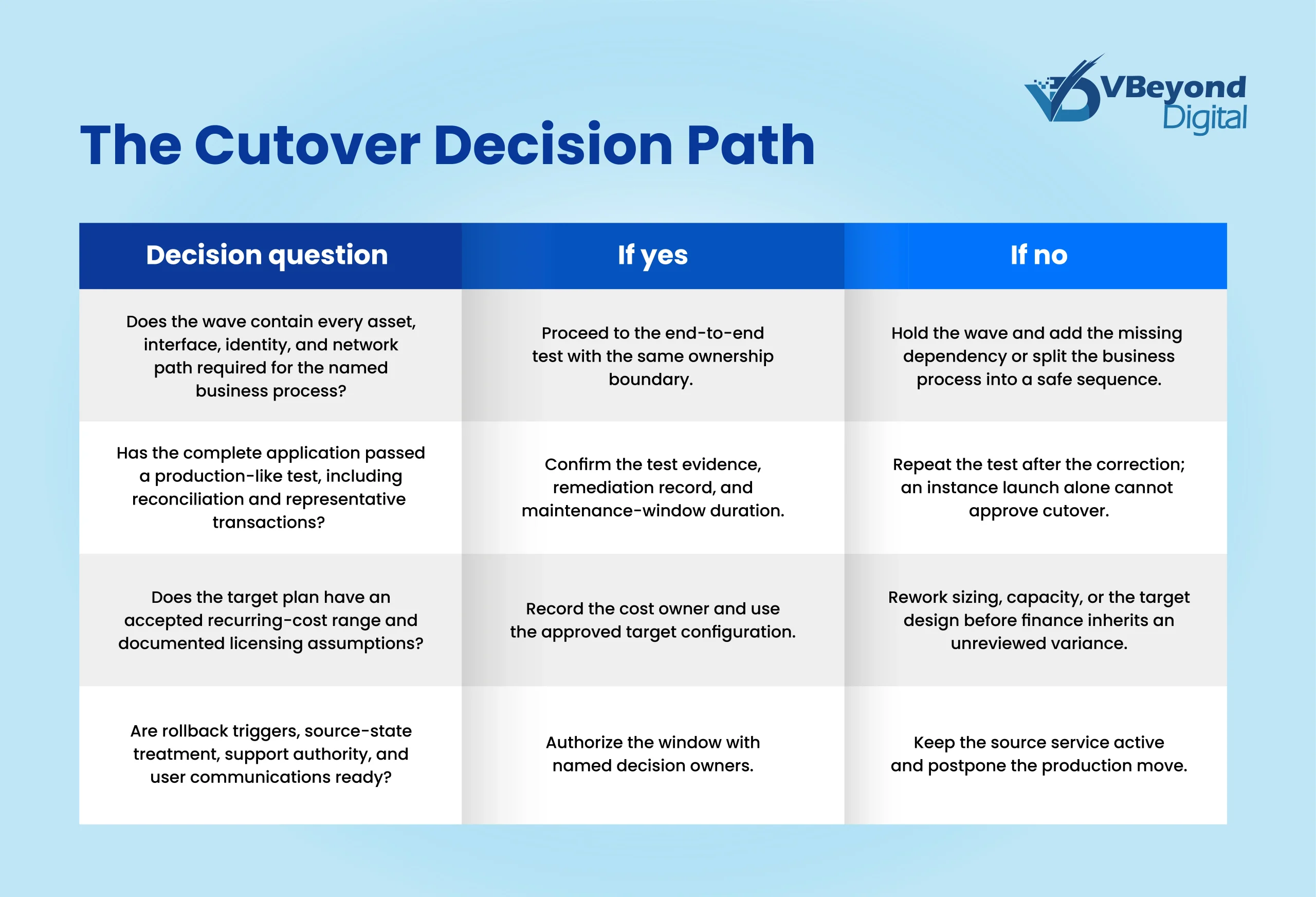
A production-like test exposes configuration changes, data-reconciliation work, and maintenance-window duration before the business is waiting for the service. The rehearsal should leave a timed cutover runbook, a defect record, an assigned owner for each correction, and a repeatable method for the production attempt.
For cross-cloud applications, the rehearsal must also cover the boundary between Oracle and Microsoft services. The Oracle Database@Azure architecture checklist is useful when the dependency chain crosses networking, identity, and operational ownership domains that do not belong to one platform team.
Target cost needs to trace back to the approved design
Migration cost depends on the target shape, storage performance, availability design, network path, temporary migration resources, licensing position, and support model. A forecast becomes useful when each of those assumptions is recorded and approved before the target goes live.
Oracle Cloud Migrations generates a monthly cost estimate for each migration plan and permits multiple plans to compare material configuration changes. Oracle also notes that temporary tenancy resources created during migration are billed at normal tenancy rates. The estimate gives the enterprise a starting point for comparing target designs, expected usage, and the operating model that will support them.
The cost record should separate one-time migration expense from steady-state service cost. It should identify the source cost, target estimate, capacity assumptions, temporary resources, expected network charges, licensing assumptions, and support cost. When the first invoice differs from the estimate, finance and the platform team can trace the variance to a named assumption or a changed operating condition.
Compare target configurations against the workload’s service requirements and expected operating costs. A unit-economics view of cloud workload placement ties that comparison to the service level and accountable owner.
Rollback has to restore business processing and infrastructure
Rollback can require source systems, interfaces, data updates, user communications, and support coverage to move together. A return to the source has data and control consequences that need to be understood before the maintenance window begins.
Oracle recommends that a production migration plan include a maintenance window, final replication after source shutdown, an action plan for success and failure scenarios, and steps to restore source functions when an attempt fails. The guidance also states that Oracle Cloud Migrations lacks reverse replication, so a return path can require manual data transfer for backup or restore.
The cutover plan should state which conditions trigger a return to source, who has authority to make that decision, and how the team will handle transactions created in the target. A failed reconciliation, a broken business-critical integration, a performance result outside the accepted baseline, a missing control report, or an unapproved security condition may each require a different response.
The rehearsal should include the return path. It reveals how long restoration takes, which configuration changes require reversal, and which business users must confirm that processing can resume.
Handover has to preserve the decisions made during cutover
The handover should carry the accepted dependency map, target configuration, cost assumptions, test results, reconciliation outcome, unresolved risks, alert ownership, support contacts, and recovery decisions into steady-state operations. The business owner and platform owner need the same record when a service issue appears after cutover.
A migration handover also sets the support boundary. It should identify the team that receives the first incident, the business owner who assesses process impact, and the route for an issue that crosses application, network, and data responsibilities.
VBeyond Digital can assess Oracle migration waves, target operating models, cost assumptions, dependency evidence, and cutover readiness across OCI and connected enterprise systems. The cutover record should show what the enterprise accepted before the service began operating.
Test Azure OpenAI changes before production rollout
FAQs (Frequently Asked Questions)
Production readiness requires more than a completed replication or launched target instance. The enterprise needs evidence that the full application works with its required integrations, identity path, network configuration, data state, reporting, and business controls. The named business owner must also accept the reconciliation outcome, operational owner, cost position, and recovery plan.
Oracle recommends separate test and production migration plans in the same migration project. The test plan should reproduce the target configuration closely enough to expose network, configuration, application, and data-consistency issues. The production plan then applies the changes that the rehearsal has validated within the actual maintenance window.
Define the reconciliation scope before the test begins. It may include record counts, financial balances, transaction totals, interface queues, reports, and control outputs. The business owner should approve the result against an agreed tolerance, with an escalation path for an unexplained difference. A technical launch result cannot replace that acceptance.
Compare the approved target configuration with the expected ongoing service model. Include compute and storage assumptions, availability requirements, network paths, temporary migration resources, licensing position, support model, and the owner for any material variance. The team should preserve the assumption record alongside the migration plan so finance can trace the first production invoice back to the approved design.
The decision should follow thresholds agreed before the window. Common triggers include a failed reconciliation, a broken business-critical integration, a performance result outside the accepted baseline, an unapproved security issue, or a recovery action that cannot be completed within the maintenance window. The authority to make that decision needs to be named before source systems are shut down.
