


GCC AI Governance Needs Named Risk Owners
AI risk does not stay with headquarters when GCC teams run the workflow.
Section
Table of Contents
- Introduction
- GCC AI Risk Moves When The Workflow Moves
- Central AI Policy Fails When GCC Teams Own The Evidence
- Decision Rights Break First At The Use-Case Boundary
- GCC AI Governance Needs Escalation Paths Before Scale
- Control Evidence Is The Real Test Of GCC AI Maturity
- The Ownership Model Should Match The Risk, Not The Location
- Conclusion: GCC AI Governance Works When Control Is Built Into Delivery
- FAQs (Frequently Asked Question)
Key Takeaways
- The blog explains why GCC AI governance fails when headquarters keeps policy ownership, but GCC teams own day-to-day AI execution.
- It shows how AI risk fragments across business, technology, risk, and offshore delivery teams when decision rights are not redesigned.
- It connects weak GCC AI ownership to audit gaps, unmanaged data exposure, slow escalation, duplicated AI work, and poor linkage to business outcomes.
- It presents an operating model for assigning AI risk owners, escalation paths, control evidence, and remediation responsibility before GCC-led AI work scales.
Introduction
In May 2026, Reuters reported that India is drawing more global capability center work as companies put AI into operations rather than keeping it in isolated pilots.
The location change is only the visible part. The deeper change is operational. A GCC team may now run an AI-assisted claims review queue, build Power BI decision dashboards, maintain Power Platform automations, tune Copilot workflows, or support Azure OpenAI applications that influence enterprise decisions. Headquarters may still own the policy. The GCC owns the work.
That split is where GCC AI governance starts to fail. Some leaders will argue that central AI governance already covers the risk. It does, but only at the level of policy intent. Once GCC teams run AI-enabled workflows, analytics, automation, and operational decision support, the governance question becomes more specific: who approves the use case, who monitors behavior, who escalates exceptions, who owns remediation, and who proves the control worked?
GCC AI governance is not a location strategy. It is an accountability model for distributed AI execution. The issue is not whether GCC teams should use AI. They already are, and Nasscom and Zinnov reported in May 2026 that India’s GCC base is expanding while moving deeper into enterprise capability and innovation work. The risk is that AI responsibility will scale faster than the operating model that controls it.
GCC AI Risk Moves When The Workflow Moves
AI risk follows the workflow, not the org chart.
That sounds obvious until a GCC starts running production work that headquarters still describes as “supported offshore.” The team in the GCC may monitor exceptions, adjust dashboards, administer automation, respond to business users, and prepare the evidence that a decision was handled correctly. Yet the formal AI risk owner may sit in a headquarters governance forum that never sees the day-to-day drift.
The common objection is that GCCs execute decisions made elsewhere. That was closer to the truth when the work was mostly process support, reporting, or ticket handling. It is less true when GCC teams configure AI-assisted workflows, run analytics that shape operational choices, manage prompt libraries, administer Power Platform automations, or support Copilot usage across functions. Execution decisions become control decisions.
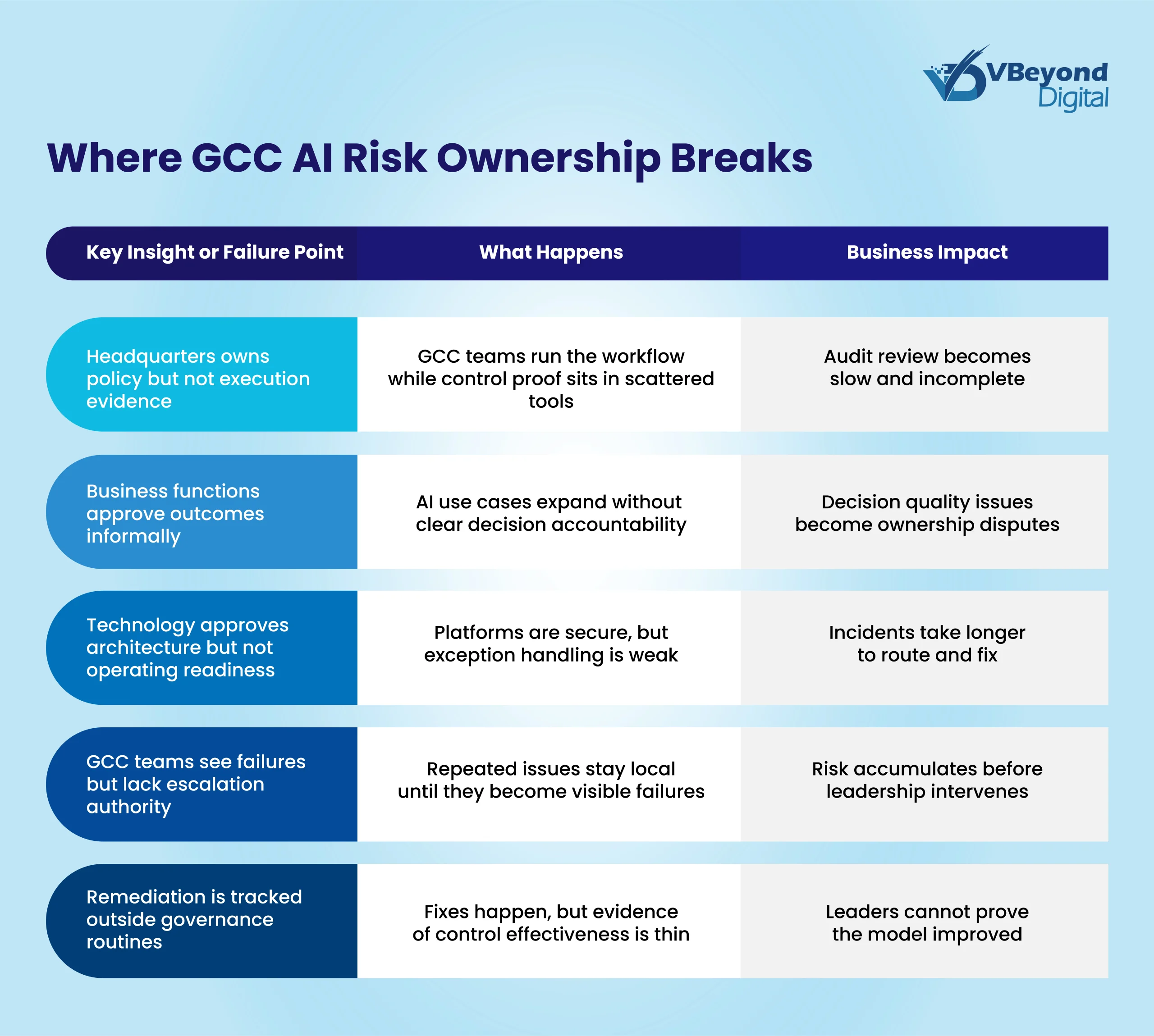
The pattern in GCC operating reviews is that ownership is clear at the program level and unclear at the exception level. A business function sponsors the use case. Technology enables the platform. Risk approves the policy. The GCC runs the workflow. When an AI output is wrong, a data source is exposed, a model behavior changes, or a business user challenges the decision, the actual owner is often whoever notices first.
That is why a GCC AI operating model has to be designed around named control responsibilities, not only service lines. The same principle applies when enterprises build or scale a broader GCC advisory and execution model: work location, service catalog, and team structure matter, but they do not replace decision rights.
Move GCC AI Governance From Policy to Ownership
Central AI Policy Fails When GCC Teams Own The Evidence
Central AI governance usually defines what should be approved. GCC execution determines whether the control can be proven.
The most tempting answer is to create one enterprise AI council and route all AI use cases through it. That helps with policy consistency. It does not tell a GCC team what evidence must be retained after an AI-assisted operational decision, who investigates a recurring output defect, or which business owner accepts residual risk after a workflow moves from pilot to steady state.
NIST’s AI Risk Management Framework is useful here because it treats AI risk management as work across governance, mapping, measurement, and management rather than a one-time approval exercise. For GCCs, the important lesson is practical: governance must reach the team that can produce evidence.
Control evidence usually sits close to execution. It includes use-case approval records, data-access decisions, prompt or workflow version history, evaluation results, human review logs, exception records, remediation tickets, and sign-off from accountable business owners. If the GCC operates the workflow but does not own or produce that evidence, headquarters gets a policy trail without an operating trail.
The consistent gap across GCC-led AI programs is that evidence ownership is assigned late. Teams build the workflow, then risk and audit ask how outputs were reviewed, which data was used, and who approved continued operation after an exception. At that point the answer depends on what the system captured, what the GCC retained, and whether the business owner stayed involved after go-live.
AI governance ownership therefore needs two levels. Headquarters should own enterprise policy, risk appetite, approved platforms, restricted use cases, and cross-functional governance. The GCC should own execution evidence, first-line monitoring, exception capture, workflow-level escalation, and remediation tracking. Business functions must own decision quality and residual risk. Without that split, AI accountability becomes ceremonial.
Decision Rights Break First At The Use-Case Boundary
The first governance failure usually appears before the model fails.
It appears when no one can say whether a GCC team is allowed to move an AI-assisted workflow from support into decision influence. A reporting assistant becomes a recommendation engine. A Power Automate flow starts routing exceptions based on AI classification. A Copilot workflow begins drafting customer or finance responses. A Power BI dashboard starts combining prediction, explanation, and operational action. Each step feels incremental. Together they change the risk profile.
Some leaders will say this should be covered by architecture review. It should, but architecture review alone does not assign business accountability. The review may confirm identity, data flow, platform fit, and integration design. It may not answer who approves the use case when AI affects a business decision, who can expand the workflow to another region, or who decides whether a recurring exception is tolerable.
The decision-rights model should separate four approvals. The business function approves the decision context and acceptable outcomes. Technology approves architecture, access, integration, logging, and platform controls. Risk and compliance approve restricted use, evidence requirements, and escalation thresholds. The GCC approves operational readiness: staffing, runbooks, monitoring routines, exception capture, and handoffs. Microsoft’s responsible AI standard is useful because it treats accountability, impact assessment, human oversight, and controls as operating requirements, not only design principles.
This is where AI governance intersects with Microsoft platform administration. If GCC teams are building or administering Copilot workflows, the operating model should connect to Microsoft Copilot governance, not treat Copilot usage as a productivity side project. If GCC teams are using low-code workflows to operationalize AI-assisted decisions, the same logic applies to Microsoft Power Platform governance.
GCC AI Governance Needs Escalation Paths Before Scale
AI escalation cannot be invented during an incident.
The objection is fair: not every AI exception deserves a formal governance route. A low-risk internal assistant that returns a weak draft can be handled through product feedback. A workflow that affects customer treatment, finance review, compliance operations, workforce decisions, or operational prioritization needs a different path. The issue is not escalation volume. The issue is escalation design.
Escalation should be tied to the type of failure. Output-quality failures need a business process owner and a product or platform owner. Data exposure concerns need security, privacy, and access owners. Model or prompt behavior changes need the AI platform or application owner. Workflow failures need GCC operations leadership because the team is closest to the process. Repeated failures need governance review because they suggest the control model is undersized.
The GCC role should be explicit. The GCC is often the first team to see repeated exceptions, slow approvals, user workarounds, and evidence gaps. If that team is treated only as a delivery group, those signals arrive late to headquarters. If it is treated as the first line of operational control, it can capture exceptions, route them, and maintain the evidence that shows whether remediation happened.
This matters for analytics and reporting as much as for generative AI. GCC teams often own dashboards, data models, semantic layers, and operational reports that leaders use to make decisions. When AI-generated signals enter those reporting flows, Power BI governance has to connect metric ownership, source lineage, access control, and exception handling with the broader AI control model.
Control Evidence Is The Real Test Of GCC AI Maturity
The mature GCC does not only deliver AI work. It proves that AI work is controlled.
That claim can sound heavy for teams measured on speed and productivity. It should. AI-enabled productivity without control evidence creates a false economy: faster execution today, harder audit and remediation later. The evidence requirement should not slow every use case equally, but it should match the decision impact of the workflow.
The EU AI Act’s obligations for deployers of high-risk AI systems show why execution evidence is becoming harder to separate from accountability. Even when a specific GCC workflow is not directly governed by that law, the direction is clear: organizations using AI in consequential settings need human oversight, logging, data discipline, and evidence that systems are used as intended.
For GCC AI governance, control evidence should answer a small set of operational questions. Who approved the use case. Which data sources are allowed. Which users can access the workflow. Which AI outputs require human review. Which exceptions trigger escalation. Which owner signs off remediation. Which evidence shows the control worked after a change.
The pattern in stronger GCC operating models is that evidence is built into the workflow. Approval records sit with the use case. Monitoring signals flow into a review cadence. Exceptions create tickets with owners and due dates. Material changes to prompts, automations, dashboards, or model configuration require review before release. Business owners do not disappear after launch.
This is also where production AI lessons matter. The article on why enterprise AI projects fail in production makes the same point from the platform side: useful pilots fail when control, ownership, and operating evidence arrive too late.
The Ownership Model Should Match The Risk, Not The Location
GCC AI governance should not make the offshore team the owner of every AI risk.
That would be as flawed as leaving all accountability at headquarters. The better model assigns ownership by decision type. The business function owns the outcome. Technology owns platform control. Risk owns policy and assurance expectations. The GCC owns execution discipline, exception capture, operational monitoring, and evidence maintenance for the work it runs.
This model creates a practical split. A GCC team can pause a workflow when a defined control fails. A business owner decides whether a workflow’s output is acceptable for the decision context. A platform owner remediates access, logging, integration, or model configuration. Risk and compliance decide whether the control evidence satisfies assurance expectations. The steering group resolves conflicts and changes risk appetite.
The hard part is not drawing the model. It is enforcing it after the first quarter. AI use cases tend to expand through adjacent work: a dashboard becomes a recommendation layer, a support workflow gets an AI classifier, a knowledge assistant starts drafting actions, a process automation begins prioritizing exceptions. Each expansion should trigger a control review because decision impact changes faster than the team chart.
A GCC-led AI control model therefore needs recurring review, not only launch approval. It should review active use cases, exceptions, overdue remediation, data-access changes, human-review overrides, user complaints, model or prompt changes, and business outcome signals. This is where AI governance becomes operational enough to survive scale.
Conclusion: GCC AI Governance Works When Control Is Built Into Delivery
The Reuters story about more AI-enabled work flowing into GCCs is not just a labor-market signal. It is an accountability warning.
If a GCC team runs the workflow, observes the exceptions, maintains the automation, prepares the dashboard, or supports the AI application, then the control model has to reach that team. The answer is not to push all risk offshore. It is to define which risk decisions stay with headquarters, which execution controls sit with the GCC, which outcomes remain with the business, and which evidence proves the model is working.
The implication for CIOs, GCC heads, and risk leaders is direct. Before expanding AI-enabled work through a GCC, they should test whether the operating model can answer four questions: who approves the use case, who monitors the workflow, who escalates failure, and who proves remediation. If those answers depend on informal coordination, the governance model is not ready for scale.
VBeyond Digital can assess GCC-led AI operating models across decision rights, escalation paths, Microsoft platform controls, evidence requirements, and managed execution routines. The goal is not a larger policy document. It is a model that makes ownership visible before the work grows.
The owner should be named before the risk arrives.
FAQs (Frequently Asked Question)
AI risk ownership should be split by decision type. Headquarters should own enterprise AI policy and risk appetite. Business functions should own decision quality and residual business risk. Technology should own platform controls, access, architecture, and logging. GCC teams should own execution evidence, first-line monitoring, exception capture, and remediation tracking for the workflows they run.
Central AI governance defines policy, standards, and approval expectations. GCC AI governance has to make those expectations work inside distributed execution. The difference is evidence. A central forum can approve a use case, but the GCC often holds the logs, exception records, operational context, and remediation trail that prove the control worked.
GCC teams should maintain use-case approval records, data-source approvals, access records, prompt or workflow version history, monitoring results, human-review logs, exception tickets, escalation decisions, and remediation evidence. The evidence requirement should match the workflow’s decision impact.
Escalation should occur when AI affects a business decision, exposes restricted data, produces repeated output failures, changes behavior after a workflow or data update, or creates unresolved remediation. Low-risk productivity use cases may use lighter escalation, but decision-influencing workflows need named owners and formal paths.
Enterprises should test whether each AI-enabled GCC workflow has an approved owner, defined decision rights, monitoring signals, escalation thresholds, remediation routines, and control evidence. If any of those exist only in informal coordination, the operating model needs repair before scale.

