

Oracle Fusion ERP: How AI Can Create Finance Control Gaps
Model choice is a workload-placement decision once AI moves into recurring production use.
Section
Table of Contents
- Introduction
- The Model Decision Has Already Become An Architecture Review
- Benchmarks Miss The Costs The Enterprise Actually Owns
- Data Location Decides More Than Latency
- FinOps Needs Workload Ownership Before Model Spend Scales
- Governance Fails When Model Choice Is Decentralized
- A Controlled Model-Placement Decision Has To Survive Operations
- Vendor Responsibility Does Not Remove Enterprise Accountability
- The Review Meeting Needs A Different Question
- FAQs (Frequently Asked Question)
Key Takeaways
- Why AI model selection should be treated as a cloud-based architecture decision once workloads move beyond pilots.
- How to evaluate model choice through data location, latency, cost ownership, governance controls, and support accountability rather than benchmark scores alone.
- Where decentralized model selection creates avoidable operating risk across Azure, SaaS applications, Oracle environments, and external providers.
- What an enterprise model-placement review should test before recurring AI usage turns model choice into architecture debt, including who remains accountable when vendors own only part of the technical stack.
Introduction
The model review starts in a conference room with a spreadsheet. The AI platform owner has latency notes, the enterprise architect has data-flow concerns, the CFO has a question about recurring inference spend, and the security lead wants to know which team will support the deployment when the model output changes during a customer-facing workflow.
At pilot scale, that meeting can still sound technical. A team wants a better answer, a lower response time, or a model that handles a longer prompt. Once the workload enters production, the same decision starts touching network design, data residency, monitoring, access control, chargeback, vendor dependency, and incident ownership. A model choice that looked small inside the experiment becomes a cloud architecture decision with finance and governance consequences attached.
The current Microsoft model guidance makes the point quietly. Microsoft Foundry Models describes a model catalog spanning providers, deployment paths, inference options, and lifecycle considerations. The architecture decision is no longer whether an enterprise can access a model. The harder decision is where the model should run, which data should move to it, who owns the operating pattern, and how the cost should be traced once the usage repeats every day.
The Model Decision Has Already Become An Architecture Review
Model selection creates architecture before most committees call it architecture. A team choosing between an Azure-hosted model, a SaaS-embedded AI feature, an Oracle-adjacent pattern, or an external provider is also choosing where data moves, where logs sit, which identity boundary applies, which monitoring path exists, and which support team receives the first incident.
There is a fair objection here. Some model decisions are still local. A small internal summarization tool with low data sensitivity and controlled usage does not need the same review weight as a finance, customer-service, claims, pricing, or supply-chain workflow. The evidence points toward a simple threshold: the decision becomes architectural when the output influences a recurring business process, moves regulated or commercially sensitive data, or creates spend that finance needs to attribute to a workload owner.
That is where benchmark-led selection starts to understate the work. The model with the best technical score in a sandbox may require data movement that the enterprise has not governed, a monitoring layer the platform team has not funded, or a support model that the business assumes IT already owns. A cloud based architecture decision has to include those operating consequences before the model is approved for scale.
In practice, the pattern across enterprise AI reviews is that model choice is often approved at the application layer while the consequences land in platform engineering, finance, security, and data teams later. That delay is the source of the risk. The person approving the model may not be the person accountable for data exposure, cost attribution, or incident response six months later.
Benchmarks Miss The Costs The Enterprise Actually Owns
Benchmarks answer a narrow question: how a model performs under a test condition. Enterprise cost ownership asks a different question: what does the workload require every time the business uses it, changes it, monitors it, and supports it?
It is tempting to treat price per unit as the cost answer. That answer is incomplete. The total cost pattern includes prompt traffic, retrieval calls, vector search, orchestration, storage, evaluation runs, logging, human review, monitoring, environment duplication, fallback paths, and support effort. If the model sits inside one platform but pulls data from another, the architecture may add movement, replication, or transformation costs that the model comparison never showed.
The FinOps view is useful because it ties cost to workload decisions instead of finance after-the-fact reporting. The FinOps Foundation workload-placement guidance frames placement as a decision that balances cost, performance, sustainability, and business value. For AI, that logic matters because the workload is not only compute. It is data path, interaction pattern, model lifecycle, and demand behavior.
The practical question for an enterprise AI platform owner is not whether one model is cheaper. It is whether the chosen model creates a cost pattern the enterprise can explain, allocate, optimize, and defend. If a business unit owns the use case but the platform team owns the model endpoint, the data team owns retrieval, and finance sees only the consolidated bill, AI cost governance will break at the first disputed spike.
Data Location Decides More Than Latency
Data location is often framed as a performance issue, but the larger issue is control. A model placed close to the application may reduce response time while creating new questions about where prompts, retrieved documents, embeddings, logs, and evaluation records live.
The obvious objection is that modern cloud platforms give architects more deployment options than they had a few years ago. That is true. Microsoft now documents multiple Foundry Models deployment types, including paths with different hosting, routing, and operational characteristics. More options help architecture teams only when the enterprise has criteria for choosing among them.
Those criteria should start with data flow. If a customer-service AI workflow retrieves regulated records from a data platform, invokes a model endpoint, logs prompts for quality review, and stores evaluation results somewhere else, the architecture review has to follow the whole chain. The model itself is only one control point. The governance question is whether each movement of data has an owner, a purpose, a retention rule, and a way to prove what happened later.
Oracle and SaaS environments make this more concrete. An enterprise may run ERP or finance processes in Oracle, analytics in Azure, productivity workflows in Microsoft 365, and AI experiments through several model providers. The model-placement decision may appear to sit in the AI platform, but the real boundary is often between systems of record, data products, and operating teams. The same logic applies to Oracle and Azure architecture boundaries when an AI workflow depends on data and controls that cross platform ownership lines.
The consistent gap in production design is that data proximity and data accountability are treated as the same thing. They are not. Moving the model closer to the workload may improve response behavior, but it does not automatically settle who governs prompts, embeddings, access paths, audit logs, or retention rules.
FinOps Needs Workload Ownership Before Model Spend Scales
AI cost becomes harder to govern when finance sees consumption before architecture names the workload owner. A budget alert can show that spend increased, but it cannot explain whether the increase came from prompt volume, model choice, retrieval design, duplicated environments, evaluation frequency, or a business process that quietly became dependent on AI.
There is a reasonable finance concern here. Too much architecture detail can bury accountability rather than clarify it. The answer is not to make the CFO read model documentation. The answer is to connect model spend to workload ownership, business purpose, usage driver, and technical pattern before the workload reaches recurring production demand.
Microsoft Cost Management describes visibility, budgets, allocation, anomaly management, and stakeholder accountability across billing and resource scopes. That tooling gives the enterprise a reporting foundation. It does not by itself decide whether the customer operations AI workload, the sales-assist workflow, or the finance exception process should own a shared model endpoint or a retrieval pipeline used by several teams.
AI cost governance has to sit closer to model-placement review. If a model choice requires dedicated capacity, heavy retrieval, high-frequency evaluation, or a separate monitoring pipeline, finance needs to know which workload benefits from that pattern. The FinOps Foundation guidance for AI points toward this need because AI demand can change quickly and value measurement depends on the business outcome, not only the platform charge.
The pattern in enterprise environments is that early AI usage is funded like experimentation, while production AI behaves like a shared operating service. That mismatch creates disputes. The platform team pays for readiness, the business claims value, finance sees growth, and no single owner can explain whether the cost increase is justified.
Governance Fails When Model Choice Is Decentralized
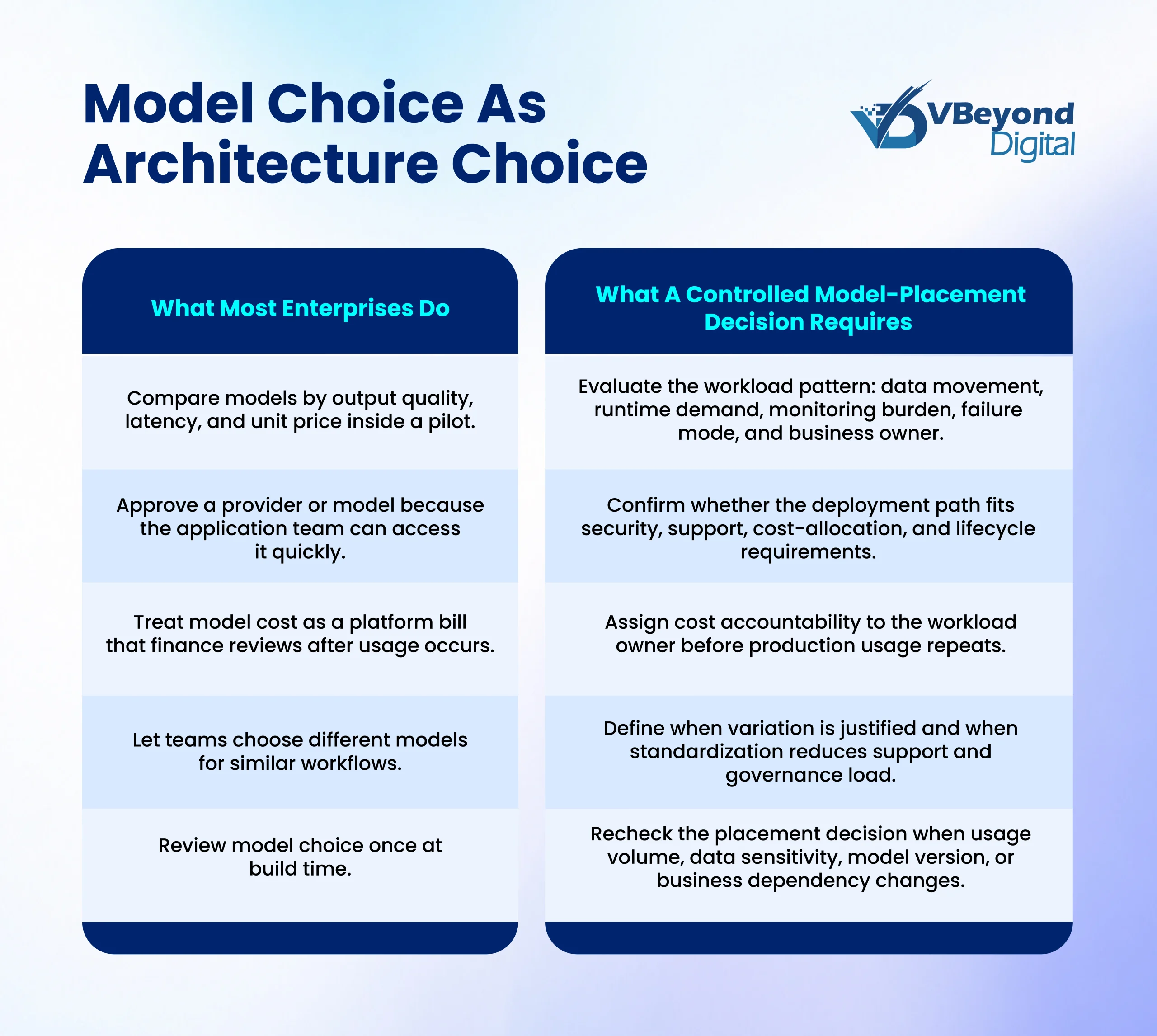
Decentralized model choice creates variation before the enterprise has decided which variation is useful. One team chooses a model because it handles long documents well. Another chooses a model because it is already available inside a SaaS workflow. A third uses an external provider because procurement was faster than platform onboarding. Each decision may be defensible alone, while the combined estate becomes difficult to monitor, secure, and support.
A strong platform team should not block every variation. Some workloads genuinely need different latency profiles, data boundaries, language capabilities, or deployment patterns. The governance failure begins when variation has no review threshold. Without a threshold, model diversity becomes a hidden operating model that no one designed.
The architecture control should ask what changes when the model changes. If a provider changes a model version, if an endpoint moves, if a SaaS vendor adds an embedded feature, if a workflow starts sending more sensitive data, or if the business volume increases, the enterprise needs a review path. This is where Azure AI model deployment discipline matters. Model operations, evaluation, monitoring, and support ownership have to be tied to the workload decision rather than added after the model is already inside production flow.
NIST’s AI Risk Management Framework places governance, mapping, measuring, and managing around the AI system lifecycle. The useful implication for model choice is plain: the enterprise has to govern the conditions under which the model operates, not only the model object. The NIST AI Risk Management Framework remains a useful reference for that lifecycle framing.
The issue that appears most often after scale is not too many models by itself. It is too many model decisions without a shared way to prove why each one exists, who owns it, what data it touches, how it is monitored, and when it must be reviewed again.
A Controlled Model-Placement Decision Has To Survive Operations
The model-placement decision is only useful if operations can live with it. A technically elegant choice that leaves support unclear will fail during the first incident that crosses business, platform, data, and vendor lines.
Some leaders will object that this slows adoption. The better reading is that it prevents rework. A lightweight model-placement review can be faster than retrofitting ownership after the workload has become embedded in a business process. The review should test whether the enterprise can answer four operating questions before scale: where the data moves, who pays for recurring use, who monitors behavior, and who owns remediation when the output or cost pattern changes.
This is where AI workload operations become part of architecture rather than post-live support. Monitoring is not limited to uptime. It has to include cost behavior, model version changes, output-quality signals, retrieval health, policy exceptions, and the business process affected by the output. Support is not only a platform ticket. It is a named path across the workload owner, platform team, security, data, finance, and vendor contacts.
The same review should decide where standardization is useful. A single enterprise model provider may reduce support and governance complexity for common workflows, but standardizing too early can force unsuitable workloads into the wrong latency, data, or risk pattern. A multi-provider approach may fit different workload classes, but only if the enterprise can govern each provider boundary and avoid duplicated evidence, monitoring, and cost allocation work.
This is the answer to the practitioner question about whether one factor should dominate. Raw model capability should rarely be the only deciding factor once the workload is recurring. Data sensitivity, business dependency, latency tolerance, support path, and cost attribution may matter more because they determine whether the selected model can operate safely and economically over time.
Vendor Responsibility Does Not Remove Enterprise Accountability
The hardest accountability question appears after the model is already inside a business process. A vendor may own a service commitment, a cloud provider may own platform availability within its contracted scope, and an implementation partner may own the configuration it delivered. The enterprise still owns the decision to use the AI system in a workflow that affects a customer, employee, financial process, operating decision, or regulated activity.
There is a practical objection here. Enterprises do not control every layer of the AI stack, especially when models, SaaS features, managed services, and cloud infrastructure come from different providers. That is true. It is also why governance has to separate accountability from responsibility. Accountability answers who ultimately stands behind the business outcome. Responsibility answers who monitors, repairs, escalates, approves, or communicates when something goes wrong. Contractual liability answers what the vendor has formally agreed to provide. Operational ownership answers who detects the issue and moves it through the enterprise.
A useful governance structure is layered rather than committee-heavy.
The structure should also define responsibility by failure type. A platform outage, data exposure, harmful output, uncontrolled cost increase, model-version change, and integration failure should not enter the same escalation path. The enterprise should know who can pause the workload, who investigates the root cause, who contacts the vendor, who communicates with affected parties, and who decides whether the system returns to production.
If those ownership paths are missing, the organization has not finished the model-placement decision. It has only selected a model.
The Review Meeting Needs A Different Question
The conference-room spreadsheet still belongs in the process. Model quality, latency, availability, and cost matter. The mistake is treating those columns as the whole decision.
A production AI review should ask a harder question before approval: what operating pattern does this model choice create? That question forces the team to map model selection to cloud based architecture, data movement, governance controls, cost ownership, monitoring, and lifecycle support. It also reveals whether the enterprise is approving a workload it can operate.
For enterprises with Azure, Oracle, SaaS, and external model-provider paths, this question becomes a practical assessment rather than a theoretical framework. A model-placement and cloud architecture assessment from VBeyond Digital reviews workloads, model choices, data paths, cost accountability, governance controls, and support ownership so the enterprise can decide where each AI workload should run before the decision hardens. The spreadsheet is still on the table, but it is no longer enough.
Prepare Oracle Workloads for Azure Operations and Support.
FAQs (Frequently Asked Question)
AI model choice affects cloud architecture because it determines where data moves, where inference runs, which identity boundary applies, where logs and evaluation records sit, and which team supports the workload. A model selected for output quality can still create architecture risk if the deployment path creates unmanaged data movement, unclear monitoring, or cost ownership that finance cannot trace.
Model selection becomes a FinOps issue when recurring AI usage creates spend patterns that depend on workload design. The model price is only one part of the cost. Retrieval, orchestration, logging, evaluation, monitoring, environment duplication, and support effort can all sit outside the original comparison. Finance needs cost attribution tied to workload ownership rather than a platform bill that arrives after usage has already grown.
Some standardization helps when multiple teams run similar workflows with similar data, latency, and support needs. A single-provider rule becomes risky when workloads have different regulatory, performance, integration, or operating requirements. The stronger control is a model-placement framework that defines when standardization is required and when variation is justified.
Architects should evaluate data location, latency tolerance, monitoring needs, model lifecycle support, provider dependency, cost attribution, access control, audit evidence, and incident ownership. The model’s answer quality matters, but production readiness depends on whether the enterprise can operate the model safely, explain its cost, and support the workflow when behavior changes.
An AI model-placement assessment reviews the business workload, data paths, model choices, deployment options, cost ownership, governance controls, monitoring requirements, and support model. The output should help leaders decide which workloads fit Azure AI, SaaS-embedded AI, Oracle-adjacent patterns, external providers, or a controlled hybrid cloud architecture.
The enterprise remains accountable for the business outcome because it decides where the AI system is used, what data it receives, whether human review is required, and how the output affects the business process. Vendors may be responsible for contracted service commitments, platform availability, model disclosures, security obligations, or technical remediation within their scope. That division should be documented before production so the enterprise is not trying to negotiate accountability during an incident.
