


Loading...
Release governance protects the close process when ERP change reaches controls, reporting, integrations, and workflows.
Section
Table of Contents
- Introduction
- Release Visibility Still Leaves The Process Unprotected
- Sandbox Validation Is Not A Substitute For Business Sign-Off
- Finance Close Breaks Across The Chain, Not Inside One Screen
- Control Evidence Is The Part Most Release Checklists Miss
- Power Platform And Copilot Make Release Governance Wider
- Finance Should Define Readiness Before IT Confirms Deployment
- The Close Process Needs Its Own Release Memory
- FAQs (Frequently Asked Question)
Key Takeaways
- Why Dynamics 365 release visibility is not the same as finance-close readiness when controls, integrations, reporting models, and workflows sit downstream of ERP change.
- How to identify which month-end close, reporting, approval, and integration scenarios need regression testing before a release wave reaches production.
- What Microsoft’s 2026 release wave 1 and One Version guidance means for sandbox validation, service-update timing, early access, and release ownership.
- How to decide whether release governance is strong enough to protect close continuity, control evidence, and executive reporting confidence.
Introduction
Microsoft gives Dynamics 365 customers months of notice before release changes reach production.
Finance teams can still meet the change for the first time during close.
Both statements are true, and the contradiction is where release governance becomes a business issue. For instance, Microsoft’s 2026 release wave 1 plan covers Dynamics 365 capabilities releasing from April through September 2026 and identifies whether features are enabled automatically for users, enabled automatically for administrators, makers, or analysts, or require action before use. This visibility is useful but not sufficient.
A finance-close problem rarely announces itself as a release-note problem. It appears as a reconciliation mismatch, a delayed approval, a report variance, a failed integration, a missing field, a different validation rule, or a user workflow that no longer behaves the way the close team expects.
The risk is not that Dynamics 365 updates are inherently unsafe. That claim would be lazy and wrong. The risk is that enterprises treat release readiness as an IT calendar activity when the operational consequence sits in finance, reporting, controls, integrations, and user adoption. The calendar tells the organization when change is coming. Governance decides whether the business is ready for the change.
Release Visibility Still Leaves The Process Unprotected
Release plans describe product change, but finance close depends on process behavior.
The distinction matters because Dynamics 365 release content is not narrow. Microsoft says the 2026 release wave includes Dynamics 365, Power Platform, and role-based Copilot capabilities. The Dynamics 365 Finance 2026 release wave 1 overview describes investments across finance at global scale, agentic operations, period-end close, financial journals, analytics, and regulatory capabilities. Those domains sit close to the work CFOs care about most.
Some teams will argue that release notes already give the business enough time to react. They do, but only if the organization translates feature information into business-process risk. A release item is not a close scenario. A close scenario is the path from subledger activity to journal posting, reconciliation, approval, reporting, exception handling, and sign-off. The release note is one input into that chain.
The pattern in Dynamics 365 estates is that IT reads the release plan as a platform document while finance experiences the release as operational behavior. A feature that appears manageable in a release plan can touch a data entity, posting routine, security role, workflow approval, reporting model, or user habit. The business does not feel a release wave as a list of features. It feels it as a change in the way work gets done.
Release governance therefore has to begin with critical process inventory. For Dynamics 365 Finance environments, that inventory should identify which journals, subledgers, reconciliations, allocations, approvals, financial reports, integration feeds, and controls are close-critical. A release plan can then be read against the business process, not beside it.
Assess Finance Close Readiness Before Dynamics 365 Updates
Sandbox Validation Is Not A Substitute For Business Sign-Off
The sandbox gives the enterprise a place to test. It does not decide what must be tested.
Microsoft’s One Version guidance gives finance and operations apps customers a validation window after sandbox updates. The One Version service updates FAQ states that customers have seven calendar days for validation after a sandbox update, can use deployable packages through Lifecycle Services to get more time before production rollout, and can pause only one update before taking the next service update.
That structure helps, but it also forces discipline. A seven-day validation window is short when the test scope depends on late business availability, unclear process ownership, and informal regression coverage. The issue is rarely whether the sandbox was available. The issue is whether finance, operations, reporting, integration, and support owners entered the sandbox with a shared definition of readiness.
The common failure is sequencing. IT updates the sandbox, confirms the environment is available, and asks business users to validate. Business users then test what they remember, what seems visibly changed, or what they have time to check. That method misses the scenarios that matter during close because close risk often sits in the sequence, not the screen.
Business sign-off should start earlier. Finance should define the release-sensitive scenarios before the sandbox changes: period-end journals, subledger reconciliations, bank matching, intercompany processing, tax steps, approvals, consolidations, Power BI refreshes, and exception routing. Integration owners should define which inbound and outbound jobs matter to close. Reporting owners should define which metrics must reconcile after the update.
This is where Dynamics 365 implementation services should leave behind a durable asset after go-live: a living regression library tied to business processes. The test library should not be rebuilt from memory every wave.
Finance Close Breaks Across The Chain, Not Inside One Screen
The first close issue may appear in Dynamics 365 Finance, but the cause may sit outside the finance application.
A finance-close process depends on data movement, workflow, security, reporting, custom extensions, and user routines. Microsoft release-wave announcements (such as the 2026 release wave 1) routinely describe updates across Dynamics 365, Microsoft Power Platform, Copilot Studio, and role-based agents. That connected application model changes the release-governance question. The enterprise cannot validate ERP in isolation and assume the close process is safe.
The reasonable objection is that end-to-end testing for every connected system is impractical. It is. Release governance should not pretend every workflow deserves the same test burden. It should rank scenarios by business consequence. A field-label change and a journal approval path do not deserve the same attention. A low-risk sales workflow and a record-to-report integration do not carry the same close risk.
The recurring issue is that ownership follows application boundaries while close follows transaction flow. Finance owns the close result. IT owns the ERP environment. Integration teams own data movement. Reporting teams own semantic models and dashboards. Power Platform teams may own approval flows. Support teams own incident intake. The release defect moves across all of them.
Governance has to follow the transaction. If an update can affect order-to-cash, procure-to-pay, record-to-report, inventory valuation, service billing, or executive reporting, the test owner should trace the chain from Dynamics 365 transaction to integration, workflow, data model, report, control evidence, and support path.
This is why Power BI validation belongs in the release-readiness model. Finance close is not complete when a transaction posts. It is complete when the reported number can be trusted.
Control Evidence Is The Part Most Release Checklists Miss
A release checklist proves that steps were performed. It may not prove that close risk was controlled.
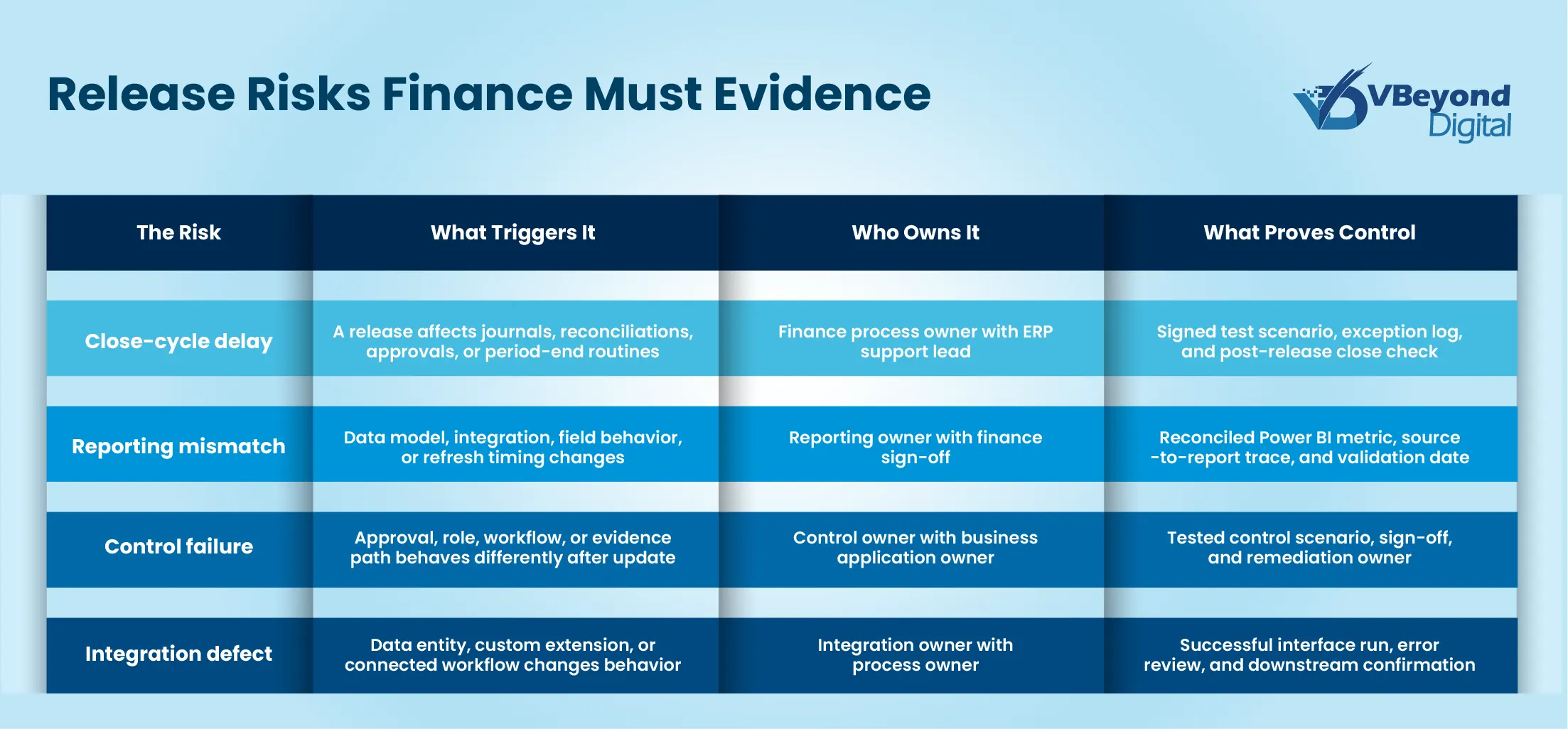
The easy checklist says release reviewed, sandbox validated, users notified, testing complete, production date accepted. That may be enough for low-risk change. It is not enough for close-critical processes. A CFO or control owner needs a different record: which process was tested, which risk was covered, who performed the test, what exception was found, who accepted residual risk, and who owns post-release remediation.
The One Version model makes this evidence discipline harder to avoid. Microsoft’s guidance states that finance and operations apps customers are scheduled for automatic service updates, that updates include application and platform changes, and that environments more than one version behind are moved through sandbox and production updates. The enterprise cannot treat release governance as occasional project hygiene.
The delivery pattern is that release evidence gets created after something fails. Teams reconstruct what was tested, who signed off, which report changed, and whether the issue existed in sandbox. That reconstruction is slow because the evidence was not designed into the release process.
Release governance should preserve a small but durable evidence trail. The record should include release wave, process area, scenario tested, test owner, test result, exceptions, remediation owner, business sign-off, integration validation, report validation, and post-release monitoring period. The value is not paperwork. The value is faster isolation when a close-cycle issue appears.
Power Platform And Copilot Make Release Governance Wider
Dynamics 365 release readiness now extends beyond ERP administration.
Finance and operations teams increasingly depend on Power Platform workflows, Dataverse extensions, Power BI models, and Copilot-enabled experiences around Dynamics 365. A release wave can therefore affect close readiness through a workflow, data connection, security assumption, user experience, or agentic capability rather than through a visible Finance screen.
The Microsoft 2026 release wave 1 announcement highlights AI-powered experiences, Power Platform governance and administration updates, Copilot Studio capabilities, and role-based agents for business applications. That does not mean every enterprise should enable every new capability quickly. It means release governance has to account for the connected Microsoft business application estate.
The weak model assigns each platform to a separate owner and asks each owner for isolated readiness. Finance signs off finance. Power Platform signs off flows. Reporting signs off dashboards. Support waits for tickets. The model looks organized until the defect crosses the boundary.
The better model defines release scenarios by business outcome. A journal approval path should be tested as a finance process, a Power Platform workflow, a role-permission path, a notification path, a support route, and a reporting input where those dependencies exist. A Copilot or agent capability used by finance should be reviewed for data access, enablement, evidence, and user support before it is treated as business-ready.
That is why Microsoft Power Platform governance has to be part of Dynamics 365 release governance. Separate administration does not remove shared business risk.
Finance Should Define Readiness Before IT Confirms Deployment
Release readiness fails when finance receives a status update instead of setting the standard.
The CIO may own the platform. The ERP team may own release coordination. The managed-services team may own monitoring and support. Those roles are necessary, but the finance close standard belongs to finance. If a release can affect close timing, control evidence, reporting confidence, or sign-off quality, finance leaders should define what ready means before IT confirms that deployment is complete.
This does not require a CFO to inspect every release note. It requires finance leadership to name the processes that cannot fail quietly: record-to-report, allocations, bank reconciliation, intercompany, tax, consolidation, management reporting, and any workflow that affects close certification. The finance systems owner can then translate those processes into tests, evidence, and sign-off expectations.
The operating model is straightforward when it is kept current. IT owns environment readiness, scheduling, deployment coordination, and technical issue management. Business application owners own process validation and user impact. Finance owns acceptance for close-critical and control-critical scenarios. Reporting and integration owners own downstream confidence. Support owns the post-release path when issues appear.
The problem is not the model. The problem is maintenance. If the process-risk inventory, regression library, report validation list, and support roster are updated only when a release wave begins, the enterprise is already late. Release governance works when those assets are treated as part of ERP operations.
Dynamics 365 consulting services can help connect release planning to that operating model. The value is not a larger checklist. It is a clearer answer to who validates the process, who accepts the risk, and who owns the fix.
The Close Process Needs Its Own Release Memory
The next release wave will not wait for finance to remember what broke last time.
A mature release model keeps memory in the system. It records which close scenarios are sensitive to change, which reports have failed before, which integrations need early validation, which approval paths rely on Power Platform, which roles create control exposure, and which support owners should be ready during the close window.
That record gives the enterprise a different posture. When the release plan arrives, the discussion starts with process risk. When sandbox validation begins, business users test named scenarios. When production updates land, support teams know which signals matter. When close starts, finance is not discovering release readiness for the first time.
VBeyond Digital can assess Dynamics 365 release governance across close-critical scenarios, regression testing, Power BI reporting validation, Power Platform workflows, integration checks, sign-off evidence, and post-release support. The assessment should show whether release readiness is protecting finance continuity or only documenting deployment activity.
The release history is part of the control environment.
FAQs (Frequently Asked Question)
Dynamics 365 updates do not automatically disrupt finance close. They can create disruption when release governance does not test close-critical scenarios, integrations, reporting dependencies, approval workflows, and control evidence before production change reaches users.
Dynamics 365 release governance is the operating model for reading release plans, validating sandbox updates, testing business processes, confirming reporting and integration behavior, preserving evidence, assigning business sign-off, and preparing post-release support.
Enterprises should test processes whose failure would delay close, weaken controls, or damage reporting confidence. That usually includes journals, subledger reconciliations, approval workflows, bank matching, intercompany, tax steps, consolidations, integrations, Power BI reports, role-sensitive actions, and exception handling.
Microsoft One Version creates a recurring update model for finance and operations apps. The model gives customers sandbox validation time and service-update structure, but it also means release readiness has to be maintained continuously rather than rebuilt before each wave.
A release-readiness assessment should review the release calendar, process-risk inventory, sandbox validation plan, regression test library, reporting validation, integration checks, Power Platform dependencies, control evidence, sign-off ownership, and post-release support model.

