

Loading...
Section
Table of Contents
Key Takeaways
- The blog explains why generative AI Pilots fail when enterprise workflows, controls and data access are not production-ready.
- It connects enterprise AI failure in production to cost, integration, auditability, prompt variation and weak evaluation.
- It defines how Azure OpenAI production governance supports measurable generative AI ROI and lower risk.
- It positions how VBeyond Digital partners for enterprise AI implementation strategy and production-grade Azure OpenAI Production Architecture.
Introduction: Pilot Value Does Not Prove Production Readiness
Azure OpenAI can reduce support effort, speed up document handling, improve knowledge access, and help teams make faster decisions. These outcomes only become measurable when enterprise AI projects move beyond controlled trials into governed, connected, and observable production systems. That is where many programs stall.
McKinsey’s 2025 global survey found that 88% of respondents report regular AI use in at least one business function, while only about one-third say their organizations have started scaling AI programs across the business.
This is the central issue behind enterprise AI failure in production. Generative AI pilots often prove that a model can answer a narrow question. They do not prove that the business can govern prompts, control cost, trace data, test outputs, manage risk, and connect AI into CRM, ERP, support, finance, and product workflows.
For CIOs, CTOs, IT Directors, Product Heads, and Transformation Leaders, Azure OpenAI production governance is now a business requirement. An enterprise AI governance framework helps convert experimentation into generative AI ROI by making quality, cost, security, and adoption measurable from the start.
Why Azure OpenAI Pilots Break When Scaled
Generative AI Pilots usually start with a narrow scope: one team, one workflow, one dataset, and a small group of users who understand the experiment. That setting can produce fast wins, but it does not reflect production pressure. Enterprise AI projects face different demands when the same assistant must serve multiple departments, follow access rules, read live enterprise data, and produce answers that leaders can measure against cost, quality, and risk.
This is where enterprise AI failure in production often begins. The issue is not only technical performance. It is the absence of Azure OpenAI production governance across the full delivery model.
Common failure points include:
- Integration complexity: A pilot may use uploaded documents or manually selected data. A production system must connect with CRM, ERP, ITSM, contact center, data lake, and identity systems. If these integrations are weak, AI output remains disconnected from business action.
- Uncontrolled usage growth: Azure OpenAI pricing includes pay-as-you-go billing for input and output tokens, while provisioned throughput is available for more predictable workloads. Production teams must plan usage by model, workload type, and traffic pattern.
- Variable agent cost: Microsoft notes that function calling and agent use cases can have variable token usage, which means teams need detailed tokens-per-minute planning before moving steady workloads to provisioned throughput.
- Quota pressure: Azure OpenAI token-per-minute and request-per-minute limits are defined by region, subscription, model, and hosting type, so scaling requires capacity planning across business units and regions.
- No evaluation discipline: Without evaluation frameworks for LLMs, teams cannot test accuracy, consistency, groundedness, latency, safety, or regression before release.
Where Production Failure Shows Up in the Business
Enterprise AI failure in production becomes visible through business metrics before it appears in architecture reviews. A support assistant that worked during generative AI Pilots may increase review time if agents cannot trace source documents. A finance summarization tool may reduce drafting effort but still fail audit review if leaders cannot see which records informed the answer. A product knowledge assistant may get high pilot feedback, then lose adoption when users find inconsistent responses across regions, policies, or customer segments.
These failures usually point to missing Azure OpenAI production governance. Without an enterprise AI governance framework, teams cannot connect usage, output quality, risk, and cost to measurable generative AI ROI.
Key failure signals include:
- Inconsistent answers across teams: If prompts, retrieval settings, and model versions are not managed, the same question can produce different answers across sales, support, finance, or operations.
- Limited auditability: Regulated workflows need records of source data, user identity, prompt version, response output, approval path, and downstream action.
- Cost growth without value tracking: Azure API Management supports token-per-minute limits and token quotas for LLM APIs, including hourly, daily, weekly, monthly, or yearly periods. This matters because unmanaged consumption can turn successful enterprise AI projects into cost centers.
- Security and misuse risk: Prompt Shields in Azure AI Content Safety detect and block adversarial prompt attacks before content generation, which supports Agentic AI risk management for systems that act on tools, documents, or enterprise data.
- Weak data trust: Groundedness detection checks whether LLM responses are based on provided source material, helping teams reduce unsupported or fabricated outputs in RAG and knowledge workflows.
What a Production-Ready Azure OpenAI Setup Requires
A production system needs more than model access. It needs Azure OpenAI production governance built into architecture, delivery, measurement, and daily operations. The goal is practical: reduce handling time, improve knowledge accuracy, control consumption, protect enterprise data, and prove generative AI ROI through business metrics.
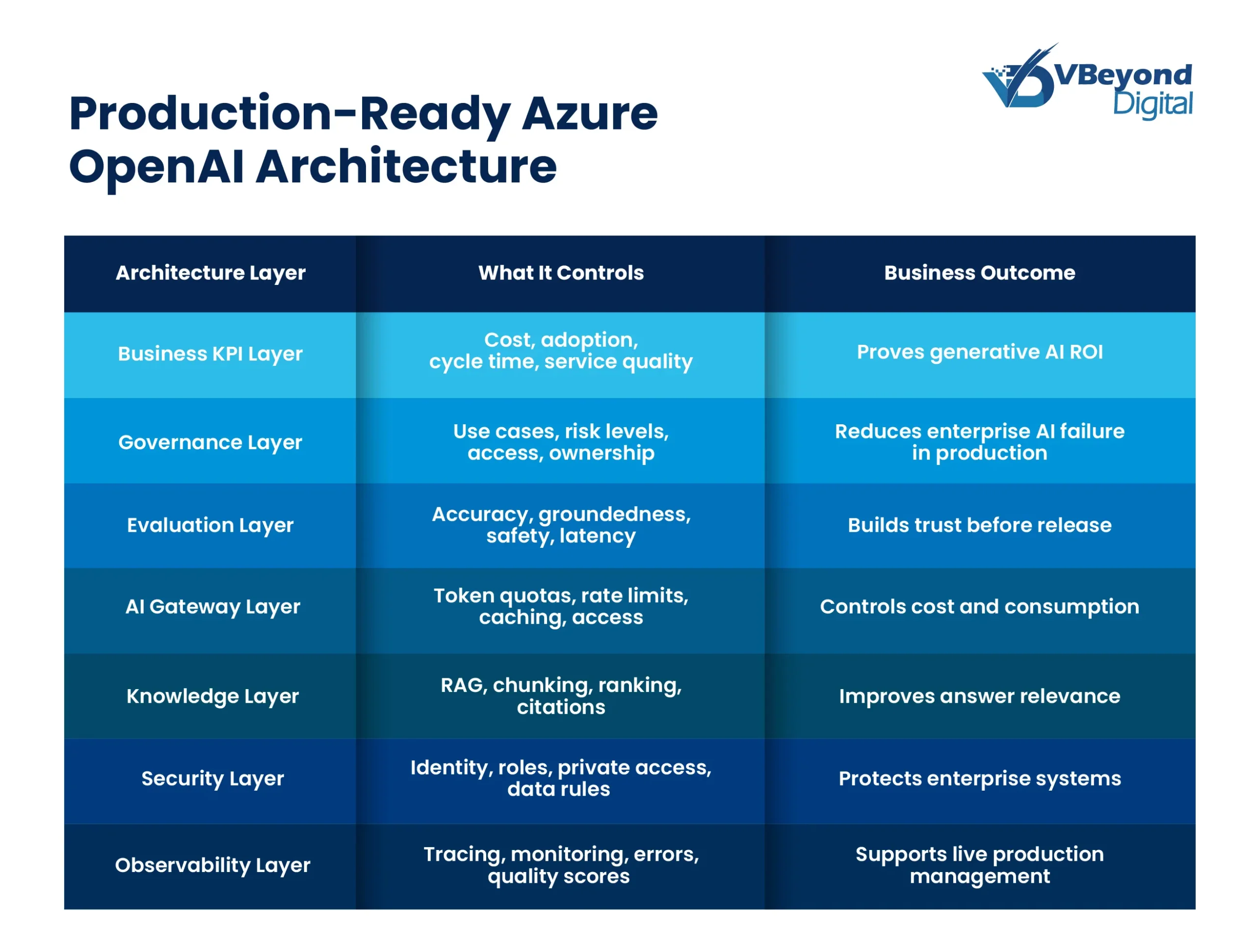
A strong Azure OpenAI Production Architecture should include these operating layers:
- Business KPI layer: Define the measurable outcome before build work starts. Examples include lower average handling time in support, faster proposal drafting in sales, shorter document review cycles in legal, or reduced manual triage in IT operations.
- Enterprise AI governance framework: Set rules for approved use cases, risk levels, data boundaries, user access, prompt ownership, model selection, and human review. This reduces enterprise AI failure in production by making accountability clear.
- Evaluation layer: Use evaluation frameworks for LLMs to test accuracy, groundedness, relevance, consistency, safety, latency, and cost before release. Microsoft Foundry Observability supports evaluation, monitoring, and tracing, and connects with Azure Monitor Application Insights for production visibility into performance, safety, and quality metrics.
- AI gateway layer: Place Azure API Management in front of model endpoints to manage authentication, authorization, token quotas, rate limits, semantic caching, and access policies. Microsoft describes Azure API Management as an AI gateway for governing models, agents, and MCP servers, with token quotas, semantic caching, and content safety controls for model access.
- Knowledge and retrieval layer: For RAG use cases, design content ingestion, chunking, vectorization, metadata, permissions, semantic ranking, and citation behavior. Azure AI Search supports classic RAG and agentic retrieval, with capabilities such as automatic chunking, OCR, multilingual analyzers, integrated vectorization, synonym maps, and semantic ranking.
- Security and data access layer: Production workloads need identity-based access, role controls, private networking, and restricted access to enterprise data. Microsoft documents Azure OpenAI On Your Data configuration with Microsoft Entra ID role-based access control, virtual networks, and private endpoints.
Scale Azure OpenAI with confidence
Conclusion: Move from Pilot Wins to Governed Business Value
Enterprise AI projects create measurable value only when generative AI Pilots mature into governed production systems. Only about one-third of organizations are scaling AI programs across the business, which reinforces why Azure OpenAI production governance is critical for CIOs, CTOs, IT Directors, Product Heads, and Transformation Leaders. A strong enterprise AI governance framework, evaluation frameworks for LLMs, Azure AI Foundry evaluation, Agentic AI risk management, and a well-defined Azure OpenAI Production Architecture help reduce enterprise AI failure in production and connect AI usage to generative AI ROI.
VBeyond Digital helps leaders define the enterprise AI implementation strategy, engineering controls, and workflow integrations required to move from experimentation to measurable business outcomes.
FAQs (Frequently Asked Question)
Pilots run in controlled settings with limited users, curated data and narrow workflows. Production exposes integration gaps, cost growth, weak governance, missing evaluation, and audit needs. MIT NANDA’s 2025 report found only 5 percent of evaluated task-specific GenAI tools reached production.
There is no universally accepted average. Some 2026 secondary sources cite $7.2 million as average sunk cost for an abandoned large enterprise AI initiative, but this should be treated as directional, not a standard benchmark.
Use Azure API Management token limits, quotas by time period, rate controls, semantic caching, model routing, output-length rules, usage dashboards, and budget alerts. Microsoft documents token-per-minute limits and quotas for LLM APIs in Azure API Management.
Production prompt governance needs version control, ownership, approval flows, testing, rollback, prompt logs, access controls and evaluation frameworks for LLMs. Azure AI Foundry evaluation and observability can test quality, safety, groundedness and production performance.
Weak integration keeps AI outside daily work. If systems cannot read enterprise data, respect permissions, update records or trigger business actions, adoption drops and generative AI ROI remains unclear. MIT linked GenAI failure to brittle workflows and poor fit with daily operations.

