


Loading...
ERP integration reliability depends on knowing which failures can be replayed, who decides, and what evidence remains afterward.
Section
Table of Contents
- Introduction
- A Green Dashboard Does Not Settle Whether the Business Process Finished
- Every Integration Needs a Business-Impact Tier Before It Needs Another Alert
- Resubmission Is a Business Decision Disguised as a Technical Action
- Human Review Belongs Where a Correction Can Change a Business Record
- Incident Ownership Cannot Stop at the Integration Team
- Audit Trails Matter Only When They Reconstruct the Decision
- Start with the Transactions the Business Cannot Reconstruct Later
- FAQs (Frequently Asked Question)
Key Takeaways
- How to identify the ERP integration paths where a late or duplicated transaction can affect close, procurement, reporting, or fulfillment.
- How to decide whether a failed Oracle Integration Cloud instance should be replayed, corrected first, or escalated to a business owner.
- Which responsibilities belong with the integration team, the ERP process owner, and the person who can accept a correction to a high-impact record.
- What incident and audit evidence should remain after an integration failure has been resolved.
Introduction
When an ERP transaction fails after it has left one system and before the next system has accepted it, who decides whether to send it again? The integration developer may see a failed instance. The procurement manager may see an order that never reached a supplier. Finance may see the same amount twice when a retry succeeds after an uncertain response. Each view is accurate. None of them is enough on its own.
That question becomes urgent after go-live, when Oracle Integration Cloud sits between Fusion ERP, supplier systems, banks, planning tools, data platforms, and customer operations. The platform can expose status, errors, activity streams, audit information, and instance-level details. The production discipline begins when those signals are connected to a business process, an accountable owner, and a defined recovery decision.
A Green Dashboard Does Not Settle Whether the Business Process Finished
An integration can complete its technical path and still leave the business process incomplete. A message can reach a target system with a value that is rejected later, arrive after a cutoff, or create a record that a downstream team must reconcile. The status screen tells the integration owner where to look. It cannot tell a finance or procurement leader whether the transaction has become safe to rely on.
A fair objection is that dashboards already expose the number of successful, errored, and aborted instances. They do. Oracle Integration’s recent observability updates add audit visibility around activity-stream viewing, business identifiers in the audit trail, approval-flow notifications, and Log Analytics integration for human-in-the-loop workflows. Those capabilities create a stronger technical record, yet they still require the enterprise to decide which records matter enough to trigger action.
The reliable starting point is a critical-path map, not a list of integrations. It identifies the transaction type, source, target, business identifier, expected volume, cutoff sensitivity, downstream dependency, and business owner. A journal feed during close, a supplier-master update before a procurement run, and a product-availability event for fulfillment should not share the same alert threshold or recovery authority. The pattern across post-go-live programs is that teams can describe the connection long before they can describe the business consequence of its delay.
Every Integration Needs a Business-Impact Tier Before It Needs Another Alert
Alerts create attention. They do not create a decision. If every failed instance reaches the same queue, the integration team will spend its day sorting technical errors while a failed payment, procurement approval, or order event waits behind lower-risk work.
The obvious pushback is that a tiering model adds administration to a platform that should already be automated. It does, but the alternative pushes the classification work into the middle of an incident, when the transaction context is hardest to reconstruct. Tier-one paths should cover processes where a delay, duplicate, or out-of-sequence record can affect close, customer commitments, inventory, or a regulated approval. Tier-two paths can affect operational reporting or a scheduled business process. Lower-impact paths can follow a standard recovery route with less immediate business involvement.
The tier should set the monitoring threshold, the escalation target, the evidence retained, and the rule for resubmission. Oracle’s current Integration 3 release notes describe observability enhancements for integration statistics, instance filtering, business identifiers, and activity-stream data. The control design decides which of those signals reaches which owner and how quickly.
Resubmission Is a Business Decision Disguised as a Technical Action
The most expensive integration incident is often the one that looks fixed after a resubmission. A technical retry can be correct when the target was unavailable and no business action was accepted. It can also create a duplicate payment, order, journal, or notification when the target processed the first message, but the source did not receive confirmation.
The counterargument writes itself: automated retry protects availability and prevents manual work. It does for transient, well-understood conditions. The problem begins when the failure state is ambiguous, the message changes after correction, or a replay occurs after an ERP user has already intervened. Oracle’s release guidance covers integration status, instance filtering, activity-stream data, and retry-related operational capabilities. Those controls expose the recovery path; they do not assign the authority to use it.
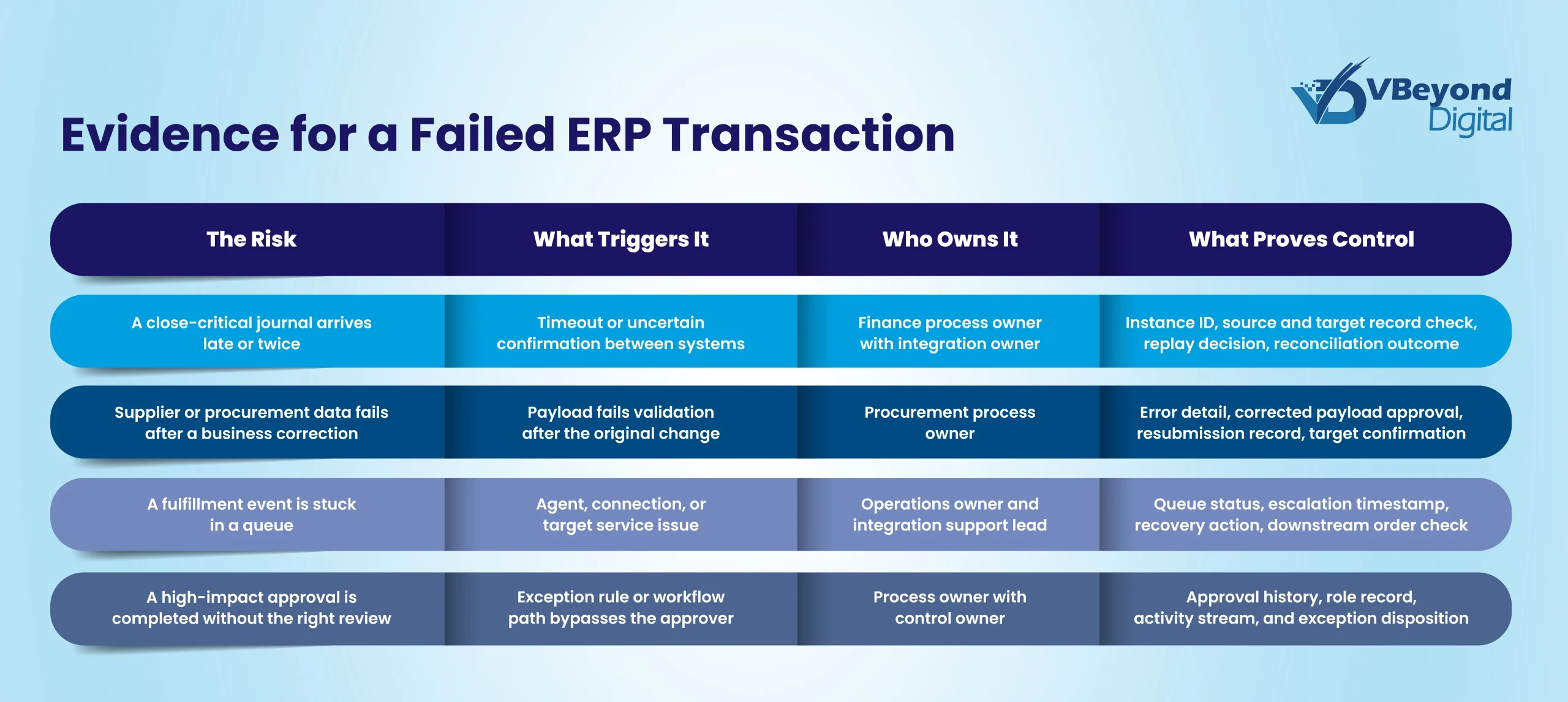
The replay rule should be explicit for each critical path. It needs to state whether the integration owner may resubmit automatically, whether the source or target record must be checked first, who approves a corrected payload, how duplicates are detected, what time window is safe for replay, and when a business owner takes over. This is where Oracle integration services become an operational question rather than a connectivity question. The integration team owns the technical path. The process owner owns the consequence of sending the business transaction again.
Human Review Belongs Where a Correction Can Change a Business Record
Human intervention is not necessary for every integration error. It belongs where a retry could alter a financial record, release an order, change supplier or customer data, bypass a control, or create a decision that the system cannot safely infer. Too much review slows routine recovery. Too little review leaves a developer deciding whether an operational consequence is acceptable.
A reasonable objection is that approval steps become a bottleneck during high-volume processing. They can. The answer is to limit human-in-the-loop controls to exceptions that carry a material business effect and to define the reviewer, response time, fallback owner, and escalation path in advance. Stan Tanev, Product Manager for OCI Process Automation at Oracle, describes the same pattern: an agent pauses while a structured approval workflow records the human response before the next action. That prerequisite is more than setup work. It is a reminder that authority has to exist before the exception arrives.
The control has to record who reviewed the exception, what they saw, what they decided, and how the integration proceeded afterward. A person approving a resubmission without the business identifier, the source and target status, and the reason the first attempt failed is only approving uncertainty. For agentic or automated workflows, the same discipline prevents a process from silently stepping past the point where human judgment was required.
Incident Ownership Cannot Stop at the Integration Team
An integration team can resolve a connectivity error and still leave the enterprise with an unreconciled business record. A finance team can identify the missing journal and still lack the authority to inspect the error or reprocess the instance. The gap appears when responsibility is divided by application boundary rather than by the transaction that failed.
Some leaders will argue that a single incident manager can coordinate every failure. That helps during a severe outage. Daily reliability depends on clearer ownership before the incident reaches that scale. Every tier-one integration needs an integration owner, a business-process owner, a technical recovery owner, and a control owner for audit evidence. The same roles should appear in the runbook, the monitoring dashboard, and the post-incident review. If a record crosses Oracle Fusion, a data platform, and a reporting model, the ownership chain should cross those boundaries too.
This is particularly important where downstream metrics become a proxy for operational performance. A late or duplicated ERP transaction can make a dashboard appear wrong when the reporting model has faithfully reflected the data it received. Reporting control gaps after Oracle Fusion go-live show why integration monitoring and downstream reporting reliability cannot be run as unrelated workstreams.
Audit Trails Matter Only When They Reconstruct the Decision
An activity stream can show that an error occurred. An audit trail can show that a person changed a connection, viewed a flow, or resubmitted an instance. Neither record on its own reconstructs the decision to correct a business transaction, which is what internal audit and process owners need when the same incident is examined weeks later.
Evidence suggests that a usable incident record should link the business identifier, instance ID, failure category, source and target state, decision owner, correction made, replay or resubmission outcome, and reconciliation result. The record also needs the timestamp at which the business owner was informed when a tier-one path failed. This makes it possible to distinguish a short technical interruption from a failure that changed close, procurement, fulfillment, or reporting.
The newest Oracle Integration release notes add activity-stream audit events and business identifiers to audit trails, while the current Integration 3 release notes describe the status and performance information available for running integrations. The information exists. The operating model decides whether it remains a technical log or becomes evidence of a controlled business decision.
Start with the Transactions the Business Cannot Reconstruct Later
The first step is not a platform-wide error-handling project. It is a working session around the small number of integration paths whose failure would force finance, procurement, supply chain, or customer operations to reconstruct what happened from several systems. Map the transaction, the owner, the monitoring signal, the replay rule, the human decision point, and the evidence retained. Then test the recovery path before the next business cutoff makes the defect visible.
VBeyond Digital can conduct an Oracle Integration Cloud reliability assessment across critical ERP paths, monitoring thresholds, recovery rules, ownership, and audit evidence. Start with the integrations that the business cannot reconstruct later.
Turn Azure Chargeback Disputes Into Clear Cost Decisions
FAQs (Frequently Asked Question)
Identify the ERP transaction paths that have a defined business cutoff or downstream control dependency. For each path, name the source, target, business identifier, process owner, technical owner, monitoring threshold, recovery rule, and evidence needed after an incident. The map should focus on critical transactions rather than every integration in the tenant.
Resubmit only after the owner knows whether the target system accepted, rejected, or partially processed the original message. A transient connection failure with no accepted business action can follow a standard retry route. A failure involving an uncertain confirmation, a corrected payload, or a financial or operational record requires a defined review before replay.
Observability exposes the health and movement of integrations through dashboards, instances, errors, logs, and audit information. It does not prevent every failure, and it cannot decide the business consequence of a late, duplicated, or corrected record. The monitoring signal needs an owner and a recovery rule.
Use human intervention for exceptions where the next action can change a financial record, release a supplier or customer transaction, bypass an approval, or create a business consequence that an automated rule cannot safely resolve. Routine, low-impact technical retries should remain automated when their behavior is understood and tested.
The record should preserve the business identifier, integration instance ID, error detail, source and target status, accountable owner, recovery decision, payload correction where applicable, resubmission outcome, and reconciliation result. For high-impact flows, include the escalation and approval record as well.
