


Loading...
Oracle Database@Azure changes the placement question. It does not remove the operating decisions behind it.
Section
Table of Contents
- Introduction
- Platform Proximity Does Not Settle Ownership
- Identity And Network Design Decide More Than Latency
- Cost Governance Has To Follow The Boundary
- Support Paths Have To Be Designed Before The Incident
- Reporting And AI Workloads Change The Placement Question
- Workload Placement Needs A Decision Model, Not A Preference
- The Placement Decision Is Still Waiting For An Owner
- FAQs (Frequently Asked Question)
Key Takeaways
- How to decide whether an Oracle workload belongs on Oracle Database@Azure, stays on OCI, remains on-premises, or needs another placement path.
- Why workload placement must settle ownership for identity, networking, keys, monitoring, cost, support, and performance before migration work begins.
- What current Oracle Database@Azure documentation means for Azure subscription onboarding, delegated networking, multicloud links, and operational accountability.
- How to assess whether Oracle and Azure teams share enough control evidence to support ERP continuity, analytics reliability, and incident resolution.
Introduction
If Azure already runs the enterprise applications, analytics, AI services, integration layer, identity controls, and reporting estate, is the Oracle workload-placement decision still a cloud decision?
It is tempting to answer yes. Oracle Database@Azure gives enterprises a practical way to bring Oracle database services close to Azure workloads without treating Oracle modernization as a detached cloud programme. Current Microsoft documentation describes Oracle AI Database@Azure as Oracle database services running on OCI infrastructure in Microsoft datacenters, with Azure subscription onboarding, delegated subnet models, OCI multicloud links, and Azure-based access paths in the service overview.
That architecture changes the choices available to CIOs and enterprise architects. It does not make the placement decision automatic. The harder question is not whether Oracle can run closer to Azure. The harder question is who owns the result after the workload is placed there.
Performance, identity, networking, monitoring, cost allocation, backup, disaster recovery, support escalation, and reporting continuity do not belong cleanly to one platform team when Oracle services, Azure workloads, and OCI infrastructure meet inside one operating model. The placement decision may reduce one kind of complexity while creating another.
For enterprises modernizing ERP, analytics, integration, and AI around Azure, Oracle Database@Azure should be evaluated as a workload-placement model, not a migration shortcut. The difference matters because a migration asks where the database can run. Placement asks who owns the service once business continuity depends on it.
Platform Proximity Does Not Settle Ownership
Oracle Database@Azure can bring Oracle database services closer to Azure applications. It cannot decide who owns the cross-cloud control model.
The common migration narrative is attractive because it simplifies the story. Oracle workloads sit beside Azure applications. Data paths shorten. Azure-native teams can manage more of the surrounding application, analytics, and integration estate. Oracle and Microsoft designed Oracle Database@Azure to bring Oracle database services running on OCI infrastructure into Microsoft datacenters, reducing the distance between Oracle data services and Azure applications.
The operating model is less simple. The database service may be consumed through Azure subscription and portal flows, while OCI infrastructure and Oracle service responsibilities remain part of the architecture. Networking, support paths, service limits, identity mappings, operational telemetry, and commercial treatment require explicit ownership. If those decisions are left until after placement, the enterprise gets proximity before accountability.
The pattern in Oracle-Azure architecture reviews is that teams often agree on the platform direction before they agree on the operating boundary. The Azure team assumes it owns the application path. The Oracle team assumes it owns database behavior. Security assumes identity and key decisions follow existing standards. Finance assumes cloud cost will be attributable. Support assumes incidents will route cleanly. Each assumption is reasonable. Together, they create the risk.
That is why Oracle platform services have to be discussed with Azure architecture, not after it. A workload-placement decision is safe only when the enterprise can name which team owns database performance, network reachability, identity access, key governance, backup evidence, cost movement, monitoring signals, and escalation during an incident.
Prepare Oracle Workloads for Azure Operations and Support.
Identity And Network Design Decide More Than Latency
The first workload-placement question is often latency. The better first question is control.
Latency matters. An ERP integration, finance reporting process, analytics workload, or low-latency application path can justify a placement model that reduces distance between Oracle data and Azure services. Current Microsoft guidance for Oracle AI Database@Azure networking describes delegated subnet requirements, virtual network planning, CIDR considerations, network security groups, service endpoints, and routing requirements in network planning documentation.
The mistake is treating that network design as a technical precondition rather than a governance decision. A subnet choice can affect who can reach the service. A routing decision can affect which team diagnoses latency. A security group can affect how access exceptions are handled. A private endpoint, DNS decision, or connectivity pattern can affect the incident path between application, database, and network teams.
Identity works the same way. Azure teams may think in Microsoft Entra ID, role-based access control, subscriptions, policies, and resource groups. Oracle teams may think in database roles, OCI constructs, administrative accounts, and database-level privileges. The placement model has to explain how those controls meet. Otherwise, access governance becomes two partial models with no single owner of the business risk.
In practice, the strongest placement decisions begin with a control map. The map names which identity system governs which action, which network path carries which traffic, which team approves access, which team investigates failed connectivity, and which logs prove that the path worked as designed. Without that map, the enterprise may improve architecture proximity while weakening operational clarity.
Microsoft Azure cloud architecture becomes relevant here because the Azure landing zone is not just a hosting container. It is where identity, network, policy, observability, and application connectivity decisions become enforceable.
Cost Governance Has To Follow The Boundary
Cross-cloud placement can make the application architecture cleaner while making cost ownership harder.
A CFO will not accept “multicloud complexity” as an explanation for unclear spend. The cost model has to explain which charges belong to Oracle database service consumption, which belong to Azure infrastructure around the workload, which belong to network traffic, which belong to backup and protection, which belong to monitoring, and which belong to support or managed operations.
The practical concern is not only total cost. It is attribution. A workload may serve an ERP function, a reporting platform, an integration layer, an analytics team, and an AI use case. If the database sits inside an Oracle-Azure model but consuming services sit across Azure applications and reporting systems, finance needs a cost attribution model before the workload scales.
The pattern in multicloud cost reviews is that costs are visible before they are explainable. Subscription owners see Azure spend. Oracle owners see database service consumption. Finance sees a total that needs allocation. Business owners want to know which capability justifies the run rate. Without a placement-specific cost model, the enterprise can end up with better infrastructure and weaker accountability.
Oracle Database@Azure workload placement should therefore include a cost-governance test. Which budget owns the database service. Which product or process owns the application demand. Which team owns network or shared-service cost. Which forecast accounts for backup, disaster recovery, monitoring, and non-production environments. Which unit of value justifies the run rate.
The earlier article on public and private cloud workload decisions makes the same point from a unit-economics angle: placement is a business decision when the workload has material cost, performance, and operational consequences.
Support Paths Have To Be Designed Before The Incident
The most expensive cross-cloud incident is the one where every team is technically involved and no team owns the resolution.
The support model for Oracle Database@Azure cannot be inferred from the architecture diagram. A production incident may involve an Azure application, network path, Oracle database service, OCI infrastructure component, identity decision, backup process, monitoring gap, or integration defect. If the runbook does not name the first responder and escalation path, the incident starts with triage politics.
This is not a criticism of either platform. It is a feature of shared operating models. Each provider and internal team can own its part and still leave the enterprise without a clear resolution owner. The enterprise has to define the control plane for incident response, not only the technical planes that make the workload run.
The pattern in post-placement support reviews is that service ownership is usually clear for steady-state tasks and unclear for boundary failures. A database performance issue that affects an Azure application. A networking issue that appears as a database timeout. A reporting delay that may be database load, integration lag, or semantic model refresh. An access failure that could be identity, privilege, policy, or expired credential.
The operating model should define incident classes before production. Database performance, network reachability, identity access, backup and restore, data replication, reporting freshness, integration failure, and security exception should each have a named owner, escalation route, evidence source, and decision authority.
This is where Azure managed services and Oracle operational support need to be designed together. A service desk that cannot route across the Oracle-Microsoft boundary will discover the boundary during the worst possible hour.
Reporting And AI Workloads Change The Placement Question
Oracle workload placement is not only about ERP continuity. It also affects the data products built around ERP.
Many enterprises use Azure as the platform for analytics, AI, integration, and reporting even when core Oracle systems remain central to finance, supply chain, procurement, or operations. That makes Oracle Database@Azure attractive because it can bring Oracle data closer to Azure-native services. The placement decision, however, should ask whether the reporting and AI teams can trust the data path, evidence model, and access controls after the move.
The obvious assumption is that closer data means easier reporting. Sometimes it does. The evidence still has to be checked. A Power BI model may depend on refresh timing, source consistency, semantic-layer ownership, and access rules. An AI or analytics use case may depend on data lineage, allowed-use boundaries, and reproducible extraction logic. A finance report may depend on reconciliation between Oracle source data and Azure reporting transformations.
In delivery reviews, reporting risk often appears late because the database migration is treated as the major event. The reporting layer is tested for connectivity, not meaning. The dashboard refreshes, but the business metric is subtly different. The data pipeline runs, but the ownership of source-to-report reconciliation is unclear. The AI use case consumes data, but the approved-use rule is not visible to the platform team.
Placement governance should include downstream data consumers from the start. If an Oracle workload supports executive reporting, the test plan should include source-to-report reconciliation, refresh timing, semantic model ownership, exception handling, and sign-off from the business owner who relies on the metric.
Power BI governance becomes part of the workload-placement decision when Oracle data feeds Azure reporting. The database location matters less than whether the reported number can be traced, explained, and defended.
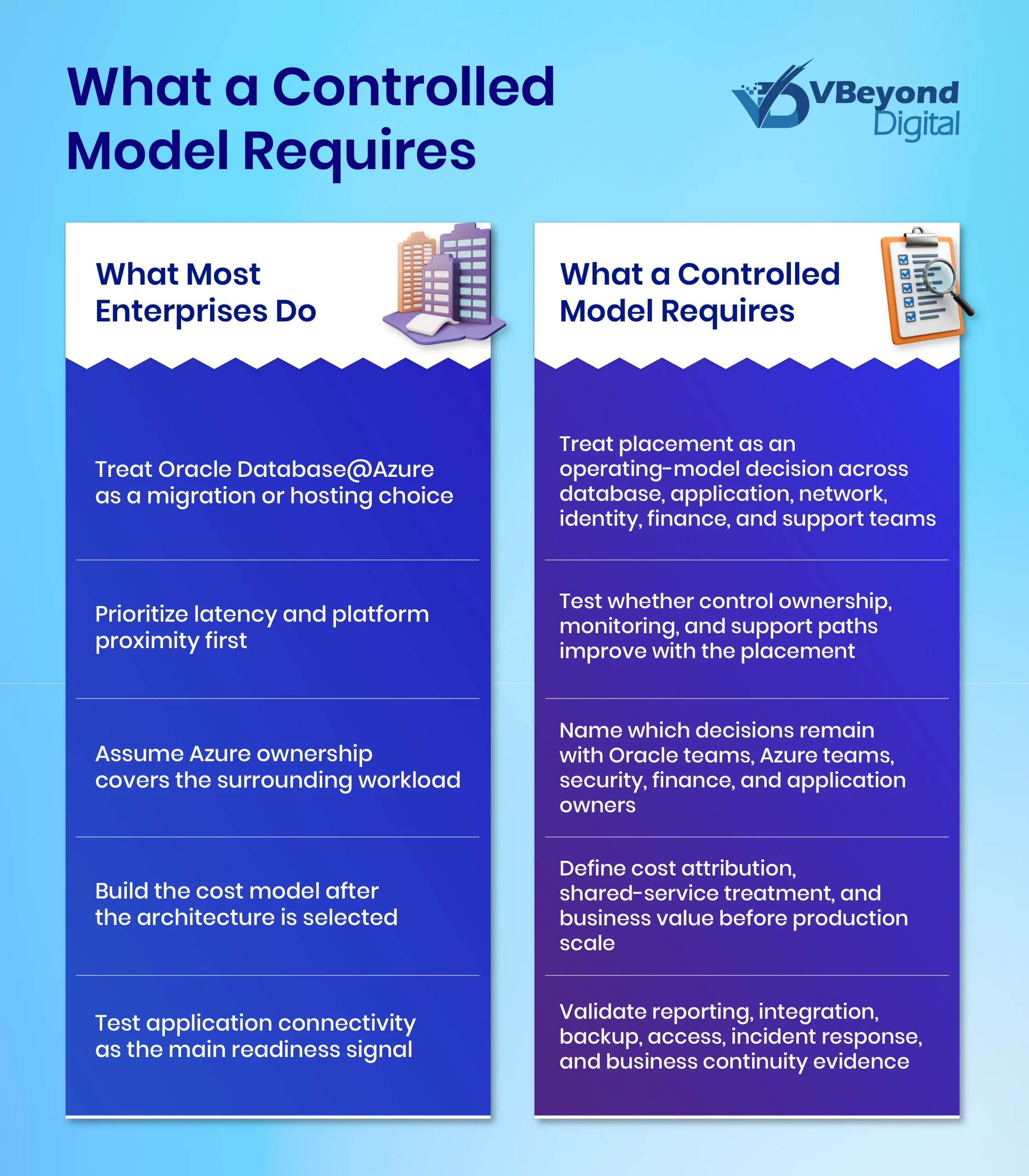
Workload Placement Needs A Decision Model, Not A Preference
The enterprise does not need one answer for all Oracle workloads.
Some workloads may fit Oracle Database@Azure because they need proximity to Azure applications, analytics, AI services, or integration layers. Some may remain better placed in OCI, on-premises, or another architecture because of latency pattern, regulatory treatment, operational maturity, licensing, support, customization, or business-continuity constraints. The placement decision should expose those differences rather than hide them.
The decision model should start with workload character. Is the workload tied to finance close, ERP transaction throughput, analytics extraction, AI consumption, integration, reporting, or disaster recovery. Does it need low-latency access to Azure services. Which team owns the application. Which team owns database operations. Which controls must be preserved. Which support path will carry the first incident.
Then the model should test placement consequences. What changes in network design. What changes in identity administration. What changes in cost attribution. What changes in monitoring. What changes in backup, restore, and disaster recovery evidence. What changes in support ownership. What changes in downstream reporting and data use.
The strongest Oracle Database@Azure decisions are not framed as cloud preference. They are framed as operating readiness. A workload belongs where the enterprise can meet performance, control, cost, security, support, and business-continuity requirements with named owners and visible evidence.
This is why the earlier Oracle Database@Azure architecture checklist remains relevant. Architecture decisions matter most when they are tied to the operational proof leaders need after go-live.
The Placement Decision Is Still Waiting For An Owner
The question at the start was whether Oracle workload placement is still a cloud decision when Azure is already everywhere.
It is partly a cloud decision. It is also a finance decision, a security decision, an integration decision, a reporting decision, and a support decision. Oracle Database@Azure gives the enterprise a new placement option. It does not answer who owns performance, identity, keys, access, monitoring, cost allocation, data movement, or incident resolution after that option becomes production architecture.
VBeyond Digital can assess Oracle Database@Azure workload placement across Oracle platform services, Azure architecture, network and identity design, reporting dependencies, cost governance, integration patterns, and managed operations. The assessment should help leaders decide where each workload belongs and what operating model must exist before it moves: if an Oracle workload moves closer to Azure, who owns the incident when performance, identity, and cost evidence cross the Oracle-Microsoft line?
FAQs (Frequently Asked Question)
Oracle Database@Azure workload placement is the decision process for determining which Oracle databases or Oracle-dependent workloads should run through Oracle database services deployed in Azure datacenters, and which should remain in OCI, on-premises, or another architecture. The decision should account for performance, identity, network design, cost, support, integration, and business continuity.
No. Oracle Database@Azure creates another placement option, not a universal rule. Some workloads may benefit from closer integration with Azure applications, analytics, and AI services. Others may have operational, cost, latency, regulatory, or support constraints that point to another placement model.
Enterprises should define workload ownership, identity and access control, network routing, monitoring, backup and recovery evidence, cost attribution, support escalation, integration testing, and reporting validation before production placement. These decisions shape whether the architecture is operable after migration.
Oracle Database@Azure can shift how costs appear across Oracle and Azure operating models. Finance teams need to know which budget owns the database service, which workloads consume it, how shared services are allocated, and which business outcome justifies the run rate.
A placement assessment should examine workload criticality, latency requirements, Oracle and Azure ownership boundaries, identity model, network design, cost attribution, monitoring, backup and disaster recovery, reporting dependencies, integration paths, and incident support. The output should be a placement recommendation tied to operating ownership.

