


Loading...
Section
Key Takeaways
- 56% of CEOs report zero financial returns from artificial intelligence investments, highlighting a critical failure to convert technology spending into measurable business value.
- The core problem is not technology access, but severe execution gaps across business workflows, legacy system integration, and financial performance tracking.
- Leading organizations achieve positive returns by building rigid data foundations, establishing strict risk governance, and embedding artificial intelligence directly into core product lines.
- Technical leaders must pivot from isolated experimentation to operational discipline by tying every use case to concrete metrics like margin contribution and turnaround time.
Introduction
Across the global corporate environment, a frustrating reality is taking hold. Massive investments in artificial intelligence are frequently failing to move the business metrics that matter most: revenue, costs, and profit margins. For CIOs, CTOs, and product heads, the pressure is mounting to convert technology spending into measurable business value. The disconnect between heavy capital expenditure and actual financial returns points to a deep systemic issue within modern IT operating models. We bring clarity and velocity to your digital initiatives by helping technical leaders bridge the gap between initial testing phases and actual operational profitability.
According to PwC’s 29th Global CEO Survey, which gathered insights from 4,454 business leaders across 95 countries between September 30 and November 10, 2025, a staggering 56% of CEOs reported neither higher revenues nor lower costs from artificial intelligence over the past 12 months. While “zero ROI” serves as a headline shorthand for this lack of clear financial benefit, the missing AI ROI for CEOs highlights a critical failure in translating technical capability into true business value. The same survey indicates that only 12% of organizations have successfully reported both revenue gains and cost reductions. This raises serious questions about the true AI return on investment and the current efficacy of many enterprise AI solutions available on the market.
The core problem is not a lack of access to advanced models or computing power. Rather, the root cause lies in poor execution across workflows, core business systems, governance frameworks, and financial measurement. Many organizations are struggling with severe AI implementation challenges, leaving their projects stuck in isolated pilot programs that never reach full production scale. To realize a tangible AI return on investment, leaders must shift their focus from acquiring isolated tools to embedding data models deeply into the core operational workflows of the business.
This article examines the root causes of stagnant AI adoption in enterprises and outlines the exact steps IT directors and product heads must take to align artificial intelligence with tangible financial outcomes in the coming year.
Why AI Spend Still Fails to Show Up in Business Result
While initial pilot programs often generate internal excitement, translating isolated technical wins into a measurable AI return on investment remains a severe hurdle for corporate leadership. The data from the PwC 2026 Global CEO Survey press release illustrates a fragmented reality. Currently, 30% of surveyed CEOs observed additional revenue from artificial intelligence, and 26% noted lower operational costs. However, these isolated successes are simply not prevalent enough to shift the macro-level financial picture. In fact, a concerning 22% of respondents reported higher overall costs due to their AI initiatives. This highlights a critical reality for leaders facing rising model training fees, integration overhead, and workflow redesign expenses.
The core issue driving these AI implementation challenges is not a lack of experimentation; IT teams are testing models at record rates. The actual failure point is the massive operational divide between running localized, tactical projects and executing an enterprise AI strategy at full production scale. According to the PwC press release summary, only 33% of organizations reported financial gains in either cost reduction or revenue generation, leaving the majority completely stagnant.
When investigating why AI projects fail, technical leaders must address several practical roadblocks.
- First, integration complexity severely limits progress. Connecting new algorithms into legacy core systems and established business processes requires exact architectural planning.
- Second, there is often limited visibility into where tools are active and what specific metrics they are changing. Without a clear dashboard for measuring AI impact, financial attribution becomes impossible.
- Third, scalability problems emerge when successful algorithms remain trapped inside local pilots, unable to serve the broader organization. Finally, risk exposure increases dramatically when responsible governance, data policy controls, and legal review processes lag rapid generative AI adoption.
Ultimately, artificial intelligence can raise local task output, yet these tools will still miss board-level business metrics if they are not explicitly tied to operating workflows and measured strictly against cost and revenue outcomes. To address this gap, organizations need structured execution frameworks that bring clarity and velocity to digital initiatives.
What the 12% Firms Are Doing Differently
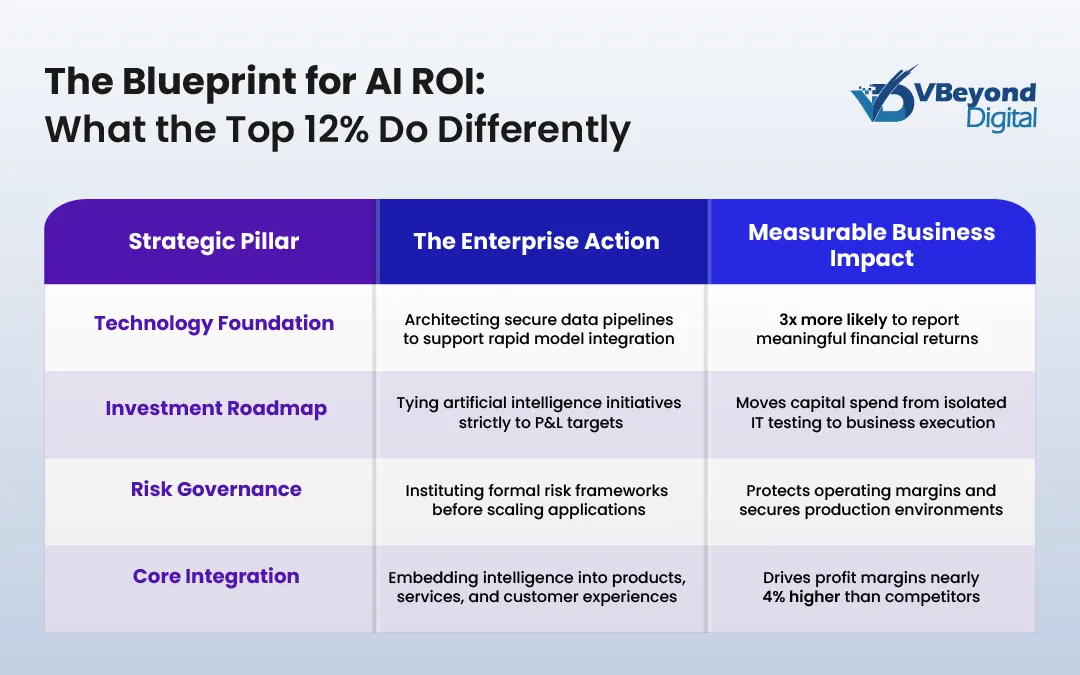
The organizations successfully driving financial returns are not simply spending more capital. They are operating fundamentally differently. According to PwC, the 12% of firms reporting both revenue gains and cost reductions are the ones furthest ahead in building rigid technical foundations. These leaders treat their enterprise AI strategy not as an isolated IT experiment, but as a core driver of business execution. When establishing an AI transformation strategy, the contrast between success and failure becomes obvious. The most successful organizations move beyond standalone algorithms and embed intelligence directly into their operating models. To achieve this level of operational maturity, organizations require precise execution. From strategy to build, we help tech leaders turn these technical initiatives into measurable outcomes by bridging the gap between localized testing and full-scale production.
PwC explicitly notes that CEOs whose organizations possess stronger technical foundations are three times more likely to report meaningful financial returns. Building this baseline requires strict discipline across four critical pillars:
- A structured technology environment: Architecting data pipelines and infrastructure that actively support rapid, secure model integration.
- A highly defined roadmap: Moving away from scattered testing and establishing a clear sequence for artificial intelligence initiatives tied directly to P&L goals.
- Formal risk processes: Instituting strict governance and responsible risk frameworks before scaling applications across the business.
- An aligned organizational culture: Securing board leadership and operational support to drive widespread generative AI adoption across daily workflows.
Turn AI investments into outcomes.
Where CIOs and CTOs Should Focus First in 2026
To turn research insights into a practical action sequence, technical leadership teams must shift from broad experimentation to precise operational execution. The most effective enterprise AI strategy begins with a tightly defined set of workflows where business value is measured easily. Ideal starting points include customer support, sales operations, internal engineering, service delivery, or resource planning.
Leaders must use the given findings on limited scaling as a critical reality check. Currently, only a small fraction of CEOs report that artificial intelligence is applied to a large or very large extent in key business areas:
- 22% in demand generation
- 20% in support services
- 19% in products, services, and experiences
- 15% in direction setting
- 13% in demand fulfillment
To overcome these AI implementation challenges, CIOs and CTOs must establish strict operational priorities for 2026.
In practice, this requires structured execution frameworks. From strategy to build, we help tech leaders turn transformation into measurable outcomes by focusing on these foundational elements:
- Build a rigid data and integration layer: Supply AI systems with trusted, secure business data to prevent errors and integration failures.
- Set up strict governance: Institute mandatory reviews for models, risk control, and active cost tracking to protect profit margins.
- Define baseline metrics: Establish current performance levels before any technical work begins, making measuring AI impact a prerequisite rather than an afterthought.
- Create total visibility: Build centralized dashboards across teams so leaders can track spend, technology usage, output quality, and business effect in one place.
- Tie use cases to operating metrics: Connect every individual project to a measurable operating metric such as turnaround time, cost to serve, conversion rates, first contact resolution, defect rate, or margin contribution.
Conclusion
Despite massive industry momentum and escalating capital investments, the majority of CEOs still do not report measurable revenue or cost gains from their artificial intelligence initiatives. This widespread failure to deliver a tangible AI return on investment is the most pressing issue for corporate leadership in 2026.
To overcome AI implementation challenges, technical leaders must pivot their enterprise AI strategy away from isolated pilots. The practical fix is straightforward but requires strict operational discipline. Leaders must build the necessary data architecture, integration layers, rigid governance models, and precise measurement structures first. Only then can they expand generative AI adoption into the workflows that actually dictate revenue, cost, and margin.
We bring clarity and velocity to your digital initiatives. VBeyond Digital partners with IT directors and product heads to build these exact frameworks.
From strategy to build, we help tech leaders turn transformation into measurable outcomes. Whether you are modernizing infrastructure or building a digital-first product team, we help you get there faster with less risk.
FAQs (Frequently Asked Question)
Returns remain low because organizations isolate artificial intelligence in fragmented pilot programs. Companies struggle with integration complexity, lack centralized visibility into performance metrics, and fail to tie algorithm outputs to hard financial targets like cost reduction or revenue generation.
Organizations must shift from broad experimentation to strict operational execution. This requires building secure data layers, establishing rigorous governance models, and embedding intelligent systems directly into daily operational workflows while tracking specific baseline metrics from the start.
The primary hurdles include forcing new algorithms into legacy core systems, managing rising model training costs, and overcoming isolated scalability problems. Additionally, lagging risk frameworks and low daily user adoption rates prevent tools from reaching full production scale.
Successful organizations treat artificial intelligence as a core driver of business execution. They build structured technology environments, institute formal risk processes, and extensively embed intelligent systems directly into products, services, and customer experiences to drive higher profit margins.
CIOs must build rigid data foundations and demand clear visibility across all projects. They should target specific workflows where value is easily measured, such as customer support or sales operations, and explicitly tie every technical use case to operating metrics.

