


The New Global Operating Model: Why a Global Capability Center is a Must-Have for Digital-First Enterprises
Section
Table of Contents
- Why traditional outsourcing and fragmented shared services struggle with digital-first work
- What is a Global Capability Center and why it is showing up in CIO operating plans
- What A Global Capability Center Actually Does in a Digital-First Enterprise
- GCC 3.0: From Cost Arbitrage To AI-Native, Outcome-Owned Centers
- Why GCCs Are Central to a Resilient Global Operating Model
- Operating Model Design: How To Structure A GCC For Digital Outcomes
- AI, Data, And Product: Where GCCs Create Distinct Advantage
- Conclusion: GCCs As A Strategic Requirement, Not A Side Bet
- FAQs (Frequently Asked Question)
- Global Capability Centers are shifting from cost savings to product ownership and AI innovation under the GCC 3.0 model.
- US enterprises prioritize nearshore hubs in Latin America for real-time agile collaboration.
- Agentic AI and platform engineering are redefining workforce productivity and delivery standards.
- Direct oversight mitigates risks in critical programs like Oracle Fusion Cloud ERP.
A global operating mode requires an enterprise-owned control point. The GCC business model provides product, platform, and run ownership with measurable KPIs. GCC vs outsourcing differs on accountability. A GCC for digital enterprises owns roadmaps, architecture standards, and production reliability, not just ticket completion. This structural evolution, driven by the need for innovation rather than just cost arbitrage, moves the model into its next phase. GCC 3.0 shifts charters toward AI-native delivery, shared data foundations, and outcome ownership, including platform engineering and an AI Center of Excellence. GCC setup in nearshore and global hubs benefits from time-zone alignment, talent density, and operational control, which helps reduce delivery risk for critical programs like Oracle Fusion Cloud ERP.
CIOs and CTOs face requests to deliver AI-first features, data-driven customer journeys, and always-on digital products across markets. The pressure is not only about cost. It is about speed, reliability, security, and the ability to scale engineering capacity without losing control of architecture and delivery quality.
The executive conversations have shifted towards a small set of technology outcomes:
- Shorter release cycles for customer-facing and employee-facing products.
- Better data visibility across business units and regions.
- Consolidation of platforms and tooling to reduce complexity and reduce operational risk.
- Stronger security and compliance posture across cloud and SaaS estates.
- Practical AI adoption that fits enterprise controls, not isolated experiments.
This is where the current global operating model often breaks down.
Why traditional outsourcing and fragmented shared services struggle with digital-first work
Outsourcing and multi-vendor shared services can work well for standardized operations. Digital product work is different. It requires deep context, fast decisions, and accountability for measurable outcomes.
Common failure patterns we see in digital programs include:
- Slow decision cycles: Contract structures push decisions through change requests, governance gates, and vendor handoffs. This friction shows up as a longer cycle time from idea to production change.
- Limited product ownership: Vendors typically deliver tickets and milestones. They rarely own a product roadmap, technical debt strategy, or production KPIs end to end.
- Weak alignment with business roadmaps: When engineering capacity is organized around functions instead of product portfolios, teams can stay busy while strategic outcomes slip.
- Difficulty building deep engineering and data capability: Vendor-heavy setups can dilute architectural consistency, standard engineering practices, and institutional knowledge. This becomes a risk when you are modernizing core platforms such as Oracle Fusion Cloud ERP and connecting it to data platforms, integration layers, and customer systems.
The result is a global operating mode that looks staffed but behaves brittle under digital load.
What is a Global Capability Center and why it is showing up in CIO operating plans
Global Capability Center is a dedicated, enterprise-owned capability node that carries real responsibility for building and running technology products and platforms, not a satellite team for back-office work.
The model is being adopted rapidly across the globe. This growth reflects a structural shift where enterprises are reclaiming ownership of their core IP and technology stacks.
Adoption is particularly strong among US enterprises looking for “nearshore” advantages. Regions like Latin America are becoming critical nodes, driven by the need for real-time collaboration in US time zones.
Build your GCC for outcomes.
What A Global Capability Center Actually Does in a Digital-First Enterprise
A modern enterprise GCC is not a remote staffing pool. In a digital-first context, the GCC business model functions as an integrated delivery and run capability that owns measurable outcomes for specific products, platforms, and cross-cutting engineering domains. This definition aligns with how industry bodies describe GCCs as centralized units that provide specialized services for the parent enterprise, including technology and business services.
From “extended back office” to an integrated capability node
When leaders ask “What is a Global Capability Center,” the most useful answer is operational, not descriptive. A GCC for digital enterprises exists to deliver three things that a fragmented vendor setup struggles to deliver: clear ownership, consistent engineering practice, and predictable delivery capacity that maps to business roadmaps.
This shift matters when your portfolio includes complex platform programs such as Oracle Fusion Cloud ERP, where success depends on integration, data quality, security controls, and sustained product support across regions.
Core responsibilities that matter to CIOs and product leaders
In mature programs, GCC charters commonly include responsibilities like the following:
- Product and Platform Engineering: The GCC owns engineering for defined product lines, services, or internal platforms.
- Shared Platforms: The GCC builds and runs shared platforms that teams across regions depend on, including developer platforms (IDPs), CI/CD toolchains, and internal APIs.
- Data Engineering: The GCC runs capabilities that produce governed datasets for analytics and AI use cases.
- AI Center of Excellence: The GCC operates an AI Center of Excellence that standardizes model delivery practices, MLOps routines, and governance controls for enterprise AI work.
- Cybersecurity Engineering: The GCC owns security operations and engineering capabilities that support product teams through threat modeling, secure build practices, and incident response readiness.
- Site Reliability Engineering (SRE): The GCC runs SRE practices that improve production reliability through clear SLOs, error budgets, and incident learning routines.
- FinOps: The GCC runs FinOps practices that improve cloud cost visibility and cost accountability at the product and platform level.
- DevSecOps: The GCC runs DevSecOps practices that integrate security checks into build and release workflows without slowing delivery.
Operating model characteristics of modern GCCs
A GCC for digital enterprises works when the global operating mode is designed for end-to-end accountability.
- The GCC aligns with business lines and product portfolios, not only with functions.
- The GCC owns end-to-end KPIs and OKRs for specific services or products, including reliability, cycle time, and customer-impact metrics.
- The GCC works with HQ product managers and architects through shared planning routines, shared engineering standards, and shared production metrics.
- The GCC uses consistent toolchains and reference patterns across teams, so that quality and security practices remain consistent across regions.
GCC 3.0: From Cost Arbitrage To AI-Native, Outcome-Owned Centers
CIOs and CTOs are no longer asking whether a GCC can reduce run cost. They are asking whether the GCC business model can carry digital and AI work with clear ownership, measurable value, and tight control over IP, data, and engineering standards. That shift is what many leaders describe as GCC 3.0.
The progression to GCC 3.0 is a change in mandate, not just scale
Research on GCC maturity commonly describes three phases:
1. GCC 1.0 primarily focused on cost arbitrage.
2. GCC 2.0 expanded into larger knowledge work and deeper competencies at scale.
3. GCC 3.0 positioned as a value creation center for the enterprise; this means the center is expected to contribute directly to products, platforms, and business outcomes.
What “outcome-owned” looks like inside GCC 3.0
A GCC 3.0 for digital enterprises typically shows the same operating traits across industries.
1) Product and platform ownership, with real decision rights
- The GCC 3.0 owns a defined product or platform scope; it owns the backlog and release plan with business stakeholders.
- The GCC 3.0 takes responsibility for service health and customer impact, not only feature delivery.
- The GCC 3.0 has authority to set engineering standards, reference patterns, and reusable components that other teams must follow.
2) Shared data and AI foundations with governance
- The GCC 3.0 runs the shared data platform, data contracts, and metadata practices that product teams depend on.
- The GCC 3.0 runs MLOps pipelines, model monitoring, and access controls that security teams can audit.
- The GCC 3.0 can host an AI Center of Excellence that sets reference patterns and review gates for model risk, data usage, and production readiness.
3) Control over IP, delivery, and operating cadence
- Unlike outsourcing, where IP risk is higher, GCCs ensure 100% retention of Intellectual Property and complete visibility into the development process.
- That level of ownership is what allows a GCC 3.0 model to carry platform engineering, security engineering, and AI work that cannot sit behind a vendor boundary.
Why GCCs Are Central to a Resilient Global Operating Model
Digital-first enterprises run products across time zones on distributed stacks that mix cloud services, SaaS platforms, APIs, and legacy systems. A global operating model that relies on fragmented shared services and vendor handoffs often fails under this load. The result is slower recovery from incidents, inconsistent engineering standards, and higher integration risk when systems must work together at scale.
The new operating challenge for CIOs and CTOs
Most global enterprises are dealing with three practical constraints at the same time:
1. Enterprises must support customers and employees across regions with 24×7 availability targets.
2. Platforms must integrate across legacy cores, modern microservices, and SaaS suites, including systems like Oracle Fusion Cloud ERP that sit on critical financial and operational workflows.
3. AI and data work must meet security, audit, and governance expectations, while still moving fast enough to deliver measurable business value.
These constraints create failure modes that are easy to recognize in production. Teams ship features without consistent reliability practices, and incident patterns repeat. Data definitions drift across regions, and reporting numbers stop matching across business units. Integration work grows into long dependency chains, and release plans slip because too many teams own small pieces, and nobody owns the full outcome.
How a GCC addresses the operating challenge
A GCC for digital enterprises can act as a stable control point for cross-cutting capabilities that do not fit cleanly inside a single business unit.
- A GCC can own architecture guardrails and reference patterns that product teams must follow.
- A GCC can own security engineering and data governance practices that apply across products and regions.
- A GCC can provide a single home for platform engineering and SRE practices, including service-level objectives, incident response routines, and reliability metrics that remain consistent across teams.
- A GCC can consolidate scattered digital work under one accountable leadership group, which reduces ambiguity in decision rights and reduces duplication.
Location and scale factors that reduce execution risk
For US enterprises, the GCC setup decision is increasingly shaped by “nearshore” advantages.
- Time Zone Alignment: US CIOs are prioritizing locations that allow real-time collaboration. Latin America is emerging as a top alternative, offering overlapping time zones (EST/CST/PST) that enable agile sprints without the “night shift” lag.
- Talent Availability: Regions like Eastern Europe (e.g., Poland, Romania) and Latin America (e.g., Mexico, Colombia, Costa Rica) offer deep engineering talent pools.
Operating Model Design: How To Structure A GCC For Digital Outcomes
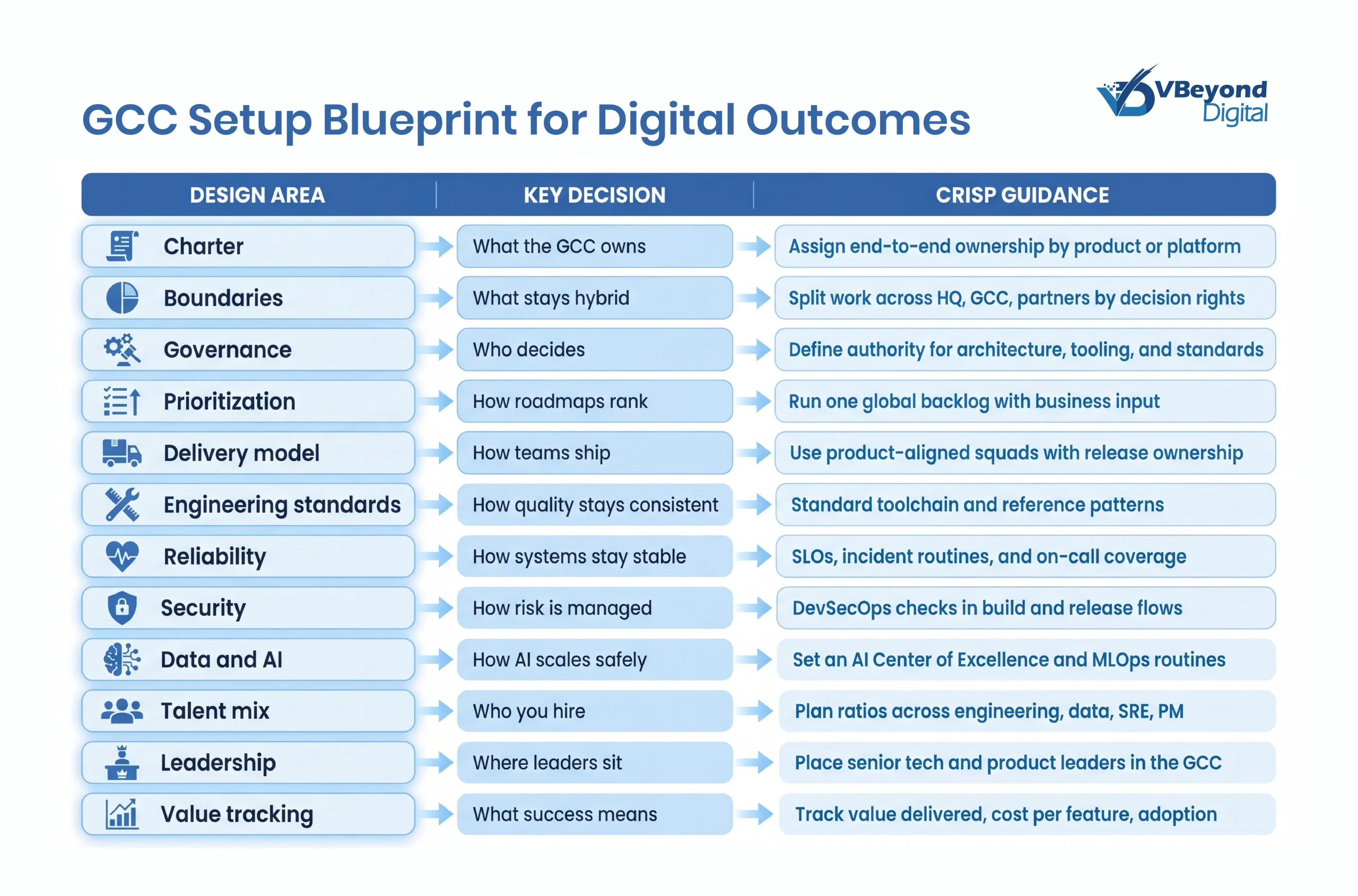
A GCC for digital enterprises only delivers results when the operating model is designed around ownership, decision rights, and measurable outcomes. A large team in one location is not enough. The design must connect product strategy, engineering execution, and production accountability in a single global operating model.
Common GCC archetypes and what they deliver
Most organizations gravitate toward one of these patterns during GCC setup:
1. Landlord centers host teams but do not own outcomes. This model can scale headcount quickly, but it often struggles with consistency because teams remain tied to distant decision makers.
2. Embedded product or capability centers own outcomes for defined domains. This model aligns with the next evolution of GCCs, or GCC 3.0, because it assigns accountability for roadmaps, reliability, and value delivery.
3. Centers attached to Global Business Services operate with a digital-specific charter. This model can work when digital governance is protected from routine process work and when product ownership stays clear.
The second pattern usually performs best for digital programs because it clarifies what is owned inside the GCC business model versus what remains with HQ or partners.
Critical design decisions for digital-first work
1) Scope and charter
A useful charter names the products, platforms, and services that the GCC owns end to end. It also names the boundaries for hybrid ownership across HQ, GCC, and partners. A clear scope can include platform engineering, data engineering, integration engineering, and an AI Center of Excellence. It can also include enterprise programs such as Oracle Fusion Cloud ERP integration services, reporting layers, and governed data pipelines that connect Oracle Fusion Cloud ERP with analytics and customer systems.
2) Governance and decision rights
Governance must specify who decides architecture, tooling, and delivery priorities. The GCC must have defined decision rights for reference patterns, CI/CD standards, and production practices. Roadmap prioritization must include business stakeholders, product owners, and platform owners, with one accountable owner per product or platform.
3) Talent model and leadership
The talent model must match product ownership, not only engineering capacity. The GCC needs a planned mix of engineers, data engineers, SREs, security engineers, and product managers. Career paths must include senior technical leadership based in the GCC, not only at HQ.
AI, Data, And Product: Where GCCs Create Distinct Advantage
AI delivery and data delivery fail when they sit inside scattered teams with inconsistent data definitions, inconsistent security controls, and inconsistent production practices. A GCC for digital enterprises can fix that failure mode because the GCC business model can hold long-term ownership of shared platforms, governance, and product outcomes inside one global operating mode.
AI and data are primary drivers for GCC expansion
A GCC that carries AI and data outcomes usually owns the engineering foundations, not only model building.
- Central data platforms and data contracts: A GCC can own ingestion standards, schema governance, master data alignment, and a semantic layer so that analytics and AI teams work from consistent definitions across regions.
- Metadata management and lineage: A GCC can run a catalog, lineage capture, and access controls that audit teams can review. This matters when sensitive data flows into customer analytics and GenAI use cases.
- MLOps pipelines and model monitoring: A GCC can own CI/CD for models, including approval gates, drift and quality monitoring, and rollback routines aligned with production reliability targets.
- GenAI accelerators and domain use cases: A GCC can build reusable retrieval patterns, evaluation frameworks, and prompt governance for copilots that support customer support, engineering productivity, and operations.
- Responsible AI controls: A GCC can run review workflows for data usage, policy checks, and testing for unsafe outputs as part of an AI Center of Excellence. This keeps AI delivery aligned with enterprise risk expectations.
Product and platform advantage, including Oracle Fusion Cloud ERP programs
Product velocity improves when teams own the full loop from roadmap to production KPIs. That is the practical difference between GCC vs outsourcing for AI and platform work.
A GCC can own integration-heavy programs such as Oracle Fusion Cloud ERP in ways that reduce delivery friction:
- Integration Layer: A GCC can own the integration layer that connects Oracle Fusion Cloud ERP to identity, data platforms, and downstream reporting.
- Data Pipelines: A GCC can own data pipelines and governed metrics that convert Oracle Fusion Cloud ERP operational data into analytics-ready datasets for finance and operations teams.
- Reliability: A GCC can own reliability and incident routines for the services around Oracle Fusion Cloud ERP, so that reporting and downstream systems remain stable across time zones.
Conclusion: GCCs As A Strategic Requirement, Not A Side Bet
Digital-first enterprises need a global operating model that can deliver AI, data, and product engineering with speed, reliability, and governance across markets. A modern answer is the GCC business model, because it puts delivery ownership, engineering standards, and production accountability inside your organization.
When leaders ask, “What is a Global Capability Center,” the most practical definition is this: A GCC for digital enterprises is a capability node that owns measurable outcomes for products, platforms, and cross-cutting engineering domains. That ownership is what separates GCC from outsourcing in day-to-day execution, as vendor models typically split accountability across contracts, while a GCC retains it under enterprise leadership.
At VBeyond Digital, we bring clarity and velocity to your digital initiatives. From strategy to build, we help tech leaders turn modernization goals into reliable, measurable outcomes, including programs anchored on Oracle Fusion Cloud ERP and platform engineering that must perform across regions.
FAQs (Frequently Asked Question)
Global Capability Center is an enterprise-owned capability node. GCC vs outsourcing differs because GCC teams hold decision rights, own roadmaps, and are accountable for production of KPIs and outcomes, not vendor tickets and milestones.
Digital-first delivery needs fast decisions, consistent engineering standards, strong data governance, and 24×7 reliability. A GCC for digital enterprises provides stable capacity and ownership inside one Global operating mode, which reduces dependency risk and improves delivery speed.
GCC 3.0 includes product and platform ownership, shared engineering standards, SRE practices, security engineering, data platform ownership, MLOps routines, and an AI Center of Excellence. It is outcome-owned, with measurable KPIs and OKRs.
A GCC supports AI and data by owning shared data platforms, data contracts, metadata practices, and governed access. It can run MLOps pipelines, model monitoring, and responsible AI controls through an AI Center of Excellence tied to business outcomes.
GCC setup in India offers access to a large skilled talent pool and mature GCC ecosystem. Policies in states such as Karnataka and Uttar Pradesh include incentives and targets that can improve investment economics and reduce multi-year execution risk.

