


Loading...
Azure governance needs a post-go-live operating model, not only management groups, policies, dashboards, and initial guardrails.
Section
Table of Contents
- Landing Zones Start As Architecture And Become Operations
- Policy Exceptions Become Drift When No One Retires Them
- Cost Dashboards Fail When Tags Outlive Ownership
- Identity And Network Changes Expose The Governance Boundary
- AI Workloads Make Drift Harder To Ignore
- Governance Needs A Cadence After Go-Live
- If The Landing Zone Is Drifting, Start With Ownership
- FAQs (Frequently Asked Question)
Key Takeaways
- Why Azure landing zones can drift after go-live even when management groups, Azure Policy, tagging, dashboards, and guardrails were implemented correctly.
- How to tell whether the governance problem is a missing tool, an unowned exception process, a weak cost-attribution model, or a workload-standard issue.
- What leadership should review on a recurring cadence to keep Azure governance tied to workload ownership, security posture, financial accountability, and platform change.
- How AI workloads make Azure governance drift more visible because cost, security, data, and operational decisions move faster than traditional cloud review cycles.
Most Azure landing zones start drifting before anyone agrees that governance has become an operating problem.
The evidence usually arrives in fragments. A workload team requests another policy exemption because deployment timelines are tight. Finance questions why tagged spend still cannot be mapped cleanly to a product owner. Security finds a subscription pattern that does not match the approved baseline. The platform team points to the landing-zone design and says the controls exist. Each statement can be true, and the governance model can still be weakening.
Azure governance is often treated as a setup achievement because the visible assets look finished. Management groups exist. Policies are assigned. Subscriptions follow a structure. Dashboards report spend. That initial order matters, but it does not answer the harder post-go-live question: who keeps the model honest after workloads, exceptions, teams, and cost centers multiply?
Landing Zones Start As Architecture And Become Operations
A fair defense of the landing-zone approach is that it gives enterprises the structure they lacked before cloud scale. That defense is correct. The problem begins when the enterprise mistakes structure for sustained control.
Microsoft frames the Azure governance design area around compliance auditing, automated guardrails, and consistent application of controls across subscriptions. Microsoft’s Azure governance design guidance gives platform teams a clear foundation for policy, monitoring, and compliance. The operating gap appears after that foundation is live, because the guidance cannot decide who in a specific enterprise approves exceptions, revises tagging rules, resolves cost disputes, or enforces workload standards when delivery pressure rises.
The pattern in post-go-live Azure environments is that accountability stays close to the platform team even after control decisions have moved into the business. A platform owner can maintain policy assignments but cannot alone decide whether a revenue-critical workload should receive an exemption. A finance leader can see cost movement but may not know which architecture decision caused it. A security leader can see noncompliance but may not own the product timeline that created the deviation.
That is why Azure cloud governance work needs to extend beyond the initial landing-zone build. The governance model should identify which decisions remain with the platform team, which move to workload owners, and which require a joint review because cost, security, identity, and operational risk now intersect.
Policy Exceptions Become Drift When No One Retires Them
Temporary exceptions become permanent when the review process is weaker than the delivery pressure that created them.
Every mature Azure environment needs exceptions. A policy that blocks an urgent regulated workload, a region constraint that delays a customer deployment, or a network rule that does not fit a legacy integration may require a controlled exemption. The issue is not that exceptions exist. The issue is that many enterprises lack a named owner, expiry logic, evidence requirement, and review cadence for exceptions after they are granted.
Azure Policy supports assignment scope and exemption structure, which means the technical model already recognizes that enforcement decisions need boundaries. Azure Policy scope guidance explains how policy applies across scopes and Azure Policy exemption guidance describes exemption objects as part of the control model. The enterprise operating question is sharper: when an exemption is approved, who owns the risk until it is removed?
The common failure mode is quiet accumulation. One exemption is defensible. Ten exemptions across multiple subscriptions may still be defensible. The problem is that no one can explain whether those exemptions represent approved business risk, delayed remediation, workload-owner avoidance, or platform-team fatigue. Once that distinction disappears, Azure governance becomes a record of exceptions rather than a control model.
In managed Azure environments, the strongest signal is not whether policy violations exist. The stronger signal is whether each violation has an owner, reason, expiry point, and remediation path. Azure managed services should therefore include exception lifecycle review, not only monitoring and incident response.
Give Azure Landing Zones a Post-Go-Live Control Cadence
Cost Dashboards Fail When Tags Outlive Ownership
Cost visibility can improve while cost accountability gets worse.
This is the uncomfortable point for finance and platform leaders. A dashboard can show more detail than ever and still fail to answer who made the workload decision that created the spend. Tags can exist and still be incomplete, stale, misapplied, or disconnected from the product and business owners who can change the behavior.
Microsoft Cost Management emphasizes visibility, accountability, and allocation across cost data. Microsoft’s Cost Management overview provides the right foundation for cost review. The governance gap begins when cost data is treated as reporting output rather than decision evidence.
The pattern across Azure cost-governance reviews is that tagging standards often survive longer than the ownership model behind them. A cost center changes, but the tag dictionary does not. A workload moves from project to product funding, but the allocation model remains project-based. Shared services grow, but no one updates how identity, networking, monitoring, and data-platform costs are distributed. Finance sees cloud spend. Platform teams see resource groups. Workload owners see only the part they control.
This is where Power BI service dashboards should be designed around ownership questions rather than only cost summaries. A useful cost dashboard should help the reader identify whether spend belongs to a workload, shared service, environment, product team, AI experiment, or exception. If the dashboard cannot support that conversation, it is visibility without accountability.
Identity And Network Changes Expose The Governance Boundary
Governance drift often becomes visible first in policy or cost data, but the harder operational risk sits in identity and network change.
This is not because identity and networking are inherently harder to govern than other Azure design areas. It is because the consequences of drift are less forgiving. A subscription placed under the wrong management group can inherit the wrong controls. A workload exception can weaken segmentation assumptions. An identity change can expand access without a matching review of the workload’s risk profile.
Microsoft’s management group guidance presents management groups as the hierarchy used to organize subscriptions and apply governance. It gives the structural baseline. The enterprise still has to operate the boundary: who approves movement between groups, who validates inherited policy impact, and who confirms that identity and network assumptions still match the workload’s classification?
The recurring gap is that platform teams design a clean hierarchy, then business change makes the hierarchy politically and operationally messy. A new product line wants speed. A merger creates subscriptions that do not fit the original model. A high-value workload receives exceptions because the delivery date is fixed. Over time, the actual Azure estate reflects negotiation more than design.
That is why workload placement decisions cannot be separated from governance operations. Once placement decisions affect identity, network routing, cost attribution, and support ownership, the landing zone has moved from architecture into operating accountability.
AI Workloads Make Drift Harder To Ignore
AI does not create the governance problem from nothing. It makes weak governance easier to see.
AI workloads add pressure because they often involve new data paths, uncertain consumption patterns, faster experimentation, model access controls, and a larger gap between pilot ownership and production accountability. A landing zone that already struggles with policy exceptions, tagging consistency, cost attribution, and identity review will struggle more when AI teams begin asking for faster provisioning and more flexible controls.
Microsoft’s current AI infrastructure governance guidance connects AI workloads to policy, security, cost, observability, and operational control. It reflects the same direction the enterprise is now facing: AI scale turns cloud governance into a business-control question, not only a platform-standard question.
The practical risk is that AI workloads become a special lane before the organization has defined who owns the lane. Data teams may own experimentation. Platform teams may own deployment patterns. Security may own access controls. Finance may own consumption review. Business functions may own the outcome. If the governance model does not connect those responsibilities, AI spend and AI control drift will appear as separate problems even though they share the same operating cause.
This is where Power Platform governance belongs in the same conversation as Azure governance. Low-code automation, copilots, analytics workflows, and Azure-hosted services often share identity, data, and monitoring concerns. Treating them as separate governance tracks creates a gap exactly where enterprise AI and automation work now meet.
Governance Needs A Cadence After Go-Live
The most useful governance question after landing-zone go-live is rarely whether the controls exist. It is whether the enterprise reviews the right drift signals before they become audit, cost, or security problems.
Microsoft’s landing-zone currency guidance tells enterprises to keep landing zones aligned with platform updates and design changes. It supports a simple operational point: governance needs a review mechanism after the initial build.
That review mechanism should be short enough to survive, specific enough to change decisions, and senior enough to resolve ownership disputes. It should examine policy exemptions, noncompliant resources, untagged or stale-tagged spend, management group changes, identity exceptions, network changes, AI workload requests, shared-service allocation, and recurring workload deviations.
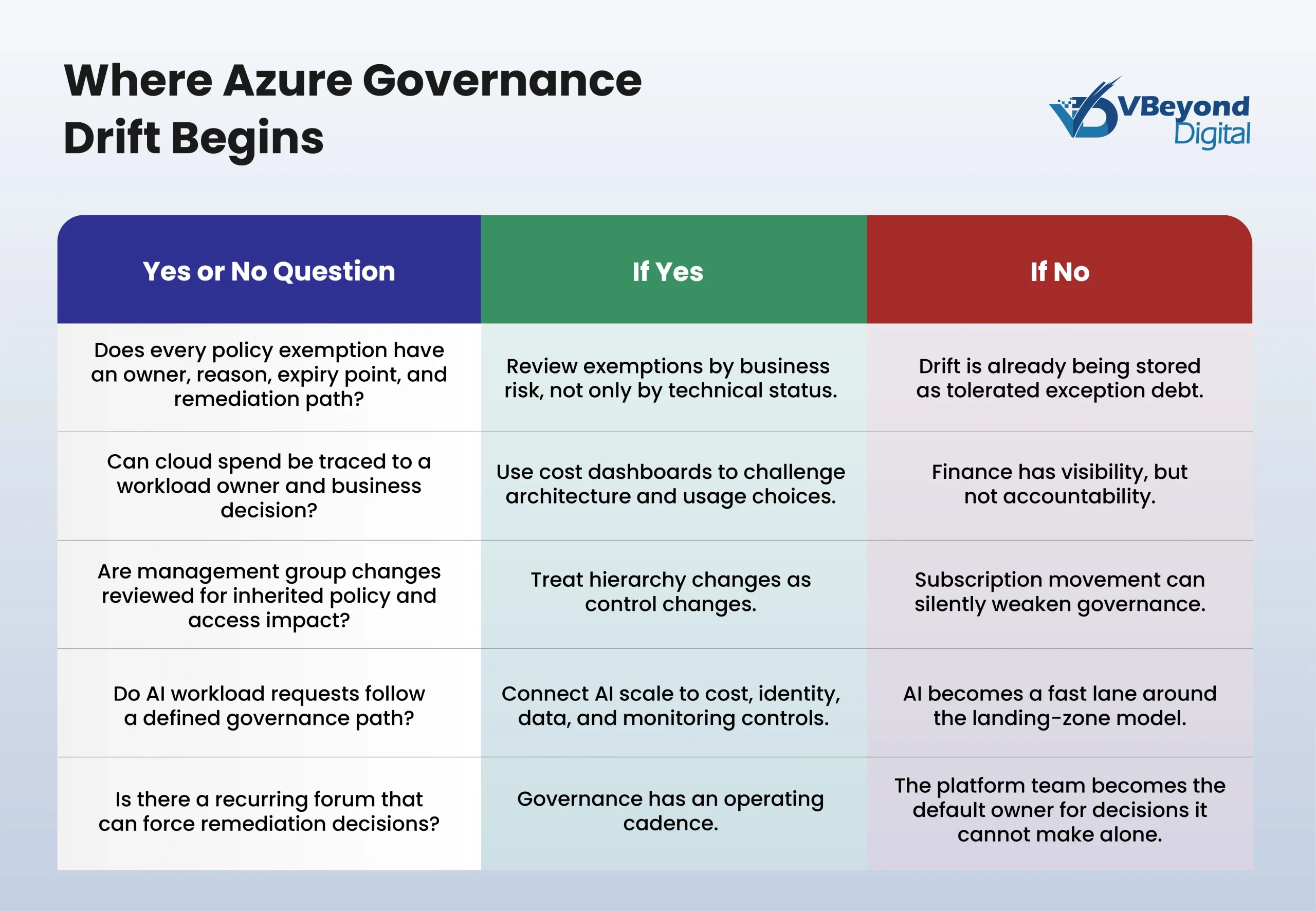
The review cadence should not become another reporting ritual. The test is whether the forum can force decisions. If exemptions remain open, someone must approve continued risk or fund remediation. If cost attribution fails, someone must correct ownership. If identity or network changes weaken the baseline, someone must decide whether the business case justifies the control change.
If The Landing Zone Is Drifting, Start With Ownership
Azure governance does not become stronger because the dashboard has more filters or the policy library has more assignments.
Those tools matter, but they only work when the enterprise names the people who can act on what the tools reveal. The platform owner cannot own every exception. Finance cannot correct architecture through reporting. Security cannot resolve workload timelines by flagging noncompliance. Application teams cannot govern shared services they do not fund or operate.
The implication for CIOs, cloud platform owners, enterprise architects, and finance leaders is direct. If landing-zone governance is drifting, the next question is not which Azure control is missing. It is which decision has no owner, which exception has no expiry, which cost has no accountable workload, and which governance forum lacks authority to force repair.
VBeyond Digital’s Azure governance drift assessment reviews landing-zone operating maturity across policy exemptions, management groups, tagging, cost attribution, identity, workload standards, dashboards, AI workload governance, and remediation cadence. If the landing zone is live but governance confidence is weakening, the work starts with the decisions the current model cannot assign.
FAQs (Frequently Asked Question)
Azure landing zones drift when the structure remains in place but the operating model behind it weakens. Policy exceptions, tagging rules, management group changes, cost ownership, identity reviews, and workload standards need recurring ownership. Without that cadence, the landing zone still exists, but governance becomes harder to prove.
Sometimes, but not usually. Azure provides strong tooling for policy, scope, management groups, compliance visibility, and cost management. Drift becomes an enterprise problem when no one owns exceptions, stale tags, workload deviations, shared-cost allocation, or remediation decisions after the initial implementation.
The platform team should administer the exemption process, but the business or workload owner should own the risk created by the exemption. Security, finance, and architecture teams may need review rights depending on the exemption type. The important point is that every exemption needs an owner, expiry point, and remediation path.
Finance leaders should ask whether spend can be traced to workloads, environments, shared services, product owners, and business outcomes. If the dashboard shows cost movement but cannot identify who can change the workload decision, cost governance is still weak.
An assessment should review landing-zone structure, policy assignments, exemptions, management group hierarchy, tagging quality, cost attribution, identity and network exceptions, AI workload governance, reporting reliability, and the cadence used to approve or remediate drift. The output should identify ownership gaps, not only technical findings.

