


Public vs Private Cloud in 2026: Making Workload Decisions Using Unit Economics
Section
Table of Contents
- Introduction: The decision is about unit cost and business outcomes
- The unit-economics model: How to calculate cost per unit for any workload
- Public cloud economics in 2026: Where unit cost rises and where it stays competitive
- Private cloud economics: Where it makes sense and what must be priced in
- Workload decision playbook: A scoring matrix plus 3 concrete use cases
- Conclusion: What to do next in the next 30 days
- FAQs (Frequently Asked Question)
Key Takeaways
- This blog defines FinOps Unit Economics and a cost-per-unit formula for cloud cost comparison across public vs private cloud and hybrid cloud costs.
- It shows where public cloud economics rise: steady workloads, heavy data movement, and reserved GPU pricing changes.
- This blog provides a workload placement strategy with a scoring matrix, plus 30-day steps to improve cloud cost optimization with shared visibility.
Introduction: The decision is about unit cost and business outcomes
For CIOs and product leaders, the public vs private cloud debate is not a philosophical one. It is a business decision about measurable outcomes: lower cost per transaction, predictable latency at peak, faster release cycles, and audit-ready controls without adding headcount.
In 2026, the only reliable way to compare options is FinOps Unit Economics, where you define a unit of business output and track cost per unit across environments. The FinOps Foundation describes unit economics with examples such as cost per click, cost per load, or cost per gigabyte stored, which maps well to a practical cloud cost comparison by workload.
Two market shifts make this approach more urgent. First, the EU Data Act explicitly targets cloud switching friction and states that switching charges, including data egress charges, will be removed from 12/01/2027, which changes how you model hybrid cloud costs and exit assumptions in Europe. Second, GPU capacity pricing is more variable for reserved blocks, so AI unit costs can move quarter to quarter.
Model unit costs, choose confidently
The unit-economics model: How to calculate cost per unit for any workload
A useful cloud cost comparison starts by making “public vs private cloud” measurable. FinOps Unit Economics defines a unit metric that ties technology spend to an output the business already tracks, such as cost per customer, cost per transaction, or cost per ride. The FinOps Framework also gives more technical examples such as cost per load for a microservice, cost per click, or cost per gigabyte of customer data stored.
Use this structure for cloud computing economics:
Cost per unit = (Infrastructure + Platform + Operations + Security and risk controls + Data movement) / Units delivered
Step 1: Choose the unit that matches a business outcome
- Customer-facing systems: Cost per order, cost per payment authorization, cost per session
- Internal platforms: Cost per build, cost per data pipeline run, cost per report generated
- AI services: Cost per inference request
The unit must be measurable from product analytics or service telemetry, not estimated.
Step 2: Map the unit to supporting services and cost pools
Microsoft’s FinOps guidance describes mapping each unit to the cloud services that support it, then splitting shared costs using utilization data. This is where integration complexity shows up. A single transaction may touch API gateways, application compute, a database, a cache, a message bus, observability tooling, and security controls.
Step 3: Build allocation rules that engineering and finance accept
The FinOps “Allocation” capability calls out account structures, tags, labels, and derived metadata as standard methods to apportion costs to the teams and products responsible. For shared platforms, define explicit rules, for example:
- Split Kubernetes control-plane and cluster tooling by namespace CPU and memory usage.
- Split shared data platforms by query time, bytes scanned, or job runtime.
- Allocate security tooling by protected asset count or log ingestion volume.
Step 4: Put “hidden” hybrid cloud costs in the numerator
If you do not price in data movement and risk controls, hybrid cloud costs look artificially low. Include inter-zone and inter-region traffic, cross-cloud transfer, DR environments, compliance logging retention, and on-call coverage. This makes workload placement decisions defensible when audit, latency, or resilience requirements change.
Public cloud economics in 2026: Where unit cost rises and where it stays competitive
For many enterprises, public vs private cloud decisions start with public cloud because it offers fast provisioning and broad managed services. The unit-economics question is narrower: when does public cloud economics lower your cost per unit, and when does it raise it?
Where public cloud often stays cost-competitive on a cost-per-unit basis
- Bursty or uncertain demand: If your traffic swings by hour, day, or season, autoscaling and serverless patterns can reduce idle capacity. That supports FinOps Unit Economics because the numerator tracks closer to actual units delivered.
- Teams that can convert managed services into fewer operational hours: Managed databases, queues, and observability services can reduce internal operating work, but only if you measure the labor and tooling you no longer need. Otherwise, the “managed premium” inflates your cloud cost comparison.
- Global workloads that need fast geographic expansion: When a product needs new regions quickly, the time-to-market value is real. This is part of cloud computing economics when the unit includes revenue impact or avoided delay, not just infrastructure spend.
Where public cloud unit cost often rises
- Always-on workloads with stable load: When compute runs 24 by 7 at high utilization, the unit cost can trend higher than a well-run private platform, especially if the architecture is over-provisioned for safety.
- Data movement-heavy architectures: Distributed microservices, cross-region replication, and multicloud pipelines increase transfer costs and complicate attribution. In 2026, switching and transfer rules are shifting in the EU. Google also introduced Data Transfer Essentials in the EU and UK with no-cost multicloud data transfer for certain scenarios, positioning it as support for these rules. This makes hybrid cloud costs more sensitive to geography and provider policy than many older models assume.
- Reserved GPU capacity for AI workloads: If you depend on reserved capacity blocks for training or large-scale inference, treat price changes as a model input. AWS states Capacity Block prices are updated regularly, with the next scheduled update noted for April 2026 on its pricing page.
Private cloud economics: Where it makes sense and what must be priced in
Private cloud can win in public vs private cloud decisions when the business outcome is predictable unit cost for steady demand, combined with tighter control over latency, data locality, and audit scope. The strongest candidates are workloads with high, stable utilization, predictable growth, and heavy internal traffic where network design is under your control. This is a practical workload placement strategy: place stable workloads where cloud computing economics produce the lowest cost per unit, then keep burst capacity in public cloud as part of a hybrid cloud strategy.
The mistake most teams make in a cloud cost comparison is treating private cloud as “just hardware.” A credible private-cloud numerator for FinOps Unit Economics includes:
- Facilities and energy: Facilities such as power, cooling, racks, and physical access controls. Uptime Institute reporting shows power costs and capacity expansion costs are major drivers of data center unit cost increases, and staffing costs are a recurring pressure point.
- Capacity lead time and growth risk: Private capacity is not instant. Uptime Institute has also noted that lead times for major facility components can reach or exceed 12 months, affecting expansion schedules.
- Platform engineering and reliability work: Kubernetes operations, patch cadence, observability, backup, and DR testing. In managed Kubernetes, those tasks are partly priced into control-plane fees. For reference, Google Kubernetes Engine lists a $0.10 per cluster-hour management fee, and Amazon EKS pricing includes $0.10 per hour per cluster during standard support for a Kubernetes version.
- Software and support: OS subscriptions, storage and data tooling licenses, security tooling, and vendor support contracts.
Workload decision playbook: A scoring matrix plus 3 concrete use cases
A repeatable workload placement strategy turns the public vs private cloud debate into a decision you can defend in a steering committee. The goal is cloud cost comparison at the workload level using FinOps Unit Economics, then selecting placement based on unit cost plus delivery risk. Unit economics can be defined as cost per load for a microservice, cost per click, or cost per gigabyte stored, which translates cleanly into enterprise units like cost per order or cost per claim processed.
Step 1: Build a scoring matrix that combines unit cost with engineering constraints
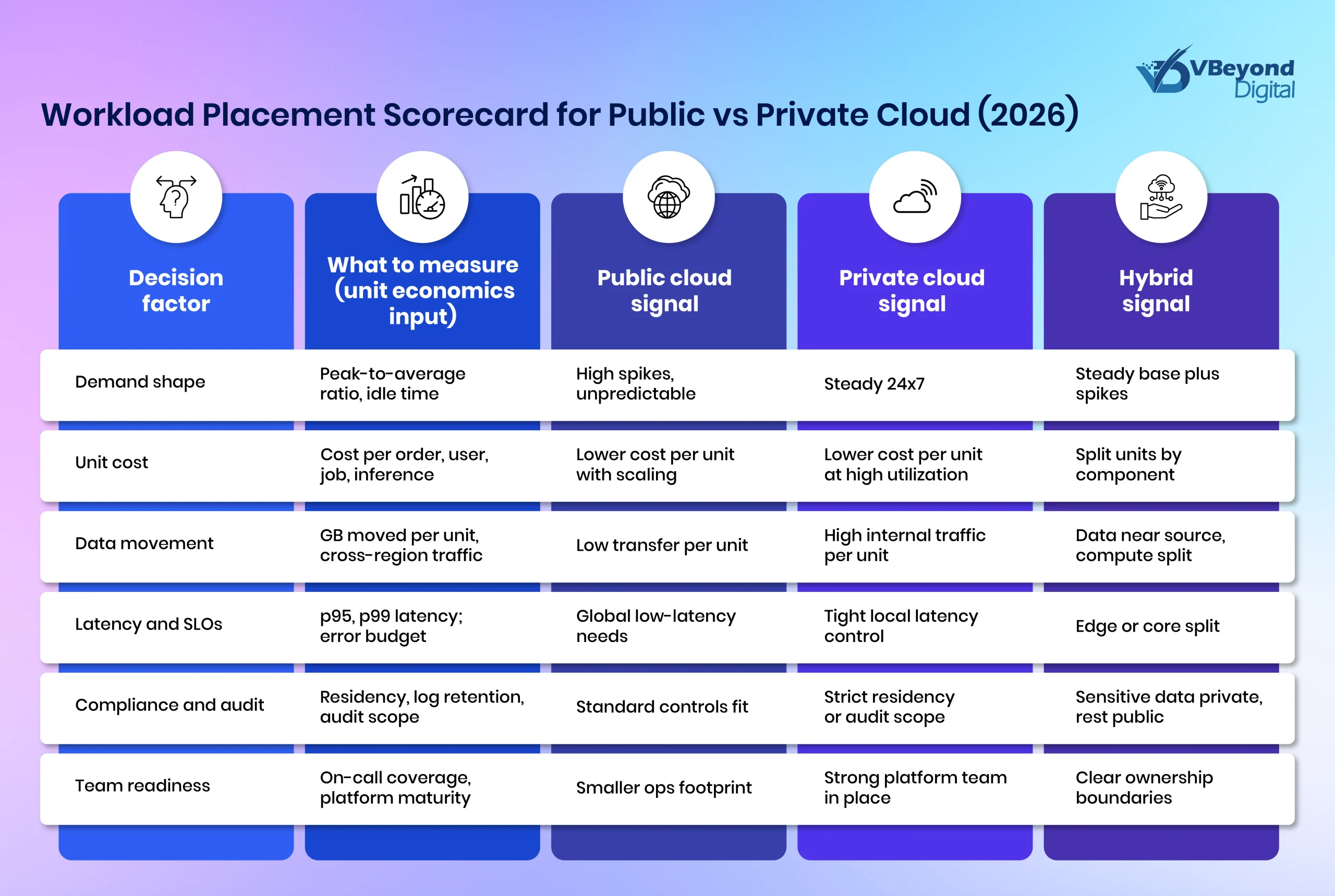
Score each workload across five dimensions, then select public, private, or hybrid:
- Demand shape: Bursty, cyclical, or steady 24 by 7
- SLO sensitivity: p95 and p99 latency targets, availability targets, recovery time and recovery point
- Data gravity and movement: Bytes moved per unit, cross-zone and cross-region traffic, cross-cloud transfer
- Compliance and exit requirements: Audit evidence, residency, portability artifacts, contract switching terms
- Org readiness: Platform maturity, on-call coverage, and tooling for cost allocation and observability
For data visibility, allocate costs using account structures, tags, labels, and derived metadata so product owners can see unit cost by workload and environment.
Step 2: Run three use cases through the matrix
Use case 1: Always-on transactional system
Unit: Initially, it is cost per order or cost per authorization. Validate steady utilization, database IOPS profile, and data movement per transaction. If the workload relies on multiple regions, include DR test cost and replication traffic in hybrid cloud costs.
Use case 2: Data platform and analytics
Unit: Initially, it is cost per pipeline run or cost per TB processed. Integration complexity matters here— identity, network segmentation, and observability toolchains can shift unit cost if they differ between public and private.
Use case 3: AI inference service
Unit: Initially, it is cost per inference request. The FinOps Foundation provides a simple formula: cost per inference equals total inference costs divided by the number of inference requests, with billing and platform logs as data sources.
Step 3: Convert scores into a placement decision and a hybrid plan
If the matrix points to a hybrid cloud strategy, define which component sits where, and make data movement explicit. In the EU, model switching and egress assumptions with the Data Act timeline, since switching charges including data egress are set to be removed from January 12, 2027.
Conclusion: What to do next in the next 30 days
A strong public vs private cloud decision is not about preference. It is about cloud computing economics tied to measurable outcomes. When you anchor workload placement on FinOps Unit Economics, you can show exactly why a workload belongs in public cloud, private cloud, or a hybrid cloud strategy. The result is practical cloud cost optimization: lower cost per unit without creating new delivery risk.
Here is a 30-day plan that CIOs and platform leaders can run without a multi-quarter program:
- Pick 3 to 5 workloads that matter to the business this quarter: Choose a customer-facing workload, a data workload, and an AI or batch workload if applicable. Define the unit for each, such as cost per order, cost per pipeline run, or cost per inference request. The FinOps Framework describes unit economics as linking costs to business units, which is the basis for a defendable cloud cost comparison.
- Instrument spend and usage so product owners can see unit cost: Fix tagging gaps and build allocation rules for shared services. Use billing exports plus telemetry to attribute compute, storage, platform tooling, and support costs to each workload. The FinOps “Allocation” capability details common allocation methods using tags and metadata.
- Model hybrid cloud costs with data movement and compliance as first-class inputs: If your architecture includes cross-region replication, cross-cloud analytics, or shared identity and security tooling, include those costs in the unit metric. If you operate in the EU, incorporate the Data Act switching timeline because switching charges, including data egress charges tied to switching, are set to be removed from January 12, 2027.
- Decide placement and write down the constraints: For each workload, document the result, the assumptions, the unit-cost calculation, the SLOs, and the operational model. This is where cloud repatriation trends become actionable: not “move back,” but “place each workload where unit cost and risk are acceptable.”
At VBeyond Digital, we bring clarity and velocity to your digital initiatives. From strategy to build, we help tech leaders turn transformation into measurable outcomes by producing a unit-economics model that finance trusts and engineering can run, then converting it into a workload placement strategy that reduces cost and delivery risk.
FAQs (Frequently Asked Question)
Public cloud cost is mainly usage-based OpEx, including compute, storage, managed-service fees, and network transfer. Private cloud cost includes hardware or leases, facilities and power, software support, and platform staff. Unit cost depends on utilization and data movement.
Start with FinOps Unit Economics: pick a unit (order, user, inference), measure cost per unit for each environment, and include ops, security, and data-transfer costs. Then score the workload by demand shape, latency SLOs, compliance, data gravity, and team capacity to decide placement.
In cloud computing, unit economics means measuring unit cost metrics and unit revenue metrics for cloud-based services, such as cost per load or cost per click, to link spend to outcomes.
Sometimes, but not always. Private cloud can be cheaper for steady workloads with high utilization and predictable growth, if platform and facilities costs are controlled. Public cloud can be cheaper for bursty demand or managed services. Many CIOs report moving selected workloads back while keeping others public.
FinOps helps by improving cost allocation, tagging, and reporting, then tracking cost per unit so teams can run an apples-to-apples cloud cost comparison. It also sets governance for budgets, commitments, and shared services, so workload placement decisions match business outcomes.
