


Loading...
Section
Table of Contents
Key Takeaways
- The blog explains why Oracle Fusion Post Go-Live Issues usually come from weak operating control after launch, not from cutover failure alone.
- It shows how Oracle Fusion reporting can drift when OTBI, BI Publisher, and BICC are used without ERP reporting standardization.
- It outlines why Oracle Fusion integration needs active monitoring, error handling, and message recovery as dependencies increase.
- It defines a control model built on governance, ownership, quarterly testing, and Power Platform environment strategy.
Introduction
Oracle Fusion does not fail after go-live. It degrades through reporting drift, integration instability, and weak control. Oracle states that implementation is only the first step in realizing business value from Oracle ERP Cloud and recommends structured post-go-live work such as a shared support model, a living instance management plan, and ongoing update testing.
Deloitte makes the same point more broadly: governance and controls matter during design, testing, and post–go-live, yet they are often treated as an afterthought.
That operating gap is where Oracle Fusion Post Go-Live Issues begin. After launch, teams add reports, interfaces, extracts, and local configuration changes to meet immediate business needs. Oracle requires customers to test their own configurations and transactions during the update cycle because Oracle cannot test customer-specific processes on their behalf.
In practice, Oracle Fusion reporting and integration drift without defined ownership, review, and change discipline. For CIOs, CTOs, and transformation leaders, the business goal is straightforward: keep the platform reliable, keep data visible, and keep growth from turning into avoidable risk. Degradation becomes visible when reports stop reconciling, integrations fail intermittently, and teams rely on manual adjustments. These are early signals of control failure, not isolated issues.
Why a successful go-live can still create rising business risk
Many leadership teams treat go-live as proof that the program is stable. Oracle’s own guidance says otherwise. Oracle states that implementation is only the first step in realizing value and recommends a shared support model, ongoing instance management, and customer-led testing during the quarterly update cycle.
Go-live validates deployment. It does not validate long-term control. That is why Oracle Fusion Post Go-Live Issues often appear after the launch window closes, not during it. In an ERP post implementation phase, the system starts carrying more users, more process exceptions, and more external data movement. At that point, the main question is no longer whether the cutover worked.
The question is whether the operating model can keep Oracle Fusion ERP stability intact as demand grows. This distinction also explains why many post-launch problems do not fit the usual idea of Oracle implementation failures. They are operating control failures that surface later.
The first pressure point is reporting.
Oracle documents OTBI as the layer for analyses and dashboards built from subject areas, while Oracle Analytics Publisher uses data models and layouts for formatted reports. Oracle also documents BICC as the bulk extraction path for loading Oracle data into external storage and downstream systems. Those are different reporting and extraction paths with different purposes. If a finance KPI is defined one way in OTBI, pulled another way through Analytics Publisher, and exported again through BICC, Oracle Fusion reporting can drift from a single source of truth.
This is where Oracle Fusion reporting issues begin to affect executive dashboards, reconciliations, and audit confidence. ERP reporting standardization is required after go-live to maintain a single source of truth.
The second pressure point is Oracle Fusion integration.
Oracle Integration exposes message counts for received, processed, successful, failed, and aborted transactions, and Oracle also provides specific recovery actions for failed instances. That operating model makes one fact clear: integrations need active monitoring and recovery discipline after production starts. If interfaces multiply without named ownership, dependency review, and failure handling, Oracle Fusion Post Go-Live Issues move from isolated incidents to business risk. The business outcome at stake is direct and measurable: reliable reporting, stable transaction flow, and lower support effort as the system grows.
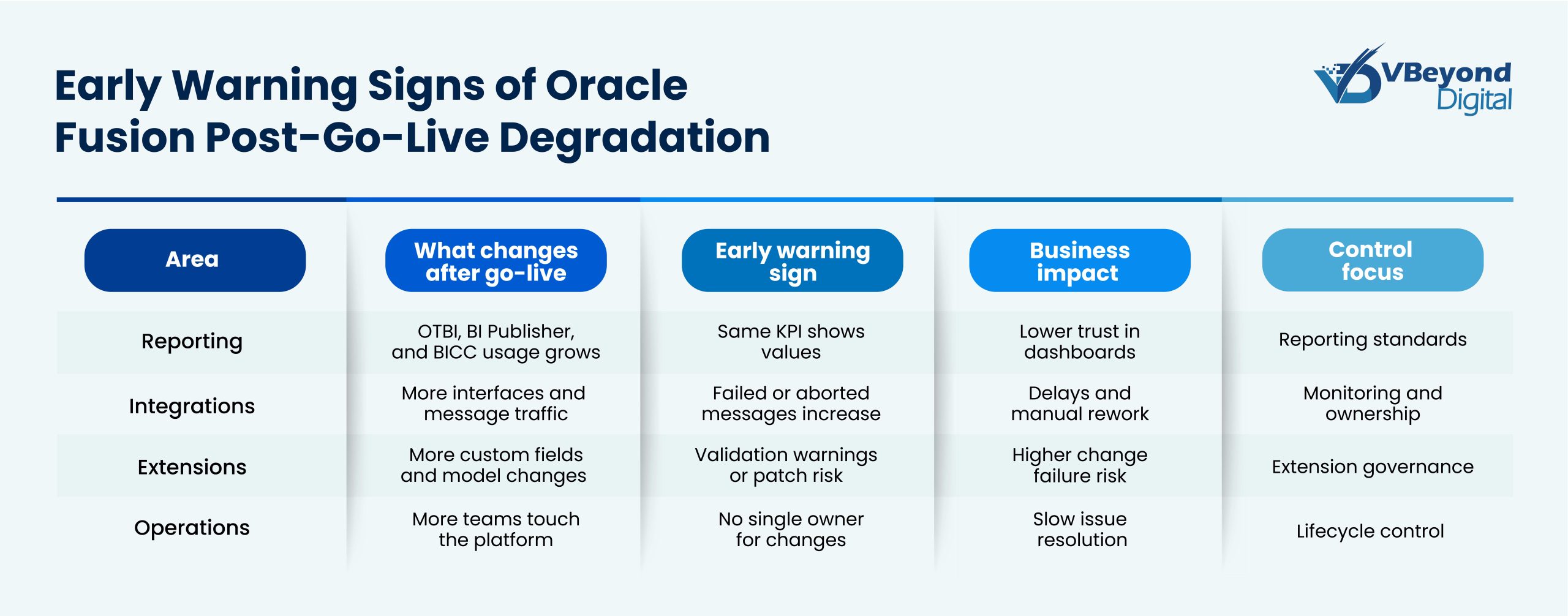
These signals appear before system failure. They indicate that control is weakening across reporting, integrations, and extensions.
Where degradation appears first: reporting, integrations, and extensions
The earliest Oracle Fusion Post Go-Live Issues usually appear in three places:
- Reporting outputs
- Integration operations
- Custom extension activity
These are the layers most likely to change after launch because business teams need new metrics, new data flows, and new workflow support as volume and process variation increase.
In Oracle Fusion reporting, drift starts when teams answer similar business questions through different tools. Oracle describes OTBI as an ad hoc reporting tool for analyses, dashboards, and infolets built on subject areas, while BI Publisher is built for highly formatted documents and report layouts, and BICC is intended for bulk export of Oracle Fusion Cloud data to downstream warehouses or third-party applications. Because these tools serve different purposes, Oracle Fusion reporting issues often begin when finance, operations, and data teams define the same KPI through separate paths without ERP reporting standardization. The result is not a technical outage. It is conflicting numbers across dashboards, extracts, and reconciliations.
In Oracle Fusion integration, degradation becomes visible through failed, aborted, or manually resubmitted messages. Oracle Integration’s monitoring pages track received, processed, successful, failed, and aborted messages, and Oracle’s error management guidance allows failed instances to be resubmitted and reviewed in detail through the activity stream and payload information. That makes integration reliability a measurable operating concern in ERP post implementation, not just a build concern during cutover.
In Oracle Fusion extensions, risk shows up when semantic customizations, added attributes, or local model changes accumulate without review. Oracle states that customizations are periodically evaluated for errors and warnings, and unresolved issues can create patching problems. If organizations also connect Oracle processes to low-code apps without a clear Power Platform environment strategy, Microsoft notes that environments, apps, and flows need governance, isolation, and lifecycle structure. Together, those conditions directly affect Oracle Fusion ERP stability.
Why control slips after go-live
The main cause of Oracle Fusion Post Go-Live Issues is usually not weak implementation quality. It is weak lifecycle control after production begins. Oracle’s post–go-live guidance calls for a shared support model across business users, SMEs, technical teams, and support functions. When these roles are not formally assigned, accountability becomes fragmented. Issues move across teams without resolution because no single owner is accountable.
Oracle is equally direct about operating discipline. It recommends a living instance management plan that tracks environment activities, quarterly testing events, PaaS environments, external integrations, reporting, ESS jobs, and extensions. Oracle also states that it cannot test customer-specific configurations and transactions, which means every customer must run functional testing during the update cycle using its own business processes. That is why many events described internally as Oracle implementation failures are actually ERP post implementation control gaps. Without that operating model, Oracle Fusion ERP stability weakens as report logic, interface dependencies, and custom objects grow.
This problem gets larger when Oracle is part of a wider Microsoft stack. Microsoft states that a Power Platform environment strategy should define how environments, security boundaries, and governance controls are organized, and its governance guidance recommends a dedicated admin role plus management practices that support scale and consistency. If low-code apps and flows are connected to Oracle data without that structure, ERP reporting standardization becomes harder and Oracle Fusion Post Go-Live Issues spread beyond the ERP boundary into adjacent apps and automations. Deloitte’s ERP controls research supports the same conclusion: governance and controls often become an afterthought even though they matter before and after go-live.
Bring Post–Go-Live Risk Under Control
The control model that restores reliability, visibility, and accountability
The most effective response to Oracle Fusion Post Go-Live Issues is a control model that ties architecture decisions to measurable operating results. Oracle’s post-go-live guidance calls for a shared support model, a living instance management plan, and customer-owned testing during quarterly updates.
For enterprise leaders, that translates into three priorities: one ownership model for change approval, one reporting architecture for metric consistency, and one operating process for integration monitoring and recovery. These controls reduce reconciliation effort, shorten incident response time, and protect Oracle Fusion ERP stability as the environment grows. When reports fail to reconcile, integrations fail repeatedly, or extensions introduce instability, teams must initiate root-cause analysis and corrective action immediately.
First, set formal governance for Oracle Fusion integration and Oracle Fusion extensions. Oracle Integration provides monitoring for received, processed, successful, failed, and aborted messages, and Oracle’s error management pages support resubmission, recovery tracking, and payload review.
Each interface requires a named owner, defined failure handling, and a review path for new dependencies. Oracle also documents structured extension methods for semantic customizations and warns that unresolved issues can create patching problems. This is the practical control point for reducing post-launch risk.
Second, standardize Oracle Fusion reporting. Oracle distinguishes OTBI for transactional analysis, Analytics Publisher for formatted reporting, and BICC for bulk export to downstream warehouses and third-party applications. Without ERP reporting standardization across those paths, Oracle Fusion reporting issues become a recurring business problem rather than a reporting-team problem. A governed model should define where each report type belongs, how KPIs are reconciled, and which data path is approved for executive reporting.
Third, connect Oracle controls with a Power Platform environment strategy when Oracle data feeds Microsoft apps or automations. Microsoft says environments act as containers for business data, apps, and flows, and recommends dedicated administration and governance practices that support management at scale.
For VBeyond Digital, this is where its fit is most direct: Oracle plus Azure integration architecture, Oracle Fusion reporting standardization, and post-go-live governance models that keep change visible and accountable across ERP post implementation work. Oracle also provides Azure Service Bus, Azure Event Grid, and Azure Storage adapters in Oracle Integration, which supports cross-platform operating models.
Conclusion
Oracle Fusion Post Go-Live Issues rarely begin as a single system failure. They build through unmanaged change in Oracle Fusion reporting, Oracle Fusion integration, and Oracle Fusion extensions after launch. Oracle’s own post-go-live guidance calls for a shared support model, a living instance management plan, documented control over reporting, interfaces, and extensions, plus customer-led testing during update cycles. That is the clearest signal that long-term Oracle Fusion ERP stability depends on disciplined ownership after go-live, not only on a successful implementation event.
For CIOs, CTOs, and transformation leaders, the practical response is clear: set ownership for every integration and reporting path, adopt ERP reporting standardization, and align Oracle controls with a Power Platform environment strategy where Microsoft apps and flows are part of the operating model. This is where VBeyond Digital fits: bringing structure to ERP post implementation work so reporting stays reliable, integrations stay visible, and growth remains controlled instead of creating hidden risk
FAQs (Frequently Asked Question)
Because Oracle Fusion keeps changing after launch through updates, reports, integrations, extracts, and extensions. Oracle says customers need shared support, living instance management, and their own update-cycle testing to keep control.
The most common issues are Oracle Fusion reporting mismatches, unstable Oracle Fusion integration flows, weak ownership across teams, uncontrolled Oracle Fusion extensions, and slow recovery from failed messages or local changes.
Oracle Fusion reporting issues occur when teams pull similar metrics through OTBI, BI Publisher, and BICC without common definitions, refresh rules, or approved reporting paths. Each tool serves a different purpose, so outputs can diverge.
As interfaces grow, message failures, aborted transactions, retry limits, and manual resubmissions increase. Oracle Integration treats monitoring and recovery as ongoing operating work, which means reliability depends on ownership and error handling discipline.
Set one ownership model for reports, integrations, and extensions; keep a living instance plan; test quarterly updates; standardize reporting paths; and apply a Power Platform environment strategy where Microsoft apps and flows connect to Oracle data.

